
Introduction: The Silent Power on Every Wall
Walk into almost any school hallway, hospital waiting room, or employee break room today, and there is a good chance you will find at least one mental health poster watching over the space. These colorful, carefully worded visuals are far more than simple decorations. They represent a deliberate, research-backed strategy for improving emotional wellbeing across communities.
In an era when anxiety, depression, and burnout are discussed more openly than ever before, mental health awareness posters have become a front-line tool for organizations that genuinely care about the people inside their walls. A single well-placed poster can remind a struggling teenager that it is okay to ask for help, reassure a burnt-out employee that their feelings are valid, or point a patient in crisis toward the resources they need.
Yet despite their widespread use, many institutions still treat mental health posters as an afterthought — ordering a generic pack online, taping them near restrooms, and moving on. That approach misses enormous potential. When mental health posters are selected thoughtfully, positioned strategically, and refreshed regularly, they become a genuinely powerful part of any wellness program.
This guide covers everything you need to know: why these posters matter, what types work best in different environments, how to design or choose them effectively, and how to measure whether they are having a real impact on your community’s wellbeing.
Quick Fact: According to the World Health Organization, mental health conditions affect approximately 1 in 8 people worldwide. Visual communication tools like mental health posters play a meaningful role in normalizing conversations about emotional wellness and directing people toward professional support.
Why Mental Health Posters Matter
The human brain is a visual processor. Studies in cognitive psychology consistently show that we absorb and retain visual information far more efficiently than text alone. This is precisely why mental health awareness posters can reach people that a brochure, email newsletter, or lunch-and-learn event might miss entirely.
Someone who would never attend a workshop on stress management might pause for 15 seconds in front of a poster listing five simple coping strategies — and that pause could be transformative. Visual cues embedded in everyday environments create what psychologists call “passive learning”: the knowledge enters without demand, pressure, or stigma.
70%
of employees say they would feel more comfortable discussing mental health at work if their employer actively promoted mental wellness resources — including through visible signage and mental health posters in shared spaces.
Mental health posters serve several overlapping functions simultaneously. They normalize the conversation around emotional health, which is especially important in environments where vulnerability is historically discouraged — such as corporate offices, military institutions, or high-performance academic settings. They provide immediate access to coping tools, helpline numbers, and peer support contacts. They signal organizational values, showing employees, students, or patients that leadership takes wellbeing seriously. And they break silence. Often, seeing words like “anxiety,” “depression,” or “burnout” displayed openly in a public space gives individuals permission to use those words themselves.
The Stigma Reduction Effect
One of the most documented benefits of mental health awareness posters is their role in reducing the stigma that still surrounds mental illness. Stigma thrives in silence and ignorance. When a poster in a university library normalizes therapy-seeking behavior, or a workplace wellness poster states plainly that “mental health is health,” it chips away at shame. Research on anti-stigma campaigns consistently identifies environmental messaging — which includes posters — as a cost-effective, scalable method of shifting attitudes over time.
This is not a trivial function. Stigma remains one of the single largest barriers preventing people from accessing mental health care. By making mental health visible, normal, and discussable, mental health posters are doing genuinely important public health work.
Types of Mental Health Posters
Not all mental health posters are created equal. The most effective programs use a variety of poster types, each serving a different communication purpose. Understanding these categories helps organizations build a more balanced and impactful visual environment.
1. Awareness and Education Posters
These posters define mental health conditions, bust common myths, and share statistics that contextualize the scale of mental health challenges. A poster that explains the symptoms of anxiety disorder, for example, can help someone recognize their own experience — perhaps for the first time — and prompt them to seek support.
2. Coping Strategy Posters
Coping strategy posters are among the most immediately practical type. They might list breathing exercises, grounding techniques, mindfulness prompts, or the “5-4-3-2-1” sensory method for managing acute anxiety. These posters give people tools they can use right now, in the moment they are standing in front of the poster.
3. Resource and Helpline Posters
These are critical in high-risk environments. A mental health crisis poster displaying a crisis helpline number, a text line, or an on-site counseling service could be life-saving. They should be prominently displayed in bathrooms, break rooms, and any private or semi-private space where someone in distress might find themselves alone.
4. Motivational and Affirmation Posters
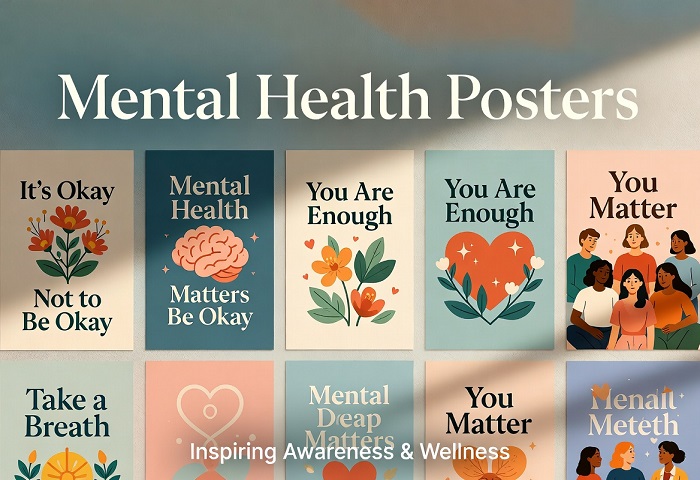
Positive psychology research supports the value of brief affirmations in building emotional resilience. Mental health motivational posters — displaying messages like “You are enough,” “Progress, not perfection,” or “It is okay to not be okay” — contribute to a supportive emotional environment. These work especially well in school corridors, gym changing rooms, and staff break areas.
5. Campaign and Awareness Month Posters
Mental Health Awareness Month (May in the US, October globally for World Mental Health Day) creates a natural opportunity to display campaign-specific mental health posters. These reinforce a sense of community and shared purpose, and they are excellent conversation starters for broader wellness initiatives.
Education Posters
Explain conditions, reduce myths, build understanding about emotional health.
Coping Strategy Posters
Provide immediate, actionable tools for managing stress and anxiety.
Resource Posters
Display helplines, counseling services, and crisis support contacts.
Motivational Posters
Build resilience through affirming, normalizing messages and quotes.
Mental Health Posters in the Workplace
Workplace mental health has moved from being a fringe HR concern to a central business priority. Organizations now understand that employee wellbeing is directly linked to productivity, retention, and organizational culture. Mental health posters for the workplace are a visible, low-cost signal of this commitment.
In the workplace context, mental health posters should be carefully calibrated. They need to feel professional without being clinical, warm without being patronizing, and informative without being overwhelming. The language should align with company culture — what resonates in a creative agency may fall flat in a law firm.
Best Placement Strategies at Work
Effective placement of mental health awareness posters in workplaces follows a few key principles. High-traffic but low-pressure areas work best: break rooms, kitchen areas, near coffee machines, and elevator lobbies are ideal because people naturally dwell there without the distraction of active work tasks. Bathrooms are another important placement, since they offer a moment of genuine privacy. Avoid placing mental health posters directly at workstations, where they can feel intrusive or create performance anxiety.
Workplace Tip: Rotate mental health posters every four to six weeks. Research on environmental familiarity shows that people stop “seeing” static elements in their environment after repeated exposure — a phenomenon called habituation. Fresh posters maintain salience and impact.
Aligning Posters with Employee Assistance Programs (EAPs)
One of the most effective strategies is integrating mental health poster content directly with your organization’s Employee Assistance Program. If your EAP provides free counseling sessions, a poster that specifically names that benefit — rather than a generic hotline — carries far more credibility and generates measurably more uptake. Specificity converts.
Mental Health Posters in Schools and Universities
Schools are arguably the most important environment for mental health awareness posters. Young people are navigating some of the most emotionally turbulent years of their lives during a period when they are least equipped to recognize and articulate their own mental states. Mental health posters for schools create what researchers call a “therapeutic environment” — a physical space that communicates safety, understanding, and support.
Childhood and adolescence are the periods when most mental health conditions first emerge. Early identification and intervention dramatically improve long-term outcomes. Mental health posters that normalize help-seeking behavior, name common experiences like exam stress and social anxiety, and provide clear pathways to school counselors serve as accessible, stigma-free first steps in that journey.
Age-Appropriate Messaging
Content must be carefully matched to developmental stage. Mental health posters for primary school children should use simple language, bright imagery, and concrete emotional vocabulary — feelings faces charts and simple breathing exercise visuals work well. For secondary schools and universities, the messaging can be more nuanced, addressing specific experiences like social media pressure, academic performance anxiety, relationship challenges, and identity-related stress.
“A single mental health poster seen every day can plant a seed of self-awareness in a young person who might not yet have the language for what they are feeling.”
Staff Wellbeing Matters Too
Schools should not neglect their own staff when it comes to mental health awareness posters. Teacher burnout is a global crisis. Dedicated staff room posters addressing workplace stress, compassion fatigue, and available support resources are an important part of a whole-school approach to wellbeing.
Mental Health Posters in Clinics and Healthcare Settings
In clinical and healthcare environments, mental health awareness posters serve a particularly high-stakes function. Patients in waiting rooms may be at their most vulnerable — anxious, unwell, isolated. A well-chosen mental health poster can provide genuine reassurance, connect someone with a resource they did not know existed, or simply remind them that what they are experiencing is real, recognized, and treatable.
Clinical mental health posters should prioritize clarity above all else. Typography must be highly legible, color contrast must be strong, and any helpline or service information must be prominently displayed. In healthcare settings, there is no room for ambiguity — if a poster is trying to communicate “call this number,” that instruction must be unmistakable.
Trauma-Informed Design
Clinics serving populations that have experienced trauma — including addiction clinics, domestic violence support centers, refugee services, and veteran healthcare facilities — should apply trauma-informed principles to their mental health poster selections. This means avoiding imagery of distress, restraint, or isolation; preferring calm, natural imagery; and centering language around agency, strength, and recovery rather than risk or deficiency.
Design Principles That Make Mental Health Posters Effective
The difference between a mental health poster that people genuinely engage with and one that fades into the background comes down to design quality. Poor design undermines even the most important message. Here are the core principles that define effective mental health poster design.
Color Psychology
Color is one of the most powerful tools in a designer’s toolkit. For mental health awareness posters, calming palettes — soft blues, greens, and muted warm tones — are generally more effective than high-contrast, high-energy combinations. That said, the choice should match the message. A coping strategy poster might benefit from a serene blue-green palette, while a “You Are Not Alone” motivational poster might use warm amber or soft gold to convey connection and warmth.
Typography and Readability
Mental health posters must be legible at a distance, during a brief glance, and for people who may be experiencing visual stress. This means using clean, generous typefaces with strong contrast against the background. Avoid decorative scripts for key information. The headline should be readable within two seconds — that is roughly the window of attention a passing glance affords.
Imagery and Representation
The people depicted in mental health posters matter enormously. Diverse, authentic imagery that reflects the actual population of the space builds trust and relatability. Stock photography of generic smiling faces tends to feel inauthentic and can actually undermine the credibility of the message. Where possible, use illustration styles or photography that feels specific rather than universal.
| Design Element | What Works | What to Avoid |
|---|---|---|
| Color Palette | Muted blues, greens, warm neutrals | Harsh reds, neon tones, high-contrast warning colors |
| Typography | Clean sans-serif, high contrast, 24px+ headline | Decorative scripts, low contrast, crowded text |
| Imagery | Diverse, authentic, illustrated | Generic stock photos, monocultural, posed smiles |
| Message Length | One core idea, 10–20 words headline | Multiple competing messages, dense paragraphs |
| Call to Action | Specific, single, easy (e.g., “Text HOME to 741741”) | Vague, multiple CTAs, buried in fine print |
Key Messages to Include in Mental Health Posters
The verbal content of mental health awareness posters is just as important as its visual presentation. Certain messages have been tested and validated by behavioral health researchers as being especially effective at reducing stigma, increasing help-seeking behavior, and building resilience.
- It is okay to not be okay — normalize emotional struggle without minimizing it.
- Mental health is health — challenge the false mind-body separation.
- You are not alone — combat isolation, the most dangerous companion to mental illness.
- Help is available and nearby — always include a specific, accessible resource.
- Reaching out is a sign of strength, not weakness — reframe vulnerability as courage.
- Recovery is possible — provide hope, which is a clinical predictor of better outcomes.
- One step at a time — honor the reality that healing is not linear or immediate.
- Your feelings are valid — affirm emotional experience without judgment.
The most effective mental health posters do not try to do everything at once. They choose one message and communicate it with clarity, warmth, and conviction. A poster that tries to educate, inspire, provide coping tools, and list resources simultaneously will do none of those things effectively. Focus is a virtue in this medium.
Digital vs. Print Mental Health Posters: Choosing the Right Format
The rise of digital signage and remote work has expanded the canvas available for mental health awareness posters significantly. Organizations no longer have to choose between reaching employees in-office and those working from home — they can do both, with appropriately formatted content.
The Case for Print
Physical mental health posters have a presence that screens cannot replicate. A large-format poster in a break room creates a shared community experience — colleagues notice it, comment on it, and by seeing it together, implicitly acknowledge that mental health is a topic their organization takes seriously. Print is also passive; it asks nothing of the viewer beyond a moment of attention, which makes it ideal for people who would never voluntarily click on a mental health resource email.
The Case for Digital
Digital mental health posters — whether displayed on office screens, shared in Slack channels, sent as email banners, or posted on internal intranets — offer unmatched flexibility. They can be updated instantly to reflect seasonal mental health campaigns, current events, or real-time resources. For organizations with distributed or remote workforces, digital is the only option for environmental wellbeing messaging. Digital formats also allow interactive elements, like QR codes linking directly to booking an appointment with a counselor.
Best Practice: Use print and digital mental health posters together. Print anchors the message in physical space and shared experience. Digital extends reach, enables updates, and connects remote or hybrid teams to the same wellness culture. QR codes on physical posters elegantly bridge both worlds.
Reducing Mental Health Stigma Through Visual Communication
Stigma around mental health is a systemic problem sustained by silence, misinformation, and cultural narratives that frame emotional distress as weakness, failure, or moral deficit. Visual communication — including mental health awareness posters — is one of the most scalable tools we have for dismantling these narratives at the community level.
The “contact hypothesis” in social psychology suggests that exposure to counter-stigma messages — even indirect exposure, such as reading a poster — can gradually shift underlying attitudes. When mental health is normalized in the visual landscape of a school, office, or hospital, it becomes harder for the stigmatizing narrative to hold. The environment itself pushes back against shame.
Language That Heals Versus Language That Harms
The language used on mental health posters matters with extraordinary precision. Person-first language — “a person experiencing depression” rather than “a depressed person” — preserves dignity and challenges the idea that mental illness defines identity. Avoiding casual terms like “crazy,” “lunatic,” or “mental” used as pejoratives is equally important. Posters that use respectful, clinical-adjacent but warm language model the kind of conversation we want people to have with themselves and others.
Similarly, imagery choices carry profound implications. Showing a person seeking help as capable, dignified, and resourceful — rather than helpless or in acute distress — reinforces positive associations with help-seeking behavior. These are small choices with outsized cultural consequences.
Free Resources and Templates for Mental Health Posters
One of the most common barriers organizations face when building a mental health poster program is cost — particularly for smaller schools, non-profit organizations, or underfunded community health centers. Fortunately, a rich ecosystem of free, high-quality mental health poster resources has developed over the past decade.
Government and Public Health Organizations
The National Institute of Mental Health (NIMH), the Substance Abuse and Mental Health Services Administration (SAMHSA), and the Centers for Disease Control and Prevention (CDC) all provide free, downloadable mental health awareness materials. The UK’s National Health Service (NHS), along with mental health charities like Mind and Time to Change, offer comprehensive free poster packs optimized for different settings.
Design Platforms
Platforms like Canva, Adobe Express, and Piktochart offer mental health poster templates that can be customized with your organization’s branding, specific resources, and local helpline numbers. These tools make professional-quality design accessible to organizations without a dedicated design team. Many templates are specifically designed around mental health awareness month themes and can be quickly adapted for print or digital use.
Mental Health Charities and Advocacy Groups
Organizations like NAMI (National Alliance on Mental Illness), the Mental Health Foundation, and Heads Together regularly release campaign-specific mental health awareness poster packs that are free to download and use for non-commercial purposes. These materials benefit from professional design input and are grounded in the latest public health communication research.
NIMH & SAMHSA
Free US government mental health awareness poster downloads for all settings.
Canva Templates
Customizable mental health poster templates — free tier available.
NAMI Resources
Campaign-ready mental health awareness materials from leading advocacy body.
WHO Materials
Multilingual global mental health poster packs from the World Health Organization.
Frequently Asked Questions
What should a mental health poster include?
An effective mental health poster should include one clear, focused message, supportive and inclusive imagery, easy-to-read typography, and a specific call to action — ideally a helpline number, QR code, or local counseling resource. Keep the design uncluttered and the tone warm, non-judgmental, and empowering.
Where is the best place to put mental health awareness posters?
The best locations are high-traffic, low-pressure areas where people naturally pause: break rooms, hallways, bathrooms, near coffee stations, waiting rooms, and elevators. Avoid placing them directly at workstations or in spaces where they could feel intrusive. Private spaces like restrooms are especially valuable for crisis resource posters.
How often should mental health posters be changed?
Mental health posters should be rotated every four to six weeks to prevent habituation — the brain’s tendency to stop noticing static elements in a familiar environment. Tie rotations to mental health awareness events, seasons, or organizational wellbeing calendar moments to keep content relevant and timely.
Are mental health posters effective at reducing stigma?
Yes, research consistently supports the effectiveness of environmental mental health messaging in reducing stigma over time. While a single poster is unlikely to change deeply held beliefs, sustained exposure to normalizing messages in everyday spaces gradually shifts cultural attitudes and increases willingness to seek and discuss mental health support.
Can I make my own mental health poster?
Absolutely. Free tools like Canva and Adobe Express offer professional templates that can be customized for any environment. When creating your own mental health poster, prioritize clear messaging, inclusive imagery, and specific local resources. Have the content reviewed by a qualified mental health professional before displaying it widely.
What colors are best for mental health posters?
Muted blues, greens, and warm neutral tones tend to perform best because they are associated with calm, safety, and trust. Avoid high-energy reds and neons, which can increase arousal and anxiety. Green specifically has strong associations with mental health awareness globally, making it a particularly well-recognized choice.
Conclusion: Every Wall Is an Opportunity
Mental health posters are one of the most accessible, affordable, and underestimated tools available to anyone committed to building a mentally healthier community. Whether you are a school counselor refreshing a hallway display, an HR manager designing a workplace wellness campaign, a clinic administrator updating a waiting room, or a parent hanging something on a bedroom wall — the choices you make about mental health awareness posters carry real weight.
They normalize the conversation. They reduce shame. They connect people to resources they might never have found otherwise. They signal that the space they are in is one where their emotional life matters.
The science is clear: environments shape behavior, and behavior shapes wellbeing. By being intentional about the mental health messages that live on the walls around us, we take a small but meaningful step toward a world where asking for help is as natural as washing your hands — and just as universally supported.
Start with one wall. Choose one message. Make it visible. That is how mental health poster programs change cultures — one thoughtful choice at a time.