
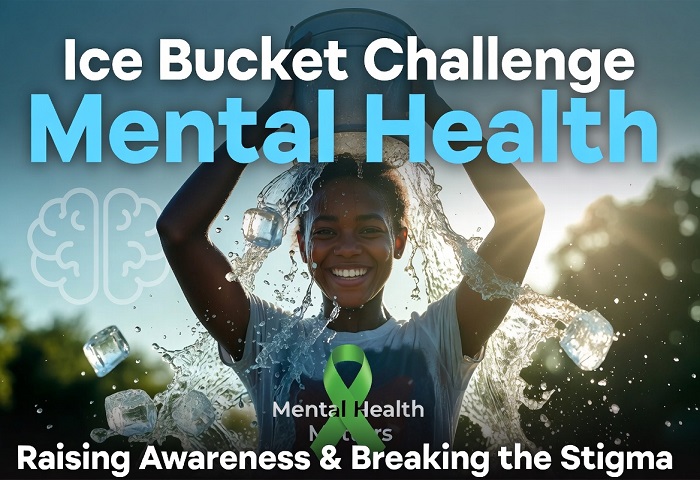
Introduction: When a Cold Bucket of Water Became a Symbol of Hope
In the summer of 2014, a simple act — dumping a bucket of ice water over your head and posting the video online — became one of the most powerful fundraising phenomena the digital age had ever seen. The original Ice Bucket Challenge raised over $115 million in six weeks for ALS research, demonstrated that social media could mobilise millions for a cause, and gave the world a template for viral advocacy it has never forgotten.
More than a decade later, that template is back — and this time, it is being used for something equally urgent. The ice bucket challenge mental health revival of 2025 has electrified campuses, social media feeds, and newsrooms across the United States, raising over $420,000 for Active Minds, the largest nonprofit in the country dedicated to transforming mental health norms among young people. What began as a small student initiative at the University of South Carolina has grown into a national conversation about depression, anxiety, suicide prevention, and the desperate need for young people to feel safe talking about how they truly feel.
This article tells the complete story of the ice bucket challenge mental health movement — from its origins and the brave student behind it, to the fundraising results, the controversies it sparked, the critical role of organisations like Active Minds, and what it all means for the broader fight to reduce mental health stigma in America. If you have seen the videos flooding your social media feed and want to understand what is really at stake, this is the guide you need.
The Original Ice Bucket Challenge: A Template for Viral Advocacy
Before exploring what the ice bucket challenge mental health revival means, it is worth understanding what made the original 2014 campaign so extraordinarily effective — because the lessons from that summer directly explain why students in 2025 chose to revive it.
The Ice Bucket Challenge was co-founded by Pat Quinn and Pete Frates, both of whom were living with amyotrophic lateral sclerosis (ALS) — a devastating progressive neurodegenerative disease that affects nerve cells in the brain and spinal cord, leading to the gradual loss of muscle control. At the time, ALS was severely neglected by research funding and largely invisible to the general public. Most people had never heard of it. Most would never encounter it unless someone they loved was diagnosed.
The challenge was elegantly simple: film yourself having a bucket of ice water poured over your head, post the video publicly, and nominate others to do the same. Those who declined the physical challenge were encouraged to donate $100 to the ALS Association instead. The nomination structure created an organic chain reaction — each participant pulled in multiple new participants, creating exponential growth that no advertising budget could have purchased.
In six weeks during the summer of 2014, the challenge raised $115 million for the ALS Association — 35 times more than the organisation had collected in the same period the previous year. Celebrities, politicians, athletes, and ordinary people from every walk of life participated. It funded genuinely transformative ALS research, including the discovery of the NEK1 gene variant as a contributor to ALS pathology — a breakthrough directly attributed to Ice Bucket Challenge funding.
The psychological mechanics that made it work were clear: a simple, shareable, slightly uncomfortable physical act; the social pressure of public nomination; visible participation by celebrities and high-profile figures; and a clearly defined charitable recipient. When students at the University of South Carolina sat down in 2025 to design their campaign, they studied that blueprint carefully — and reproduced it almost exactly.
Ice Bucket Challenge Mental Health: How the 2025 Revival Began
The story of the 2025 ice bucket challenge mental health campaign begins with grief. Wade Jefferson, a junior at the University of South Carolina, lost two of his close friends to suicide. Confronting that loss, he asked himself what he could do to ensure that others in similar pain would feel less alone — and more willing to reach out for help. His answer was to found the Mental Illness Needs Discussion (MIND) club at USC.
The MIND club was built around a simple but radical premise: mental health conversations should be as normal, as comfortable, and as socially acceptable as conversations about physical health. For the club’s inaugural fundraising campaign, Jefferson and his fellow students chose to revive the ice bucket challenge mental health format, launching the #SpeakYourMIND Challenge on Instagram on March 31, 2025. The chosen charitable beneficiary was Active Minds — the Washington, D.C.-based nonprofit widely regarded as the most effective organisation in the United States working to mobilise youth and transform mental health norms.
The format mirrored the original with one critical addition: participants were encouraged not just to pour water over their heads and nominate others, but to say something meaningful about mental health — to share a message, a personal reflection, or a statement of solidarity with those who were struggling. This additional element gave the ice bucket challenge mental health campaign an emotional depth that went beyond spectacle. It turned a physical stunt into a genuine act of advocacy.
Jefferson set an initial fundraising goal of $500, expecting the campaign to stay within the USC campus community. What happened next shocked him. Within days, the challenge had spread across social media with hundreds of thousands of views. Celebrities joined the movement: former NFL quarterback Peyton Manning, Today show host Jenna Bush Hager, TikTok creator Zach King, actor Scarlett Johansson, and many others poured buckets of ice water over their heads and tagged their millions of followers to do the same. USC’s head football coach Shane Beamer participated. The ice bucket challenge mental health campaign had gone viral.
The Numbers: What the 2025 Ice Bucket Challenge Mental Health Campaign Achieved
The fundraising impact of the 2025 ice bucket challenge mental health movement exceeded nearly every expectation. By April 22, 2025, the campaign had raised nearly $247,000 — approaching Active Minds’ stated goal of $250,000. That figure continued to climb rapidly. By the time major media coverage consolidated, the total had surpassed $322,000. Final reports from Active Minds confirmed that the ice bucket challenge mental health drive raised over $420,000 for youth mental health resources.
The website of Active Minds experienced a 922% increase in traffic following the launch of the campaign — a staggering figure that reflects not just the reach of the challenge but the depth of public interest in mental health resources among young people. More than 2,300 individual donations were made in the campaign’s early days alone, with that number growing significantly as the movement expanded beyond its USC origins to campuses and communities across the country.
To provide context for these numbers: Active Minds uses its resources to fund peer mental health advocacy programmes at universities, schools, and community organisations across the United States. The funds raised by this campaign translate directly into trained student advocates, educational resources, and support structures for young people navigating anxiety, depression, and suicidal ideation.
Beyond the dollar figures, the cultural impact of the revival was significant. The coverage in National Geographic, NBC News, Fast Company, Axios, the Philadelphia Voice, and dozens of other outlets placed mental health — and particularly youth mental health — at the centre of a national conversation during spring 2025. Former U.S. Surgeon General Vivek Murthy had already declared the youth mental health crisis a top public health priority in America. The ice bucket challenge mental health movement arrived precisely when that conversation most needed a spark.
Why Mental Health Needs a Campaign Like This
The statistics surrounding youth mental health in America make the urgent need for campaigns like this viral revival both clear and undeniable.
According to a 2024 U.S. News survey, approximately 70% of college students have struggled with their mental health since beginning their studies. Anxiety and depression are now the most commonly reported health concerns on American campuses, surpassing even physical illness. Suicide is the second leading cause of death among people aged 10 to 34 in the United States. Yet despite these stark realities, the stigma around seeking mental health treatment remains one of the most significant barriers to care.
Stigma operates through silence. When mental health struggles are treated as shameful, hidden, or embarrassing, people do not seek help. They suffer in isolation, believing their experiences are unique or that reaching out would mark them as weak. Wade Jefferson understood this when he founded the MIND club. He understood it because he had seen it cost two of his closest friends their lives.
What the ice bucket challenge mental health format does brilliantly is attack that silence directly. By making participation in mental health advocacy a public, visible, social act — something you do on camera, in front of your community — the campaign signals to anyone watching that this is a conversation it is acceptable to have. You are not alone. Your struggles are not shameful. Other people — people you know and respect — are willing to stand up and say that mental health matters.
This normalisation effect is difficult to quantify but is widely supported by public health research. When mental health is discussed openly and positively in a social context, rates of help-seeking behaviour increase. The campaign operates as a form of social permission — permission to take your own mental health seriously.
The Controversy: Respecting the ALS Community
No honest account of the 2025 ice bucket challenge mental health revival would be complete without acknowledging the controversy it sparked — a controversy that ultimately illuminated something important about both mental health and ALS.
Some members of the ALS community expressed concern that the revival of the Ice Bucket Challenge format for mental health was diverting attention and energy away from ALS — a disease that remains fatal, still has no cure, and continues to claim approximately 30,000 lives in the United States each year. Content creator and ALS patient Michael Stone stated plainly that the challenge was more than a trend for his community — it had funded life-changing research and represented the hopes of people living with a devastating disease.
These concerns deserve respect. The original challenge raised over $220 million for ALS research across its various iterations and directly funded discoveries that have advanced understanding of the disease. Any appearance that its legacy was being diluted or appropriated was understandably painful for those it was originally designed to help.
What happened next, however, was remarkable. Rather than fracturing into competing camps, this mental health movement and the ALS community found genuine common ground. The ALS Association issued a statement expressing support for the revival and celebrating the spirit of youth activism for mental health. Active Minds and the ALS Association joined forces to raise awareness for both causes simultaneously — acknowledging a truth that had long been underexplored: ALS has a profound mental health dimension. Research shows that up to 64% of ALS patients report feeling depressed and 88% report anxiety.
The connection between this campaign and the ALS community thus became one of solidarity rather than competition — a shared understanding that physical and mental health are inseparable, and that advocacy for one need not diminish advocacy for the other.
Ice Bucket Challenge Mental Health: The SpeakYourMIND Campaign in Action
Understanding how this viral campaign works in practice helps explain both its accessibility and its reach. The format is simple enough that anyone can participate, yet structured enough to maintain focus on the advocacy goal.
To participate in the ice bucket challenge mental health challenge, you record a continuous video showing yourself pouring ice water over your head. Before or after the pour, you share a message about mental health — this might be a personal reflection about your own struggles, a statement of support for someone you love, a fact about youth mental health statistics, or simply an affirmation that seeking help is a sign of strength, not weakness. You then nominate a minimum of three other people, giving them 24 hours to post their own video and continue the chain.
Participants are also encouraged to donate to Active Minds and to share the organisation’s educational resources — including self-care tools, guidance on how to support a friend who may be struggling, and information about accessing crisis support through the 988 Suicide and Crisis Lifeline.
Schools across the country have integrated this viral format into wider educational programmes. Hinsdale Central High School in Illinois launched its own version after losing two students, with its community using the challenge to commemorate those students and raise awareness in their memory. BryLin Hospital in Buffalo launched the BryLin Ice Bucket Challenge for Mental Health Awareness during Mental Health Awareness Month in May 2025, running the campaign throughout the entire month of May. In 2024, a Canadian nonprofit had already used ice bucket challenge donations to fund three new teen counselling programmes.
The format has proven remarkably adaptable. Workplaces have integrated it into wellness programmes. Sports teams have used it for team bonding and community outreach. Families have done it together as a way of starting conversations about emotional wellbeing that might otherwise never have happened at the kitchen table.
The Role of Active Minds and Wider Mental Health Organisations
Understanding the revival movement fully requires understanding who the money actually supports and what they do with it.
Active Minds is the largest nonprofit in the United States dedicated specifically to transforming mental health norms among young people. Founded in 2003 by Alison Malmon following the suicide of her brother Brian, the organisation has spent over twenty years building a network of peer advocates at high schools, colleges, and community organisations. Its programmes include the Active Minds Chapter Network — a presence on more than 800 campuses — as well as A.S.K. (Acknowledging Suicide and its Warning Signs) and Send Silence Packing, a travelling exhibition of backpacks representing college students who have died by suicide.
The ice bucket challenge mental health 988 Suicide and Crisis Lifeline, which anyone in the United States can reach by simply dialling or texting 988, provides free crisis support 24 hours a day, seven days a week. Sharing awareness of this resource is one of the explicit goals of the campaign, and many participants include the 988 number in their video captions.
Importantly, mental health experts have also cautioned that awareness campaigns, however valuable, are only a starting point. Nicole Evans, assistant director of marketing at the University of Illinois Counseling Center, noted that there is no direct correlation between awareness and better management of a mental health condition. Awareness opens the door — but therapy, professional support, and consistent treatment are what actually help people manage conditions like depression and anxiety over the long term. The revival has been explicit in pointing participants toward professional resources, not presenting social media participation as a substitute for genuine care.
The Psychology Behind Why It Works
Psychologists and public health researchers have offered insights into why this viral format is so effective at driving engagement and changing attitudes toward mental health.
The nomination structure creates social accountability. When a person you know and respect publicly challenges you by name, the social pressure to participate is significant — and that pressure is leveraged for a genuinely good purpose. Research published in public health literature notes that the original Ice Bucket Challenge succeeded partly because participation was public, immediate, and low-barrier. The same factors apply to the mental health revival.
The physical act of pouring cold water has also been noted as symbolically resonant in the context of mental health. Cold water immersion involves a sudden loss of control, a shock to the system, an experience of overwhelming physical sensation — all of which parallel the experience of acute anxiety or emotional overwhelm in a way that spectators can viscerally understand without needing words. The act communicates empathy in a language that crosses the barrier between people who have experienced mental health struggles and those who have not.
Research additionally shows that cold water exposure can briefly increase endorphin levels, potentially explaining why participants frequently report feeling good after completing the challenge — a small but real positive reinforcement that may contribute to the movement’s broad appeal.
Ice Bucket Challenge Mental Health: What It Means for 2026 and Beyond
The momentum generated by the 2025 ice bucket challenge mental health campaign has not dissipated. The 922% increase in traffic to Active Minds’ website represents thousands of young people actively seeking mental health information and resources for the first time. The $420,000+ raised has funded real programmes supporting real students in real crisis.
More broadly, the campaign has demonstrated something that every public health advocate needs to know: the format invented in 2014 to raise awareness for a neurological disease is versatile, durable, and powerful enough to serve any cause that combines urgency, emotional resonance, and the simple, shareable mechanics of peer nomination.
The 2025 revival also highlights a generational shift in how young people engage with mental health. Students at the University of South Carolina did not wait for institutions to lead this conversation. They did not wait for health departments or government campaigns. They took a viral format they already understood, pointed it at a crisis they had personally experienced, and created a movement that reached millions. That kind of grassroots, peer-led advocacy is precisely what mental health research has long identified as most effective at reducing stigma among young people.
For educators, counsellors, parents, and anyone who works with young people: this movement is not just a social media trend. It is evidence that this generation is ready and willing to talk about mental health — and that they can mobilise extraordinary energy around the cause when given the tools and the social permission to do so.
Frequently Asked Questions About Ice Bucket Challenge Mental Health
What is the ice bucket challenge mental health campaign? The ice bucket challenge mental health campaign is the 2025 revival of the viral Ice Bucket Challenge format, repurposed to raise awareness and funds for youth mental health through the ice bucket challenge mental health initiative launched by USC’s MIND club.
Who started this mental health challenge? Wade Jefferson, a junior at the University of South Carolina, launched it after founding the MIND club following the loss of two friends to suicide.
How much money has the campaign raised? As of mid-2025, the challenge raised over $420,000 for Active Minds, the largest youth mental health nonprofit in the United States.
Who benefited from the fundraising? Active Minds — a nonprofit that builds peer mental health advocacy programmes at more than 800 schools and universities across the country.
Is the movement still ongoing? Yes. The ice bucket challenge mental health format continues to spread, with schools, hospitals, and community organisations adopting it for their own mental health awareness efforts.
How do I participate? Film yourself pouring ice water over your head, share a mental health message, nominate three or more friends to do the same, and encourage donations to Active Minds or your preferred mental health organisation.
Final Thoughts
The ice bucket challenge mental health story is, at its heart, a story about what young people can accomplish when grief becomes purpose. Wade Jefferson lost two friends to suicide and turned that loss into a national movement that has already changed thousands of conversations and funded hundreds of thousands of dollars worth of mental health resources for his generation.
The cold water matters less than the warmth behind it. Every video posted with the ice bucket challenge mental health a public declaration that mental health is worth talking about, that struggle is nothing to be ashamed of, and that no one going through difficulty is as alone as they might feel.
The ice bucket challenge mental health revival has given a generation both a voice and a vehicle. What they do with that momentum — whether they push it beyond the hashtag and into the counsellor’s office, the classroom, and the policies that govern mental health funding — will determine whether 2025 becomes merely a viral moment or the beginning of something genuinely lasting.