
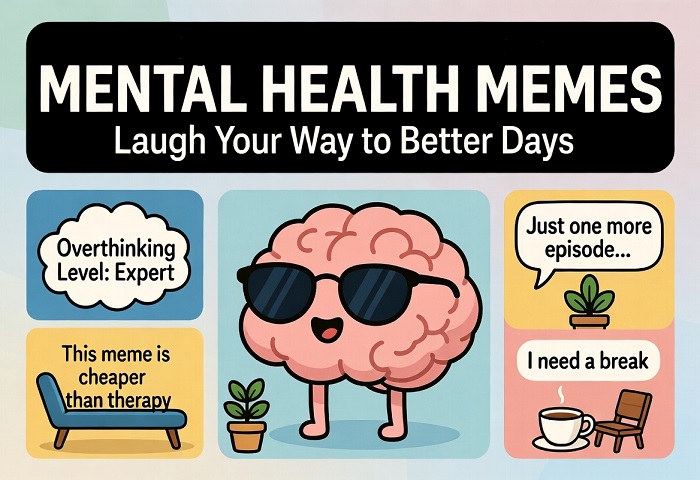
Introduction
You’re scrolling through your phone at 1 a.m., unable to sleep, mind racing with worries you can’t quite put into words — and then you see it. A simple meme: a cartoon dog sitting in a room engulfed in flames, sipping coffee, captioned “This is fine.” You laugh. You share it. You feel, for just a moment, like someone completely understands what’s going on inside your head.
That moment — the connection between a silly image and a deeply personal emotion — is exactly why mental health memes have exploded into one of the most searched, shared, and studied corners of internet culture. They aren’t just jokes. They’re a language. They’re a lifeline. And increasingly, researchers, therapists, and millions of everyday people are waking up to just how powerful they can be.
In this in-depth guide, we’ll explore everything you need to know about mental health memes: what makes them so uniquely relatable, the science behind why humor helps us cope with anxiety and depression, the real benefits they offer, and the boundaries we should be mindful of. Whether you’ve been sending these memes to friends for years or you’re just curious about why everyone keeps posting them, this article is for you.
1. What Are Mental Health Memes?
At their simplest, memes are images, videos, or pieces of text that spread rapidly across the internet, often with a humorous spin that evolves as they’re shared. Mental health memes are a specific subset of this digital art form — content that addresses psychological struggles, emotional experiences, and the everyday challenges of living with anxiety, depression, burnout, social anxiety, ADHD, OCD, PTSD, and other mental health conditions.
These memes typically combine a recognizable image or format with text that articulates an experience many people have but rarely say aloud. Think of the “distracted boyfriend” meme repurposed to show the brain ignoring responsibilities and chasing intrusive thoughts. Or the SpongeBob “mocking” format used to imitate the cruel inner critic voice. Or countless Kermit the Frog variations illustrating the internal monologue of someone with social anxiety.
What sets mental health memes apart from general humor is their intimate specificity. They don’t make vague jokes — they zero in on the texture of psychological experience: the exhaustion of depression that sleep can’t fix, the overthinking that happens hours after a normal conversation, the paradox of wanting connection but feeling too drained to socialize. That precision is exactly what makes them hit so hard.
2. Why Mental Health Memes Resonate So Deeply
There’s a reason a good mental health meme can stop you mid-scroll and make you think “wait, how does this random internet stranger know exactly what’s happening in my brain?” The answer lies in a combination of cultural timing, digital behavior, and very human psychology.
First, mental health is notoriously hard to talk about. The experience of depression isn’t easily described in clinical language — it’s not just sadness, it’s a blankness, a heaviness, a strange distance from your own life. Anxiety isn’t just worry — it’s a body locked in emergency mode when everything is technically fine. Traditional language often fails to capture these nuances. Memes, however, can compress enormous emotional complexity into a single image and three words.
Second, sharing a meme carries much lower social risk than admitting vulnerability directly. Posting a funny anxiety meme is a way of saying “I struggle with this” without the terrifying exposure of saying it plainly. It’s disclosure with a protective layer of irony and humor — which for many people is the only way they’re currently able to communicate their inner experience.
Third, the digital culture of the past decade has been shaped by generations who grew up expressing themselves through visual, fast, shareable content. For millennials and Gen Z especially, memes are not a lesser form of communication — they’re a primary one. Mental health memes live at the intersection of the internet’s native language and a generation finally willing to talk about psychological struggles without shame.
3. The Psychology Behind Humor and Healing
Laughter as medicine isn’t a new concept. Humor has been recognized throughout history as a coping mechanism, a social bonding tool, and a way of processing painful experiences at a safe distance. But what’s happening in the brain when we laugh at a depression meme — and why does it sometimes feel like relief rather than trivialization?
Psychologists point to a concept called cognitive reappraisal — the ability to reframe a negative experience in a way that changes its emotional impact. When we laugh at a meme about social anxiety, we’re not minimizing the experience. We’re recontextualizing it. We’re placing it in a frame of shared absurdity rather than isolated shame. That shift, even momentary, can reduce the emotional intensity of the experience.
Research published in peer-reviewed journals has found that individuals experiencing depression perceive depression-related memes as significantly more humorous, relatable, and shareable than their non-depressed counterparts. More importantly, they rate those memes as having greater mood-improving potential. This isn’t because memes cure depression — they don’t. But they activate something genuinely therapeutic: the feeling of being understood.
There’s also a social dimension. When someone shares a mental health meme and receives likes, comments, or “this is literally me” responses, they’re receiving social validation. And research consistently shows that perceived social support is one of the most powerful buffers against psychiatric symptoms. The meme becomes a connector — a small digital bridge between isolation and community.
Humor also works through what psychologists call benign violation theory — the idea that something is funny when it violates our expectations in a way that is also, somehow, okay. Mental health memes often follow exactly this pattern: they describe something genuinely painful (a violation of how we wish things were) through a format that’s light and absurd (making it feel, at least momentarily, survivable).
4. Types of Mental Health Memes You’ll Recognize
Anxiety Memes
Among the most widely shared online, anxiety memes typically center on overthinking, social awkwardness, catastrophic imagination, and the physical sensations of a nervous system stuck in high alert. Classic formats include imagined disaster scenarios, internal monologues during casual conversations, and the eternal fight between a tired body and a wired, racing mind that refuses to let sleep happen.
Depression Memes
Depression memes tend toward a particular kind of dry, dark humor — jokes about staying in bed, losing interest in things you used to love, the strange performance of “being fine” in public, and the baffling exhaustion that no amount of rest seems to fix. The tone is often bittersweet: funny in a way that also quietly aches.
ADHD Memes
ADHD content online has exploded in recent years, with memes capturing the specific chaos of executive dysfunction, hyperfocus, time blindness, and the experience of having seventeen browser tabs open in your brain at all times. These memes have played a significant role in helping people recognize undiagnosed ADHD in themselves and seek evaluation.
Burnout and Self-Care Memes
Burnout memes speak to the exhaustion of modern working life — the irony of being told to practice self-care within systems that cause the burnout in the first place. Self-care memes can be genuinely encouraging, gently funny, or quietly sarcastic. They reflect a generation navigating impossible productivity expectations while trying to remember that human beings need rest.
Therapy Memes
Therapy memes have helped destigmatize seeking professional mental health support by normalizing the experience of therapy — the awkward first session, the breakthroughs, the homework you forget to do, the surprise of crying about something you thought you were over. These memes have quietly shifted therapy from something shameful into something many people speak about openly.
5. Proven Benefits of Engaging With Mental Health Memes
✓ Benefits
- Reduces sense of isolation and shame
- Offers a low-risk way to disclose struggles
- Encourages cognitive reappraisal of painful experiences
- Builds community and peer support connections
- Normalizes therapy and help-seeking behavior
- Provides brief but genuine mood improvement
- Helps articulate experiences that are hard to verbalize
⚠ Potential Risks
- Can trivialize serious conditions if misused
- May normalize avoidance of professional help
- Dark humor can reinforce hopelessness
- Risk of misidentification without clinical diagnosis
- Excessive scrolling as avoidance behavior
- Content may occasionally be triggering
- Not a substitute for actual treatment
The benefits of mental health memes are not just anecdotal. Academic research — including studies published in journals like Scientific Reports and Frontiers in Psychiatry — has begun to map the psychological mechanisms through which meme engagement supports mental wellbeing. Across multiple studies, the consistent finding is that for people already experiencing psychiatric difficulties, mental health memes function primarily as a beneficial coping mechanism rather than a harmful one.
One survey of college students found that nearly half reported deliberately using memes to alleviate psychiatric symptoms — not out of denial, but as a genuine and functional emotional regulation strategy. The people using memes this way are not hiding from their problems; they are, in many cases, finding a way to temporarily lighten a load heavy enough to crush a person who has no outlet at all.
6. The Risks: When Memes Cross the Line
It would be dishonest to talk about mental health memes without acknowledging that they exist in complicated territory. The same features that make them powerful — their darkness, their bluntness, their refusal to soften painful truths — can also create problems when content tips from “relatable” into genuinely harmful.
One legitimate concern is the way meme culture can make light of conditions that require serious treatment. If every manifestation of depression becomes a punchline, it can make it harder for people to recognize when they need more than a good laugh — when what they’re experiencing is a clinical condition that deserves proper care, not just better memes. Humor can be a door through which people approach their pain; it should never become the wall they hide behind.
There is also the question of self-diagnosis. Mental health memes — especially ADHD and autism memes — have played a real role in helping people recognize patterns in themselves that they’d never had language for before. This awareness can be genuinely life-changing. But it can also lead people to self-diagnose with conditions they may not have, or to delay seeking professional evaluation because a meme felt like sufficient confirmation.
Researchers who have studied mental health meme content at scale have found reassuring data on the most alarming fears. Analysis of millions of Instagram posts found that explicit graphic content appeared in only a tiny fraction of mental health disclosures, and that the widely feared phenomenon of memes directly encouraging self-harm was not meaningfully supported by the data. Still, context matters. What is healing for one person may be a trigger for another, and mindful consumption of this content — just like any other — is worth practicing.
7. How Mental Health Memes Build Online Communities
One of the most underappreciated dimensions of mental health memes is their role in community formation. Social media pages dedicated entirely to mental health humor — on Reddit, Instagram, TikTok, and X (formerly Twitter) — have gathered millions of followers who show up not just for the laughs but for the feeling of being surrounded by people who understand.
In these spaces, the comments section is often as meaningful as the meme itself. People share their own experiences, check on one another during hard weeks, and build relationships grounded in mutual recognition of shared struggle. For people who feel unable to speak openly about their mental health in their offline lives — because of family stigma, cultural pressure, or simple social fear — these online communities can be a vital form of connection.
This is what researchers mean when they describe mental health memes as a potential “conduit for socioemotional bonds.” When someone posts a relatable anxiety meme and someone else responds “this is literally my entire brain,” a tiny but real thread of human connection has been made. Multiply that by millions of interactions across thousands of accounts, and you begin to understand why these spaces have become genuinely important to a lot of people’s emotional lives.
The mental health meme community has also played a real role in breaking down stigma at scale. A generation that grew up seeing their own intrusive thoughts turned into shared jokes is, broadly speaking, less likely to see those thoughts as a mark of weakness or shame. That cultural shift — slow, imperfect, still incomplete — is partly the work of memes.
8. Mental Health Memes in a Therapy Setting
Here’s something that might surprise you: therapists are paying attention. Clinicians who work with younger clients in particular have begun incorporating mental health memes into their practice — not as a gimmick, but as a genuinely useful therapeutic tool.
Anecdotally, therapists report using memes as ice-breakers at the start of sessions — a way of lowering anxiety and creating a lighter entry point into difficult material. More meaningfully, some clients bring memes to sessions as a way of showing their therapist what they’ve been feeling during the week. “This one,” a client might say, holding up their phone. “This is exactly what Monday felt like.” A meme can communicate in two seconds what might take twenty minutes of careful, halting description to articulate otherwise.
Researchers are now formally exploring how mental health memes might be incorporated into therapeutic frameworks — not as replacements for evidence-based treatment, but as supplements that make therapy more accessible and relatable, particularly for people who have historically been resistant to the formality of clinical settings. The goal, ultimately, is to meet people where they already are — and where they already are is often the comment section of a very relatable meme.
9. How to Create Responsible Mental Health Memes
If you’re someone who wants to contribute to this space — whether as a content creator, a mental health advocate, or just someone who processes their own experience through humor — there are a few principles worth keeping in mind.
Speak from experience, not assumption. The mental health memes that land best are the ones that come from a place of genuine familiarity. Creating memes about conditions you haven’t experienced can easily tip into caricature rather than connection.
Punch sideways, not down. The best dark humor in this space makes light of the condition, the situation, or the systems that fail people — not the people themselves. Memes that mock people for their struggles are not the same as memes that mock the absurdity of struggling.
Include resources when it matters. If you’re creating content that touches on serious territory — suicidal ideation, self-harm, severe depression — consider including a link or mention of a crisis resource. You don’t need to derail the humor, but you can acknowledge that some people seeing your content may be in a place where laughter isn’t enough.
Stay curious about impact. If people tell you a meme you created was hurtful or triggering, take that seriously. The goal is to build bridges, and bridges need to be built with care.
10. Frequently Asked Questions About Mental Health Memes
Are mental health memes actually helpful, or are they harmful?
Research consistently shows that for people experiencing anxiety and depression, mental health memes primarily function as a beneficial coping mechanism. They help people feel less isolated, provide humor as a buffer against pain, and facilitate social connection. However, they should supplement — not replace — professional mental health support when it’s needed.
Why do depression memes feel so accurate?
Because they’re made by people living with depression. The creators of the most relatable mental health memes are drawing directly from their own experience, which is why they capture nuances that clinical descriptions often miss. The precision of a good depression meme comes from lived knowledge.
Is it okay to laugh at mental health struggles?
Yes — especially when the person laughing is the one doing the struggling. Humor has long been recognized as a valid and healthy coping mechanism. The key distinction is between humor that offers relief and connection versus humor that demeans or dismisses people’s suffering.
Can memes help reduce mental health stigma?
Absolutely. Mental health memes have played a measurable cultural role in normalizing conversations about anxiety, depression, therapy, and emotional struggles. By bringing these topics into casual everyday online conversation, they help chip away at the silence and shame that still surround mental health for many people.
What should I do if a mental health meme upsets me?
Trust that feeling. Not all content labeled as “relatable” will be helpful for everyone. If certain memes consistently make you feel worse, it’s perfectly reasonable to unfollow, mute, or avoid that content. And if you’re going through a difficult time, reaching out to a counselor, therapist, or crisis line is always the right move.
Are mental health memes a replacement for therapy?
No. Mental health memes can be a wonderful complement to therapy — helping people articulate experiences, reduce shame, and stay connected to a supportive community. But they are not a clinical intervention, and they cannot replace the work of professional mental health treatment for people who need it.
Final Thoughts: A Laugh That Holds You
Mental health memes have earned their place in the cultural conversation — not because they fix anything, but because they name things. They take the shapeless, heavy, hard-to-articulate experience of psychological struggle and press it into something visible, shareable, and — crucially — funny enough to survive.
They remind us that we are not alone in our anxiety spirals or our depression blankets or our therapy homework we keep forgetting. They create community out of shared confusion. They invite us to laugh not at our pain, but alongside it — which is, if you think about it, one of the most human things we can do.
So the next time you send a mental health meme to a friend at midnight and all they write back is “I felt this in my soul” — know that something real just happened. A small, silly, important bridge was built. And that matters more than we usually give it credit for.