
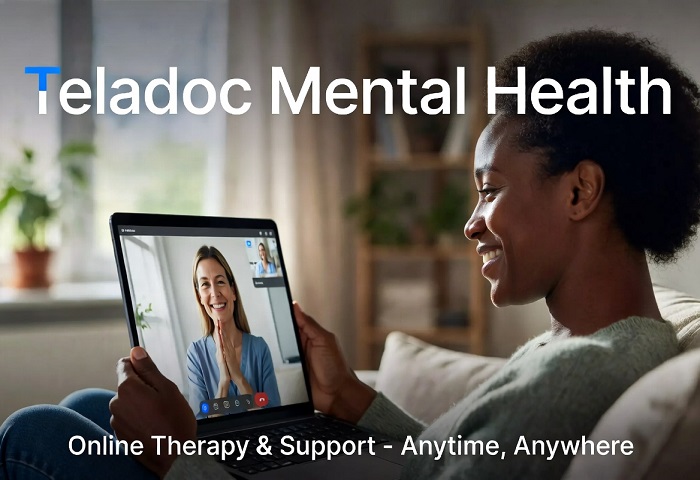
Introduction: Why Teladoc Mental Health Is Changing How We Seek Help
Getting support for anxiety, depression, or emotional stress used to mean calling a therapist’s office, waiting weeks for an appointment, driving to a clinic, and hoping the provider you finally met was a good fit. For millions of Americans, those barriers were enough to stop them from seeking help entirely.
Teladoc mental health services exist to remove those barriers. As one of the oldest and most established telehealth platforms in the United States — with virtual care delivery dating back to 2002 — the company’s mental health division has grown into one of the most comprehensive online therapy and psychiatry offerings in the country. With over 41,000 verified patient reviews, availability in all 50 states, and acceptance by most major insurance plans, teladoc mental health has become a genuine first-choice option for people seeking accessible, affordable, and confidential professional care from the comfort of their own homes.
But is it right for you? What does it actually cost? What conditions can it help with? How does the experience compare to in-person therapy? And how does it stack up against alternatives like BetterHelp or Talkspace?
This complete 2026 guide answers every one of those questions. Whether you are exploring therapy for the first time or comparing platforms as an experienced mental health consumer, you will find everything you need here to make a confident and informed decision about teladoc mental health and what it can offer you.
What Is Teladoc Mental Health?
Teladoc mental health is the dedicated mental wellness division of Teladoc Health, a global virtual care company that delivers a full spectrum of healthcare services through its app, website, and phone platform. Launched initially as a general telemedicine service, the company expanded into mental health as demand for accessible psychological care grew — particularly following the dramatic increase in anxiety, depression, and stress-related conditions that accelerated during and after the COVID-19 pandemic.
The platform offers two primary categories of service. The first is therapy — sessions with licensed therapists, psychologists, licensed clinical social workers, and professional counselors who help you work through emotional and psychological challenges using evidence-based approaches. The second is psychiatry — appointments with board-certified psychiatric providers who can evaluate your condition, make clinical diagnoses, and prescribe or manage medications where appropriate.
Beyond these core services, the platform also offers a digital self-care programme — a personalised app-based tool that provides guided activities, meditations, mood tracking, and skill-building courses for people who want support between sessions or who prefer a self-directed approach. According to data published by Teladoc Health, four out of five users of the digital programme found it as effective as in-person therapy at a fraction of the cost.
In April 2025, teladoc mental health made a significant strategic leap by acquiring UpLift, a virtual therapy and psychiatry provider in a deal valued at up to $45 million. UpLift brings a network of approximately 1,500 clinicians and payer partnerships covering over 100 million lives — meaningfully expanding the platform’s clinical depth and insurance accessibility. In July 2025, Teladoc also launched Wellbound, a new employee assistance programme offering therapy, psychiatry, and medication management services as a workplace benefit for qualifying employees.
What Conditions Does Teladoc Mental Health Treat?
One of the most important practical questions anyone considering teladoc mental health services will ask is whether the platform can actually help with their specific situation. The range of supported conditions is broad and covers the vast majority of challenges that bring people to therapy.
Anxiety and stress are among the most common reasons people seek online therapy. The licensed therapists on the platform are well-equipped to work with generalised anxiety disorder, social anxiety, panic disorder, and situational stress. Cognitive behavioural therapy (CBT) and other evidence-based modalities can be delivered effectively in a virtual setting, and research consistently shows that online therapy produces outcomes comparable to in-person care for anxiety conditions.
Depression is another area where the platform delivers meaningful results. Both therapy and psychiatry services are available for depression, meaning clients can access talk therapy alone, medication management alone, or a combination of both — all through the same system. For mild to moderate depression, virtual therapy is often highly effective. For more complex presentations, a psychiatrist can assess whether medication is appropriate and manage treatment accordingly.
Other conditions routinely addressed through this service include relationship difficulties, grief and loss, life transitions and adjustment challenges, work-related stress and burnout, postpartum depression, sleep disorders and insomnia, trauma and PTSD, self-esteem issues, eating concerns, ADHD assessment and medication management, obsessive-compulsive patterns, and substance use support.
Important limitation: Virtual therapy and psychiatry services through this platform are not appropriate for psychiatric emergencies. The company explicitly states that anyone experiencing a mental health crisis, thoughts of self-harm, or acute symptoms requiring immediate intervention should call 911 or visit the nearest emergency room rather than requesting a virtual session. For non-emergency ongoing care, however, the clinical territory covered is impressively wide.
How Teladoc Mental Health Works: Step by Step
Understanding how the platform functions in practice helps set accurate expectations and removes uncertainty for first-time users. The process is designed to be simple and fast, even for people who have never engaged with telehealth before.
Step 1 — Create Your Account. Sign up at teladochealth.com or through the Teladoc Health mobile app. Registration takes approximately five minutes and requires basic personal information, a brief health history form, and your insurance details if applicable. No extensive medical records are required to get started.
Step 2 — Confirm Your Coverage. During registration, you enter your insurance provider’s information to instantly check what services are covered under your plan. This transparency — knowing your exact cost before confirming an appointment — is one of the features users most consistently praise across independent reviews.
Step 3 — Choose Your Provider. You browse a selection of matching therapist or psychiatrist profiles, each showing credentials, specialities, languages spoken, gender, and available appointment slots. You choose who you want to work with based on your personal preferences and clinical needs. This provider-selection process puts control in your hands from the very beginning.
Step 4 — Complete a Pre-Visit Questionnaire. Before your first session, a brief mental health questionnaire gathers context about where you are emotionally and what you hope to address. This ensures your first appointment is substantive rather than spent entirely on intake paperwork.
Step 5 — Attend Your Session. Sessions take place by video or phone, seven days a week from 7 a.m. to 9 p.m. in most states. Sessions last as long as you need them. Many clients attend from home, a private office, or any space where they feel safe and comfortable to speak openly.
Step 6 — Continue Your Care. After each visit, your provider shares a summary through the secure member message centre. You can schedule follow-up sessions, request prescription refills where applicable, and maintain continuity with the same provider throughout your care. If you decide to switch providers, your records and notes transfer automatically — you do not start from scratch.
Teladoc Mental Health Costs: What You Will Actually Pay
Cost is one of the most practical considerations for anyone exploring this service, and the pricing structure is notably straightforward compared to many competitors.
Without Insurance
For self-pay users accessing virtual mental health care without insurance coverage, therapy sessions with a licensed therapist, psychologist, or clinical social worker cost $119 per session. Initial psychiatry appointments — your first evaluation with a psychiatric provider — cost $299. Follow-up psychiatry visits are $129 per session.
These prices reflect a pay-per-session model. Unlike BetterHelp, Talkspace, and many other online therapy platforms that require monthly subscription commitments, the service charges on a per-visit basis with no minimum commitment required. This flexibility is a significant advantage for users who want to explore therapy before committing or who only need occasional sessions rather than ongoing weekly care.
With Insurance
The platform works with the majority of major commercial insurance plans, including most employer-sponsored health programmes. For insured users, costs can drop dramatically — in many cases to zero. Under standard PPO and EPO plans, many users access therapy sessions at a $0 co-pay. Under High-Deductible Health Plans (HDHPs) for 2026, pre-deductible costs are approximately $94 for a licensed therapist session, $210 for an initial psychiatrist or PMHNP visit, and $110 for follow-up psychiatric appointments.
Teladoc mental health also accepts Health Savings Account (HSA), Flexible Spending Account (FSA), and Health Reimbursement Arrangement (HRA) cards, allowing eligible users to pay for mental health sessions with pre-tax dollars. All major credit cards and PayPal are accepted for direct payments.
Employer-Provided Access
Many employers include virtual mental health services within their employee benefits package. If your employer has enrolled in the Wellbound programme or another Teladoc-powered employee assistance arrangement, you may have access to therapy, psychiatry, and medication management at absolutely no personal cost. If you are unsure whether your employer offers this, check with your HR or benefits manager before assuming you need to pay out of pocket.
Teladoc Mental Health Therapy: What the Experience Is Like
Understanding the clinical experience of virtual therapy — what it actually feels like to attend a session — is something that concerns many first-time users, particularly those accustomed to in-person care or those who have never sought psychological support before.
The session format closely mirrors traditional in-person therapy. You connect with your licensed therapist over video or phone at a pre-scheduled time. There is no waiting room, no travel, no parking. You are in your chosen environment — whether home, a private office, or any space where you feel comfortable and genuinely safe to open up. Your therapist guides the session with the same professional attentiveness they would bring to any face-to-face appointment.
One important distinction: unlike BetterHelp — which is actually a subsidiary of Teladoc Health — the main platform does not offer between-session messaging with your therapist. All therapeutic contact happens within your scheduled sessions. For users who want the ability to message their therapist between appointments, BetterHelp’s subscription model may be the better fit. For users who prefer a traditional, clearly structured therapeutic framework, this boundary is entirely appropriate.
All therapists on the platform are licensed professionals. The vetting process includes background checks and active licence verification for every state in which providers practise. Choosing a therapist based on their profile, and switching if the fit is not right after a session or two, is encouraged — and records transfer automatically so continuity of care is preserved. Independent reviewers at ChoosingTherapy.com gave the service 3.5 out of 5 stars, noting ease of access, insurance compatibility, and broad provider availability as clear strengths.
Teladoc Mental Health Psychiatry and Medication Management
The psychiatry component of this service is one of its most practically important features, particularly for individuals who need medication management as part of their treatment plan.
Teladoc’s board-certified psychiatrists and Psychiatric/Mental Health Nurse Practitioners (PMHNPs) can diagnose conditions, recommend and initiate treatment plans, and prescribe a wide range of psychiatric medications. This includes antidepressants such as SSRIs and SNRIs, mood stabilisers, antipsychotics, some anxiolytics, and certain non-stimulant ADHD medications including Intuniv, Strattera, and Kapvay.
Critical limitation: Teladoc psychiatric providers cannot prescribe controlled substances. Medications such as benzodiazepines, stimulant-based ADHD treatments like Adderall or Ritalin, and similar Schedule II or Schedule IV drugs are outside the platform’s prescribing scope. If your treatment plan requires these medications, you will need to work with an in-person provider for that specific element of your care.
For ongoing medication management and follow-up psychiatric appointments, virtual psychiatry through this service is significantly more affordable than most in-person equivalents. Follow-up psychiatry visits at $129 are well below the $200 to $400 that in-person psychiatric appointments commonly cost without insurance. The ability to manage your medication, discuss dosage adjustments, and address side effects without leaving home is a practical benefit that patients consistently identify as a major quality-of-life improvement.
Teladoc Mental Health vs. Competitors
Anyone researching this platform will inevitably compare it to other major telehealth services. Understanding the key differences helps you choose the option best suited to your specific needs.
Versus BetterHelp. BetterHelp is owned by Teladoc Health, making this an interesting internal comparison. BetterHelp operates on a subscription model — roughly $60 to $100 per week, billed monthly — that includes unlimited between-session messaging and live sessions. If you value constant therapist access between appointments, BetterHelp’s model suits that need better. If you prefer a traditional session-based structure with no subscription commitment, teladoc mental health is the stronger choice.
Versus Talkspace. Like BetterHelp, Talkspace uses a subscription model with between-session messaging. It requires at least a monthly commitment. The per-session pricing offered here gives significantly more flexibility for users who want to start slowly or use care intermittently.
Versus Brightside Health. Brightside focuses specifically on depression and anxiety, offering deeply integrated therapy and medication programmes. For users whose primary concern is one of those two conditions and who are likely to need both modalities, Brightside’s integrated approach is highly streamlined. For users wanting a broader platform covering primary care, wellness, and a range of mental health needs, the Teladoc Health ecosystem is the more comprehensive solution.
Versus in-person therapy. Virtual therapy through Teladoc is not a replacement for all in-person care — particularly for complex conditions requiring intensive treatment or crisis intervention. For the vast majority of people managing everyday anxiety, depression, stress, and relationship challenges, however, independent research consistently shows that telehealth therapy outcomes are comparable to those achieved in person.
Who Should Use Teladoc Mental Health?
The service is well suited to a wide range of people, and particularly valuable for several specific groups.
Busy professionals who struggle to schedule time for in-person appointments benefit enormously from seven-days-a-week availability and evening appointment windows. Sessions can be attended from a home office in ten minutes rather than an hour-long trip.
People in rural or underserved areas face genuine geographic barriers to professional mental health care that virtual services eliminate entirely. The platform’s nationwide availability means someone in a small town in rural Montana has the same access to licensed therapists and board-certified psychiatrists as someone in Manhattan.
First-time therapy seekers who feel nervous or uncertain about the experience often find that attending a session from a familiar, comfortable environment lowers the psychological barrier to opening up. The reduced formality of a virtual setting can make that essential first step significantly easier.
People managing ongoing conditions who need regular medication management without the inconvenience of repeated in-person appointments find the virtual psychiatry follow-up model both practical and cost-efficient.
Employees whose employers offer this service as a benefit should take full advantage of a professionally delivered mental health resource that may cost them nothing at all.
Is Teladoc Mental Health Worth It?
Teladoc mental health services represent an excellent fit for the majority of people seeking professional, accessible, and confidential virtual care. The combination of HIPAA-compliant security, licensed and board-certified providers, broad insurance acceptance, flexible per-session pricing, and availability across all 50 states makes this one of the most complete virtual mental health platforms available in 2026.
It is not the right choice for every situation. If between-session messaging is important to you, BetterHelp is more suitable. If you require controlled substance prescriptions, in-person care is necessary for that element. And if you are in a psychiatric crisis, 911 or an emergency room is always the right first call.
For everyone else — the vast majority of people dealing with anxiety, depression, stress, relationship challenges, grief, burnout, or any of the dozens of other challenges licensed therapists are trained to address — this platform offers a genuinely high-quality, affordable, and accessible route to the professional support that makes a real difference.
Frequently Asked Questions About Teladoc Mental Health
Is Teladoc mental health covered by insurance? Yes. The platform works with most major commercial insurance plans, many employer health programmes, and a range of Medicare Advantage and Medicaid managed care plans. You can check your coverage instantly during account registration.
How much does Teladoc mental health cost without insurance? Without insurance, therapy sessions cost $119 per session. Initial psychiatry visits are $299, and follow-up psychiatric appointments are $129 each.
Can Teladoc mental health prescribe medication? Yes. Psychiatric providers can prescribe antidepressants, mood stabilisers, antipsychotics, some anxiolytics, and certain non-stimulant ADHD medications. Controlled substances cannot be prescribed.
Is the service HIPAA compliant? Yes. All sessions and personal health data are fully HIPAA compliant and treated as Protected Health Information under federal and applicable state privacy laws.
Can I use my HSA or FSA? Yes. Teladoc mental health accepts HSA, FSA, and HRA cards for eligible services, allowing you to pay with pre-tax dollars.
How do I get started? Visit teladochealth.com or download the Teladoc Health app, create your free account, check your insurance coverage, choose a provider, and schedule your first session — in approximately five minutes.
Final Thoughts
Teladoc mental health represents one of the most complete and accessible virtual mental health solutions available in 2026. Two decades of telehealth experience, a growing network of licensed providers, broad insurance acceptance, transparent per-session pricing, and seamless digital access combine to create a platform that genuinely delivers on its promise to make professional mental health care available to anyone who needs it — regardless of where they live, how busy they are, or how much they can afford to spend.
For anyone who has been putting off seeking professional support because the process seemed too complicated, too expensive, or too time-consuming, this service removes those excuses one by one. The support you need is available now, from wherever you are, at a price you can plan around.
Taking that first step toward better mental health has rarely been more straightforward.