
Introduction
When was the last time you genuinely stopped, got quiet, and asked yourself how you were really doing — not just physically, but emotionally, mentally, and spiritually? If you are drawing a blank, you are not alone, and that is precisely why the mental health check in has become one of the most important wellness habits a person can build in 2026.
Life is moving faster than ever. The pressure of nonstop news cycles, AI-driven work environments, financial uncertainty, and lingering post-pandemic stress has created a world where emotional exhaustion hides behind packed calendars and forced smiles. The mental health check in cuts through all of that noise. It is a simple, intentional pause — a moment to honestly assess where you are so you can get to where you need to be.
This complete guide covers everything: what this practice really is, why it matters more now than ever, how to do one for yourself, how to check in with people you care about, how workplaces can build a genuine culture of mental wellness, and the warning signs that tell you it is time to seek professional support. Whether you are doing this for the first time or trying to make it a consistent habit, you are in the right place. Let us get into it.
What Is a Mental Health Check In?
A mental health check in is an intentional moment where you pause to honestly assess your emotional and psychological well-being. Think of it as a routine maintenance check for your mind — much like you would take your car in for a service to keep it running smoothly, or schedule an annual physical with your doctor to stay on top of your body. The difference is that this practice does not require an appointment, a co-pay, or a clinical setting. You can do it right now, wherever you are.
A mental health check in is a proactive approach to maintaining and improving mental health and wellness. Unlike physical health issues, mental health problems can present with more subtle signs and symptoms, which make them easier to overlook and ignore.
That subtlety is exactly the problem. When you break an arm, it is obvious. When you are gradually sliding toward burnout, anxiety, or depression, the signs can be so quiet and incremental that you barely notice until you are deep in the thick of it. A regular mental health check in prevents that slide by keeping you honest with yourself on a consistent basis.
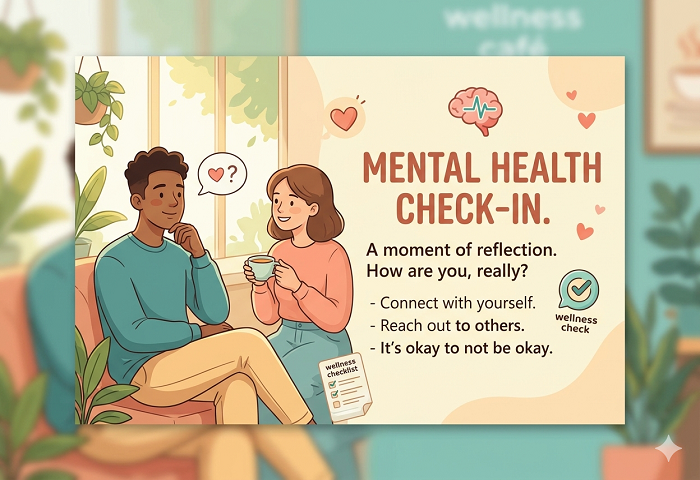
These check-ins can take many forms. You might do a private self-assessment, answer a structured set of questions in a journal, check in with a close friend, have a regular conversation with a therapist or counselor, or participate in a team check-in at work. The format matters less than the intention behind it: genuine honesty, without judgment, about where you actually are.
Why a Mental Health Check In Matters More Than Ever in 2026
If you needed a reason to take a mental health check in seriously, the statistics from 2026 make a compelling case on their own.
When examining global mental health statistics for 2026, the numbers reveal a world still reeling from the societal and economic aftershocks of the pandemic era. Global figures from the WHO show that roughly 1 in 8 people worldwide are currently living with a mental disorder, with anxiety and depression remaining the most prevalent issues. In the United States, nearly 1 in 5 U.S. adults experience mental illness each year.
The numbers are sobering. On anxiety prevalence, 58% of Americans report feeling anxious about personal finances, and 52% cite uncertainty about the future as a primary stressor. A staggering 55% of adults facing mental illness still do not access any form of treatment, highlighting a persistent gap in care accessibility.
That treatment gap is precisely where the mental health check in becomes so powerful. Health insurance often doesn’t pay, or doesn’t pay enough, to make routine mental health visits a practical option. This is a big reason why mental health check-ins — either self-administered or administered by your healthcare provider — are so all-important.
In 2026, preventive mental health care is becoming operationalized. This change has reduced crisis-driven care and allowed patients to maintain stability rather than repeatedly recover from breakdowns. The shift is happening at a systemic level, and the mental health check in is a foundational tool in that prevention-first approach.
The good news is that awareness is growing too. A late 2026 report by the American Psychiatric Association found that 33% of Americans planned to make a mental health-related resolution for 2026, representing a continued focus on emotional well-being compared to previous years. More people are prioritizing their emotional health proactively, and that shift is saving lives.
A consistent mental health check in practice helps you stay in that proactive lane instead of the reactive one. It keeps you connected to your internal experience so that when something feels off, you catch it early — before a rough patch becomes a crisis.
The Benefits of a Regular Mental Health Check In
The case for building this habit into your routine goes far beyond avoiding the worst-case scenario. The benefits are positive and wide-ranging, touching every area of your life.
Early Detection of Distress. Regular mental health check-ins can help people spot early signs of mental health issues, such as anxiety, burnout, and depression. It’s often easier to manage symptoms and prevent escalation of mental health problems when you first notice when something doesn’t feel right. The earlier you catch a problem, the more options you have and the less damage it does in the meantime.
Deeper Self-Awareness. Taking time to assess mental state can increase self-awareness. This insight fosters better emotional regulation and decision-making, and it can improve overall emotional intelligence. The more you practice it, the better you become at reading yourself in real time — not just during a formal sit-down session.
Better Stress Management. Check-ins allow you to identify stressors early and develop coping strategies. This can prevent chronic stress from leading to burnout or physical health problems. Stress does not disappear on its own. This kind of honest self-assessment gives you the information you need to actually address what is causing it.
Stronger Relationships. Sharing your thoughts and feelings during check-ins with loved ones fosters open communication and deepens connections. When you are honest about your emotional state with the people who matter to you, it builds trust, reduces misunderstandings, and creates the kind of closeness that buffers against loneliness and isolation.
Improved Productivity and Performance. A healthy mind leads to increased focus, creativity, and efficiency. Regular check-ins ensure that mental roadblocks don’t hinder your personal or professional growth. You simply cannot perform at your best when you are emotionally depleted, and regular self-monitoring ensures you can spot the signs of depletion before they tank your output.
Coping Skills Discovery. Regular self-reflection can help people learn which coping skills and strategies work best for managing stress, anger, and sadness. Over time, your mental health check in becomes a personalized map of what works for you — what restores you, what drains you, and what your early warning signs look like.
How to Do a Personal Mental Health Check In
The beauty of a personal mental health check in is that there is no single right way to do it. What matters is that it is honest, regular, and genuinely reflective. Here is a practical framework to get you started.
Step 1: Find a Quiet Space. Choose a calm environment where you can reflect without distractions. Turn your phone face down, close unnecessary tabs, and give yourself at least ten to fifteen minutes of genuine quiet. You cannot honestly assess your inner world while your outer world is screaming for attention.
Step 2: Ask Honest Questions. The core of this process is a set of honest, open-ended questions. Here are some of the most effective ones to work through:
- How am I really feeling today — physically and emotionally?
- What is taking up the most space in my mind right now?
- Have I been sleeping and eating reasonably well?
- Am I withdrawing from people or activities I normally enjoy?
- What is my current stress level, and what is causing it?
- Have I experienced any persistent sadness, worry, or irritability recently?
- What do I need right now that I am not getting?
- What has brought me genuine joy or satisfaction this week?
When we are aware of ourselves, we see ourselves clearly — who we are, our capabilities, what makes us happy or sad. We are then able to develop more confidence and creativity, make sounder decisions, build stronger relationships and communicate more effectively.
Step 3: Be Brutally Honest. This process only works if you resist the urge to give yourself the answer you think you are supposed to give. It is not an exam. There are no correct responses. The goal is accuracy, not performance. If you feel terrible, say so — at least to yourself.
Step 4: Journal Your Responses. Writing down your answers dramatically increases the effectiveness of this practice. When you put words to your inner experience, you externalize it in a way that makes patterns visible over time. You will start to notice recurring themes — particular situations that reliably drain you, specific relationships that consistently lift you, time-of-day patterns in your mood — that you would never catch if you just thought through it in your head and moved on.
Step 5: Take One Action. After completing your mental health check in, identify one small, concrete action you can take based on what you have discovered. It does not need to be dramatic. It might be going to bed earlier tonight, calling a friend you have been meaning to connect with, or scheduling an appointment with a therapist. This practice is most powerful when it leads somewhere — however small.
Doing a Mental Health Check In for Someone You Care About
One of the most loving things you can do for someone is take the time to genuinely check in with them. Not a quick “you okay?” in passing, but a real, attentive conversation that says: I see you, I have time for you, and I am not going anywhere.
It can be difficult to ask how someone is actually feeling or to start a conversation about their mental health. But sometimes — you just have to ask.
A simple, effective check-in conversation with a friend or family member might involve questions like:
- How are you feeling today, really — physically and mentally?
- What is taking up most of your headspace right now?
- When did you last do something that genuinely made you feel good?
- Do you feel supported right now, or does it feel like you are carrying things alone?
- Is there anything I can do for you that would actually help?
Spend as much time as you want on each question. Stay engaged with follow-up questions. Keep things judgment-free. You don’t have to be an expert, you just have to listen. Stay in touch after, and don’t be afraid to connect them to resources.
Before you have this conversation, it is worth doing your own mental health check in first. Before you ask someone if they are OK, you need to be sure that you are OK — ask yourself if you are in the right headspace to have the conversation, if you are willing to genuinely listen, and whether you can give them as much time as they need.
The quality of this kind of conversation depends entirely on the quality of your presence in it. Put the phone away. Hold eye contact. Do not rush toward a solution. Sometimes what a struggling person needs most is not advice — it is just to feel heard.
The Mental Health Check In at Work: Why Every Workplace Needs One
The workplace is where most adults spend the majority of their waking hours, which means it is also where mental health is most consistently either supported or undermined. A regular mental health check in culture at work is no longer a “nice to have” — it is a business imperative.
It’s highly likely that someone in your team has a diagnosed or undiagnosed mental health condition, neurodivergent traits, or other situations that make certain things harder for them. Without such check-ins, it becomes easy for employees to fall into exhaustion, feelings of isolation, anxiety, fatigue, burnout, and resentment. On the other hand, having supportive conversations early can help them feel seen, reduce hidden stress, and keep issues from escalating.
For managers and team leaders, a structured emotional wellness conversation in one-on-one meetings might include questions such as:
- Is there anything in your workload right now that feels unsustainable?
- Do you feel like you have enough support from the team?
- Are there any tasks that feel harder than they should?
- How are you feeling about your work-life balance this month?
- Is there anything I can do differently to make your role easier?
Leaders are not therapists, counselors or medical professionals. But we are fellow humans. Taking time for an honest, caring conversation can go a long way to helping someone reach the well-being they want to achieve and maintain.
The most important thing a manager can do during these conversations is listen without immediately trying to fix. The instinct to problem-solve is understandable, but it can accidentally communicate that you want the conversation to end rather than that you genuinely care about the person having it. Slow down. Ask follow-up questions. Let silence be okay.
Mental health maintenance is becoming as normalized as managing physical health. Organizations that build regular, structured emotional wellness conversations into their team culture will see lower turnover, stronger engagement, and measurably better performance over time.
Warning Signs: When a Mental Health Check In Reveals Something Serious
Sometimes this kind of honest self-assessment will surface something that goes beyond the normal ebb and flow of everyday stress. Knowing what those warning signs look like — in yourself and in others — is critically important.
Mental health challenges often start quietly. What seems like a bad mood, irritability, or constant exhaustion may actually be an early sign of something deeper: anxiety, depression, or another mental health condition beginning to take root.
Warning signs to look out for during an emotional self-assessment include:
Social withdrawal. If someone who used to be active and social is now isolating themselves, check in. Loneliness can deepen mental health issues if it goes unnoticed.
Extreme mood swings. If emotions start swinging sharply from energetic to down, or calm to angry — if it feels like you are “all over the place” emotionally — it could be time to ask for help.
Changes in sleep and appetite. Oversleeping or struggling with insomnia, losing your appetite or overeating — especially when it is out of the ordinary — are signs worth noticing. These shifts may seem small, but when your body and mind are out of sync, it can be hard to keep up with life.
Persistent hopelessness or emptiness. Feeling low for a day or two is normal. Feeling consistently hopeless, empty, or like nothing matters for weeks at a time is a sign that a conversation with a professional is overdue.
Difficulty functioning. When mental health challenges start interfering with your ability to show up for work, maintain relationships, complete basic tasks, or take care of yourself physically, that is a clear signal that professional support is needed.
If your mental health check in — or someone else’s — reveals signs like these, please do not minimize them. Reaching out to a licensed therapist, counselor, or doctor is the right next step. If you or someone you know is in crisis or experiencing thoughts of self-harm, please contact a crisis line immediately. In the United States, you can call or text 988 to reach the Suicide and Crisis Lifeline, available 24 hours a day, seven days a week.
How to Make the Mental Health Check In a Consistent Habit
The single biggest obstacle to this practice is not lack of knowledge — it is consistency. Most people understand why it matters but struggle to make it a regular practice. Here are strategies that actually work.
Anchor it to an existing habit. Pair your daily emotional wellness pause with something you already do every day — morning coffee, a lunch break walk, or the moment before you go to bed. Habit stacking is one of the most reliable ways to make a new behavior stick.
Set a recurring calendar reminder. Treat your weekly wellness review like any other important meeting. Block fifteen minutes in your calendar, give it a real title, and honor it the way you would honor a commitment to someone else.
Keep a mood journal. A simple notebook or journaling app where you record your emotional state daily creates a data trail that makes patterns unmistakably visible. After a few weeks of daily entries, your self-reflection conversations — with yourself or others — become far more specific and useful.
Use digital tools wisely. Mental health apps and wearable devices are game-changers. Apps like Calm and Headspace, or wearable tech that monitors stress levels, can make check-ins more accessible and data-driven. Technology cannot replace human connection, but it can lower the barrier to starting.
Start small. You do not need a perfect forty-five minute journaling session to benefit. Even five honest minutes of genuine self-reflection — rather than just rushing through the motions — is infinitely more valuable than nothing.
You don’t need to have a diagnosis or a crisis to benefit from checking in. Just like a physical exam or financial review, a mental health review is a proactive way to take care of yourself.
Closing Thoughts
The mental health check in is not a luxury for people in crisis. It is a fundamental practice for every human being who wants to live a life that is connected, intentional, and genuinely well. In a world that is noisier, faster, and more demanding than ever before, carving out time to honestly ask yourself how you are doing is one of the most courageous and caring things you can do.
Start today. Do your own mental health check in right now. Close your eyes for sixty seconds, breathe slowly, and answer this one question with complete honesty: How am I really doing?
Whatever the answer is, it is the right starting point. This practice does not ask you to be okay. It simply asks you to be honest. And from honesty, real change — and real healing — can begin.
If you found this guide useful, share it with someone in your life who might need a mental health check in reminder today. It could make more of a difference than you know.