
Introduction
A mental health walk in clinic gives you same-day access to psychiatric and counseling care without a scheduled appointment. This guide covers what these clinics offer, who they help, how to find one near you, what to expect during your visit, and how to get the most out of your care. Use it to act fast when you need support now.
Quick Answer A mental health walk in clinic is a facility where you can receive psychiatric evaluation, counseling, crisis support, or medication management without a prior appointment. Most accept Medicaid, Medicare, and private insurance. You walk in, register, and see a licensed clinician the same day. They are not emergency rooms but serve people who need faster care than a standard therapist waitlist allows.
What Is a Mental Health Walk In Clinic?
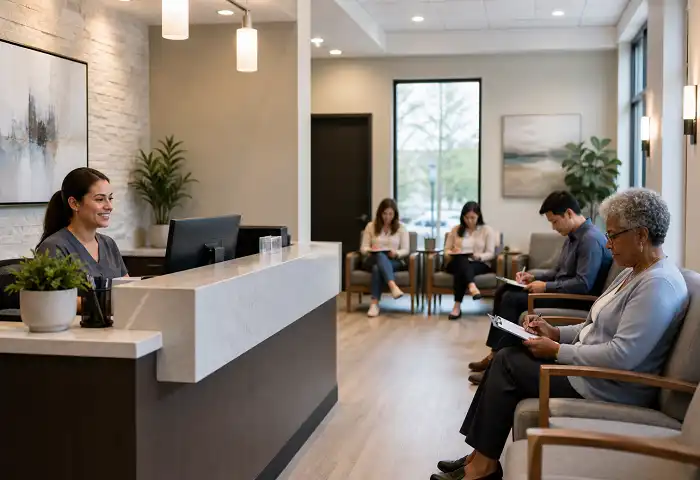
A mental health walk in clinic is an outpatient behavioral health facility that accepts patients without pre-scheduled appointments. Clinicians at these centers provide assessments, short-term counseling, psychiatric evaluation, and crisis stabilization.
These clinics sit between a therapist’s private office and a hospital emergency room. You don’t need a referral in most cases. You don’t need to wait weeks for an opening slot.
Common providers at a mental health walk in clinic include licensed professional counselors (LPCs), licensed clinical social workers (LCSWs), psychiatric nurse practitioners, and psychiatrists.
If you’ve been managing anxiety, depression, or emotional overwhelm, a walk-in clinic is often the fastest legitimate entry point into care.
Who Should Use a Mental Health Walk In Clinic?
These clinics serve people in a wide range of situations. You don’t have to be in a severe crisis to walk in.
Good reasons to visit a mental health walk in clinic:
- You’re feeling anxious or depressed and want to talk to someone today
- Your current symptoms are getting worse but you’re not in danger
- You ran out of psychiatric medication and need a bridge prescription
- You recently moved and haven’t established care with a new provider
- You were discharged from a hospital and need follow-up quickly
- You’re uninsured and need a low-cost or sliding-scale option
A mental health walk in clinic is not a substitute for emergency services. If you or someone else is in immediate danger, call 988 (the Suicide and Crisis Lifeline) or go to the nearest emergency room.
What Services Does a Mental Health Walk In Clinic Offer?
Services vary by location, but most mental health walk in clinics provide:
Assessment and Evaluation A clinician reviews your current symptoms, mental health history, and any medications you take. This initial screening helps determine the right level of care.
Crisis Stabilization For people experiencing acute distress, these clinics offer short-term stabilization without hospitalization. Staff help you de-escalate, create a safety plan, and connect you to ongoing services.
Psychiatric Medication Management A prescriber can evaluate whether medication is appropriate, adjust current prescriptions, or issue short-term refills until you connect with a regular psychiatrist.
Brief Counseling Many clinics offer one to three sessions of short-term therapy focused on coping skills, safety planning, or immediate problem-solving.
Referral Coordination Staff connect you to ongoing outpatient therapy, inpatient mental health treatment, or community programs depending on your needs.
How to Find a Mental Health Walk In Clinic Near You
Finding a mental health walk in clinic in your area takes a few direct steps.
Step 1: Search SAMHSA’s Treatment Locator Visit the SAMHSA behavioral health treatment locator and filter by “mental health” and your zip code. This database is federally maintained and updated regularly.
Step 2: Call 211 Dial 211 from any phone. This is a free social services hotline. Representatives will give you local mental health walk in clinic options, hours, and eligibility requirements.
Step 3: Check Community Mental Health Centers (CMHCs) CMHCs are publicly funded behavioral health organizations that commonly operate walk-in services. Search “[your county] community mental health center” to locate one nearby.
Step 4: Contact Your Insurance Company Call the member services number on your insurance card. Ask specifically for in-network mental health walk in clinics or urgent behavioral health services. This protects you from surprise billing.
Step 5: Ask Your Primary Care Doctor Primary care providers often know local behavioral health resources and can provide a warm referral, which sometimes speeds up your intake process.
What to Expect at Your First Visit

Knowing the process reduces anxiety about walking in for the first time.
Registration You’ll fill out intake paperwork covering your current symptoms, mental health history, medications, and insurance information. Bring your ID and insurance card.
Triage or Screening A staff member reviews your paperwork and asks a few questions to determine urgency. People in crisis are seen first. Non-urgent cases wait, sometimes 30 to 90 minutes depending on volume.
Clinical Assessment A licensed clinician meets with you privately. They ask about your symptoms, what triggered the visit, your support system, and your treatment history. Be honest. The more accurate your answers, the better the care plan.
Care Plan and Next Steps Before you leave, the clinician gives you a written plan. This might include a referral to ongoing therapy, a prescription, a safety plan, or a follow-up appointment. A mental health walk in clinic is often a starting point, not the full solution.
Insurance and Cost at a Mental Health Walk In Clinic
Most mental health walk in clinics accept:
- Medicaid – widely accepted at community-based clinics
- Medicare – covered at participating providers
- Private insurance – varies by network; verify before you go
- Self-pay / sliding scale – many nonprofit clinics adjust fees based on income
The Mental Health Parity and Addiction Equity Act requires most insurance plans to cover mental health services at the same level as physical health services. If your insurer denies a claim for a walk-in mental health visit, you have the right to appeal.
Uninsured patients should ask about Federally Qualified Health Centers (FQHCs). These federally funded clinics provide behavioral health care on a sliding-scale fee and cannot turn patients away based on inability to pay.
Mental Health Walk In Clinic vs. Emergency Room: Key Differences
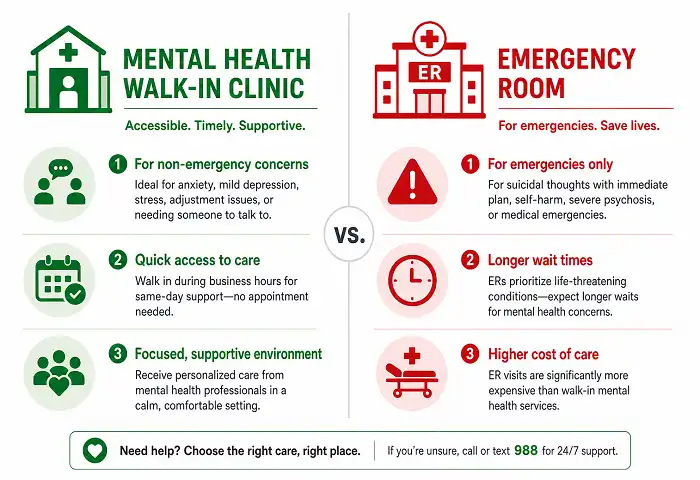
Many people default to the ER for a mental health crisis. That’s sometimes the right call, but not always.
| Situation | Go to Walk In Clinic | Go to ER |
|---|---|---|
| Feeling anxious or depressed | Yes | No |
| Panic attacks without physical symptoms | Yes | No |
| Medication refill needed urgently | Yes | No |
| Active suicidal ideation with plan | No | Yes |
| Psychotic episode with safety risk | No | Yes |
| Medical emergency alongside mental symptoms | No | Yes |
A mental health walk in clinic handles non-emergency behavioral health needs faster and at lower cost than an ER. Emergency rooms are equipped for medical stabilization, not ongoing psychiatric treatment.
If you’re managing a partial hospitalization or intensive outpatient transition, a walk-in clinic can also serve as a bridge between levels of care.
Common Mistakes to Avoid
Waiting too long to go. People often delay until symptoms are severe. A mental health walk in clinic is appropriate for moderate distress, not just crisis.
Not bringing medication information. Bring a list of all current medications, including dosages. Prescribers need this to avoid dangerous interactions.
Expecting ongoing therapy. Most walk-in clinics provide short-term support and referrals. If you need weekly therapy, ask them to connect you with a regular provider.
Assuming you need insurance. Sliding-scale and no-cost options exist. Never skip going because of assumed cost.
Going to the wrong facility. Urgent care clinics treat physical conditions. Confirm the clinic specifically offers behavioral health or psychiatric services before you go.
What Happens After Your Walk-In Visit?
The visit itself is the first step. What you do next determines your longer-term outcomes.
Follow through on every referral the clinician gives you. Call the recommended therapist or psychiatrist within 48 hours while motivation is high. Many referral slots get lost because people wait too long after discharge.
If you were given a safety plan, keep it somewhere accessible. Share it with one trusted person in your life.
If medication was prescribed, fill it promptly and take it as directed. Report any side effects to your prescriber quickly.
Check in with your primary care doctor and let them know you visited a mental health walk in clinic. Coordinated care produces better outcomes than siloed treatment.
Special Populations Served
Children and Adolescents Some mental health walk in clinics include child and adolescent psychiatric services. Bring a parent or legal guardian. Call ahead to confirm pediatric services are available.
Veterans VA-affiliated walk-in clinics and Vet Centers provide same-day mental health access for eligible veterans. Visit VA.gov or call your nearest VA facility for same-day mental health appointments.
Older Adults Geriatric behavioral health needs, including depression, grief, and cognitive changes, are addressed at many community mental health centers. If transportation is a barrier, ask about telehealth options offered alongside walk-in services.
LGBTQ+ Individuals Affirming behavioral health care matters. Ask the clinic whether staff have training in LGBTQ+-competent care. Many urban community mental health centers specifically serve this population.
If you’ve been seeking accessible and personalized care options, confirming that a clinic uses culturally informed practices will improve your experience.
Safety Notes
A mental health walk in clinic is a safe environment with licensed, supervised professionals. However, keep these points in mind:
- If your symptoms escalate while waiting, tell the front desk immediately. They will re-triage you.
- You have the right to ask who is treating you and what their credentials are.
- You can refuse treatment or leave at any time unless you pose a danger to yourself or others.
- All treatment is confidential except in situations where safety laws require disclosure.
If you or someone you’re with becomes unsafe during or after a visit, call 988 or 911.
Conclusion
A mental health walk in clinic removes two of the biggest barriers to getting help: time and complexity. You don’t need a referral, a scheduled slot, or weeks of waiting. You walk in, describe what you’re experiencing, and get professional support the same day.
Whether you’re dealing with anxiety, depression, a medication gap, or a moment of crisis that hasn’t reached emergency level, this type of clinic exists specifically for you. Start with SAMHSA’s locator or a call to 211, bring your ID and insurance card, and go.
Getting support is not weakness. It’s the most direct thing you can do for your health.