
Introduction
Tattoos have always been more than just ink on skin. For centuries, people have used body art to tell stories, mark milestones, and carry meaning with them every single day. In recent years, a quiet but powerful movement has grown within the tattoo community — one focused on mental health tattoo ideas that speak to personal struggles, survival, recovery, and the ongoing journey of healing.
If you have ever battled anxiety, depression, trauma, or any other mental health challenge, you already know how hard it is to put those experiences into words. That is exactly why so many people explore mental health tattoo ideas and turn to tattoo art. A single image, symbol, or phrase etched onto the skin can say what no conversation ever fully captures. It becomes a permanent reminder of how far you have come, a daily anchor in moments of doubt, or a quiet tribute to someone you have lost.
This guide explores over 40 mental health tattoo ideas, covering their meanings, placement options, styles, and the stories behind them. Whether you are considering your first tattoo or adding to a growing collection, you will find something here that speaks to your journey.
Why People Choose Mental Health Tattoos
Before diving into specific mental health tattoo ideas, it is worth understanding why people choose this form of expression in the first place.
For many, getting a mental health tattoo is a reclaiming act. After years of feeling defined by a diagnosis or a difficult period of life, the tattoo becomes a declaration: I went through this, and I am still here. It shifts the narrative from shame to strength.
For others, a mental health awareness tattoo serves as a coping tool. Therapists sometimes refer to this as an “anchor” — something grounding and tangible that a person can look at during a moment of crisis to remind themselves of their resilience. The physical act of glancing at the tattoo interrupts the thought spiral and brings the person back to the present.
Some people also choose mental health tattoo ideas to honor loved ones who struggle or who have been lost to suicide, addiction, or illness. In this way, the tattoo becomes a living memorial and a conversation starter that helps reduce stigma.
Research has consistently shown that reducing mental health stigma starts with open, normalized conversation. When someone wears their mental health journey visibly, it gives others permission to speak openly too. A small semicolon on a wrist or an anxiety tattoo on the forearm can open doors to meaningful connection.
The Most Popular Mental Health Tattoo Ideas
1. The Semicolon Tattoo
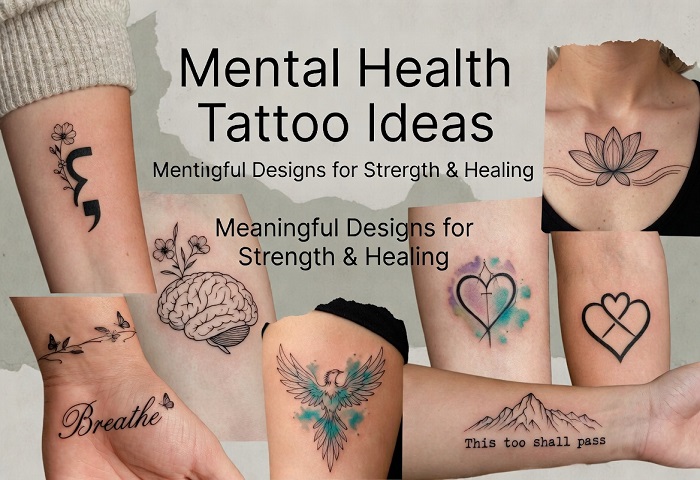
No list of mental health tattoo ideas is complete without the semicolon. Made famous by Project Semicolon — a nonprofit dedicated to suicide prevention and mental health awareness — the semicolon tattoo carries a deeply specific meaning.
In grammar, a semicolon is used when an author could have ended a sentence but chose not to. In the mental health world, the author is you, and the sentence is your life. The semicolon tattoo is a declaration that your story is not over.
This is one of the most recognized mental health awareness tattoo symbols in the world. It works beautifully as a minimalist design on the wrist, inner finger, or behind the ear. Many people incorporate it into larger pieces — combining it with butterflies, flowers, or meaningful words.
Placement ideas: Wrist, finger, ankle, behind the ear
Style options: Minimalist line art, watercolor, blackwork
2. Butterfly Mental Health Tattoo
The butterfly is a universal symbol of transformation. For people working through depression, trauma, or a life-altering mental health journey, a butterfly mental health tattoo represents emerging from a dark place into something new and free.
Butterfly tattoos are among the most versatile mental health tattoo ideas because they can be adapted to almost any style — delicate and fine-line for a subtle look, or bold and colorful for something more statement-making. Some people choose to combine the butterfly with a semicolon, blending two of the most recognized mental health symbols into one cohesive design.
Placement ideas: Shoulder blade, collarbone, forearm, upper back
Style options: Watercolor, blackwork, Neo-Traditional, fine line
3. “Still I Rise” or “I Am Enough” Tattoos
Word-based mental health tattoo ideas have soared in popularity, and for good reason. A meaningful phrase tattooed on the body becomes a mantra you can physically carry with you.
Some of the most popular phrases chosen for mental health tattoos include:
- Still I Rise (drawn from Maya Angelou’s iconic poem)
- I Am Enough
- Breathe
- This Too Shall Pass
- One Day at a Time
- Warrior
- You Are Not Alone
- Keep Going
These phrases work especially well as forearm tattoos, making them easy to see during moments of stress. A self-love tattoo with a simple affirmation can become one of the most powerful things you wear.
Placement ideas: Forearm, ribcage, collarbone, spine
Style options: Script lettering, serif fonts, handwritten style
4. Lotus Flower Tattoo
The lotus is one of the oldest and most meaningful symbols in human history. It grows in muddy, murky water yet blooms into something breathtakingly beautiful above the surface. That metaphor resonates deeply for anyone who has worked through mental illness — beauty rising from difficulty.
As one of the most spiritual mental health tattoo ideas, the lotus is especially meaningful for those recovering from trauma, addiction, or depression. It speaks to the idea that your struggles do not define your potential; they are simply where you grew from.
The lotus pairs beautifully with other healing symbols, watercolor washes of color, or mandala-inspired designs.
Placement ideas: Upper back, sternum, forearm, ankle
Style options: Geometric, watercolor, traditional, fine line
5. Anchor Tattoo for Mental Health
The anchor is a symbol of stability and groundedness. For people who struggle with anxiety, dissociation, or emotional dysregulation, an anchor tattoo carries a powerful message: I will not be swept away.
In therapeutic language, the anchor also represents grounding techniques used to manage anxiety and panic attacks. Getting an anchor as an anxiety tattoo idea is a way to visually represent that inner stability you are building — or the stable person in your life who keeps you rooted.
Placement ideas: Wrist, forearm, calf, ribcage
Style options: Traditional nautical, minimalist, neo-traditional
6. Mental Health Ribbon Tattoo
The green ribbon is the official symbol of mental health awareness. Incorporating a mental health ribbon tattoo into your body art is a direct and intentional statement of support, advocacy, or personal experience.
Green ribbon tattoos range from simple minimalist outlines to elaborate, decorative pieces incorporating florals, butterflies, or meaningful words. Some people choose to date their ribbon tattoo to mark a recovery milestone or a moment of particular significance in their mental health journey.
Placement ideas: Wrist, shoulder, behind the ear, upper arm
Style options: Minimalist, decorative, illustrative
7. Sun and Moon Tattoo
For people who live with bipolar disorder, borderline personality disorder, or any mental health condition that involves significant emotional highs and lows, the sun and moon tattoo can be deeply personal.
The sun represents clarity, energy, and light — the good days. The moon represents the darker, quieter, or more difficult cycles. Together, they acknowledge that both exist, and both are part of a complete and valid human experience. This balance is at the heart of many mental health tattoo ideas: the acknowledgment that healing is not linear.
Placement ideas: Shoulder, forearm, ribcage, back
Style options: Blackwork, celestial illustrative, geometric, watercolor
8. Arrow Tattoo
An arrow must be pulled backward before it can fly forward. This simple mechanical truth has made the arrow one of the most beloved mental health tattoo ideas for people who feel that their setbacks have set them up for something greater.
Arrow tattoos often appear alongside phrases like pulled back to launch forward or pulled back before flying. They work well as minimalist designs or incorporated into larger nature-themed sleeves.
Placement ideas: Forearm, spine, collarbone
Style options: Geometric, tribal-inspired, minimalist fine line
9. Phoenix Rising Tattoo
Few symbols carry the weight of rebirth quite like the phoenix — a mythical bird that burns to ash and rises again. For anyone who has hit rock bottom and found a way back up, a phoenix tattoo can represent exactly that experience.
As a mental health tattoo design, the phoenix is particularly meaningful for survivors of trauma, addiction recovery, or suicidal ideation. It is a bold declaration: I burned. I survived. I rose.
Phoenix tattoos tend to be larger, more elaborate designs — making them ideal for the back, chest, or upper arm.
Placement ideas: Back, chest, upper arm, thigh
Style options: Japanese traditional, neo-traditional, watercolor, illustrative
10. Mandala Tattoo
Mandalas are circular geometric designs rooted in Buddhist and Hindu traditions, representing wholeness, balance, and the universe. In the context of mental health tattoo ideas, mandala designs are often chosen for their calming, meditative quality.
Many people who practice mindfulness, meditation, or yoga as part of their mental health care choose mandala tattoos as a permanent reminder of their practice and their commitment to inner peace. A mindfulness tattoo in mandala form is both beautiful and deeply intentional.
Placement ideas: Sternum, shoulder, thigh, upper back
Style options: Dotwork, fine line, geometric blackwork
More Mental Health Tattoo Ideas to Consider
Beyond the top ten, there is a wide range of mental health tattoo ideas that carry significant meaning. Each of the following mental health tattoo ideas offers a unique way to express your personal journey:
Dragonfly tattoos symbolize resilience and adaptability — the ability to navigate life from multiple perspectives, which resonates for many mental health journeys.
Mountain tattoos represent the challenges you have climbed and the views that only come after hard ascents. They speak to overcoming obstacles in recovery and mental health treatment.
Wave tattoos capture the ebb and flow of mental health — the idea that emotions, like waves, come and go. They are especially meaningful for people practicing acceptance-based therapies like DBT or ACT.
Hummingbird tattoos represent joy, endurance, and the ability to find sweetness even in difficult circumstances. For people in recovery from depression, they carry a hopeful message.
Tree of life tattoos speak to rootedness, growth, and interconnection — meaningful for those who have found community and support in their healing.
Heartbeat line tattoos (the EKG-style line) represent being alive and fighting. Many people combine these with dates, names, or mental health symbols to create deeply personal designs.
Lotus and semicolon combinations are among the most meaningful mental health tattoo ideas because they bring together two powerful symbols into a single design.
Infinity symbol tattoos suggest that the journey continues — infinite potential, endless resilience.
Brain tattoo designs are gaining popularity among mental health advocates who want to directly acknowledge and destigmatize neurological and psychological experiences. Some incorporate flowers growing from or within a brain silhouette.
Wildflower tattoos represent untamed growth in unexpected places — a beautiful metaphor for surviving and thriving despite difficult conditions.
Placement Guide for Mental Health Tattoos
Choosing the right placement is just as important as the design itself when exploring mental health tattoo ideas. Here is a quick guide:
Visible placements (wrist, forearm, hand, neck) work well for tattoos meant as daily reminders or conversation starters. These are ideal for anchor tattoos, semicolons, or short phrases you want to see often.
Semi-visible placements (upper arm, collarbone, ankle, behind the ear) offer flexibility — visible when you choose, hidden when you need to be in professional settings.
Private placements (ribcage, sternum, spine, thigh, shoulder blade) are often chosen for deeply personal mental health tattoo designs. These are for you more than anyone else.
Tips for Getting Your Mental Health Tattoo
Take your time with the design. Unlike most purchases, a tattoo is permanent. Sit with your chosen mental health tattoo ideas for at least a few weeks before booking your appointment. The right design will feel just as meaningful two months from now as it does today.
Work with an artist who understands your vision. Not every tattoo artist specializes in fine line, watercolor, or script work. Research artists whose portfolio matches the style you are looking for.
Think about color vs. black ink. Black and grey tattoos tend to age more gracefully. Color tattoos can be stunning but may require touch-ups over time. Consider this, especially for detailed mental health tattoo designs.
Consider whether you want it to start conversations. A visible mental health awareness tattoo will, at times, prompt questions from strangers or colleagues. Some people love that — it becomes an opportunity to reduce stigma. Others prefer something more private. Both choices are completely valid.
Talk to your therapist or counselor. If you are currently in treatment for a mental health condition, it may be worth discussing your tattoo idea with your provider. Some therapists actively support the use of tattoos as part of a healing process; others may have helpful perspectives to share.
Aftercare matters. Proper tattoo aftercare ensures your design heals beautifully. Follow your artist’s instructions carefully, keep the area moisturized, and avoid sun exposure during the healing period.
Mental Health Tattoos as Part of Recovery
For many people, getting a mental health tattoo is not a casual decision — it is a milestone. It marks a moment in their recovery journey where they felt ready to own their story in a new way. Among all mental health tattoo ideas, recovery tattoos carry some of the deepest personal significance.
Therapists who work in trauma recovery or addiction treatment sometimes note that clients describe their tattoos as “turning points.” The act of choosing a design, sitting through the discomfort of the needle, and wearing the finished result can itself be an empowering experience. It puts agency back in the hands of someone who may have spent years feeling powerless over their mental health.
If you are in recovery from addiction, an anniversary tattoo marking a sobriety milestone is a particularly meaningful mental health tattoo idea. If you are a suicide attempt survivor, a semicolon, phoenix, or similar design can mark your survival in a way that feels both private and powerful.
Breaking Stigma Through Body Art
One of the most important things mental health tattoo ideas have done, collectively, is help normalize conversations about mental health in everyday settings. When someone notices a semicolon tattoo on a stranger’s wrist and asks about it, a story gets told. When someone posts their new mental health ribbon tattoo on social media, someone else who is struggling sees it and feels less alone.
Body art has always been culturally communicative. The mental health tattoo ideas movement takes that tradition and channels it toward something urgently needed: the destigmatization of mental illness. Every tattoo in this space is a small act of visibility, and collectively, those small acts add up to real cultural change.
Final Thoughts
Whether you are drawn to the minimalist elegance of a semicolon, the transformative power of a phoenix, the calming geometry of a mandala, or the simple grounding message of an anchor, there is a mental health tattoo idea out there that speaks to your specific journey.
The best tattoo is not necessarily the most artistic or the most complex — it is the one that means something real to you. It is the one you will look at during a hard day and feel even a fraction of the strength it represents. It is the one that says, in ink and in permanence: This happened. I am still here. And I am not done yet.
Take your time, choose your design with intention, and trust that your story — all of it, including the difficult parts — is worth wearing with pride.
Whether you are searching for your first mental health tattoo or adding to a collection of meaningful designs, remember: your journey is your own, and how you choose to tell it is entirely up to you.