
Introduction: Why Mental Health Coloring Pages Are More Powerful Than You Think
When was the last time you sat down, picked up a set of colored pencils, and just… breathed? Life moves fast. Notifications ping, deadlines loom, and the noise never really stops. That is exactly why mental health coloring pages have quietly become one of the most recommended self-care tools of the last decade — not just for children, but for adults navigating real emotional challenges.
Mental health coloring pages are not just pretty patterns printed on paper. They are deliberately designed therapeutic tools that tap into the brain’s natural calming response. Psychologists, counselors, and wellness coaches have begun recommending them as an accessible first step toward emotional regulation, stress relief, and even recovery from anxiety and depression.
In this guide, you will discover exactly what mental health coloring pages are, the science that makes them work, how to choose the right ones for your specific emotional needs, where to find free printable versions, and how to build a simple daily coloring practice that supports your overall mental wellness.
Whether you are brand new to coloring therapy or looking to deepen an existing habit, this article covers everything you need to know.
What Are Mental Health Coloring Pages?
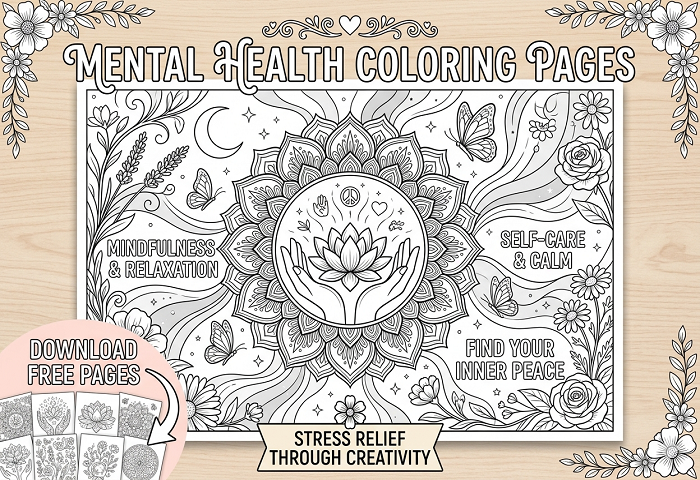
Mental health coloring pages are specially designed printable or digital coloring sheets that feature patterns, imagery, words, and scenes specifically chosen to support emotional and psychological well-being. Unlike standard coloring books for children, these pages are crafted with adult brains and adult stressors in mind.
They might include:
- Mandala patterns — circular geometric designs that encourage focus and symmetry
- Nature scenes — forests, oceans, and garden landscapes that evoke calm
- Affirmation-based designs — uplifting phrases surrounded by decorative illustrations
- Emotion wheels — visual tools that help people identify and express their feelings
- Abstract patterns — free-flowing shapes that allow for creative expression without judgment
- Gratitude journals in coloring form — prompts paired with doodle spaces
The key difference between standard coloring pages and mental health coloring pages is intention. Every element — the complexity of the design, the type of imagery, the words included — is selected to guide the person toward a more grounded, present, and emotionally aware state.
The Science Behind Coloring Therapy
You might wonder: can picking up a crayon really make a difference to your mental health? The short answer is yes, and there is real neuroscience behind it.
How Coloring Affects the Brain
When you engage in coloring, your brain enters a state similar to meditation. The repetitive, focused nature of filling in shapes and patterns activates the prefrontal cortex — the part of the brain responsible for logic and organization — while simultaneously quieting the amygdala, which is the brain’s fear and stress center.
This dual-activation is the key to why mental health coloring pages work so well. You are giving your analytical mind something simple and satisfying to focus on, which naturally crowds out anxious thoughts and overwhelming emotions.
A study published in the journal Art Therapy found that just 20 minutes of coloring mandalas significantly reduced anxiety levels in participants. Another body of research from the American Journal of Public Health highlighted that art-based activities, including therapeutic coloring, reduce cortisol levels — the primary stress hormone in the human body.
Coloring as a Form of Mindfulness
Mindfulness is the practice of being fully present in the current moment, without judgment. Mental health coloring pages create a natural mindfulness experience because the activity demands gentle attention. You focus on which color to choose, how hard to press, staying within lines (or not), and the visual outcome of your choices.
This focused awareness is almost identical to formal mindfulness meditation — but many people find it far more accessible, especially if sitting with a blank mind feels impossible during a period of high stress or grief.
Key Benefits of Mental Health Coloring Pages
Let us break down the specific mental and emotional benefits that consistent use of mental health coloring pages can provide.
1. Reduced Anxiety and Worry
Anxiety coloring sheets are among the most searched-for therapeutic tools online, and for good reason. The structured, repetitive action of coloring provides an anchor for a racing mind. Rather than spiraling through worst-case scenarios, your brain is gently redirected to the present task in front of you.
Many therapists now recommend mental health coloring pages as a between-session coping tool for clients with generalized anxiety disorder, social anxiety, and panic disorder.
2. Relief from Depression Symptoms
Coloring for depression works through a mechanism called behavioral activation — a core strategy in cognitive behavioral therapy (CBT). When depression makes it hard to feel motivated or engaged, small, achievable creative tasks like coloring can restart the brain’s reward pathways.
Completing a coloring page, no matter how simple, gives your brain a small hit of dopamine — the feel-good neurotransmitter. Over time, this can help break the cycle of withdrawal and low mood that defines depressive episodes.
3. Better Sleep Quality
Many people struggle to switch off before bed. Scrolling through a phone, watching intense content, or lying awake with anxious thoughts are all common nighttime habits that wreck sleep quality. Replacing screen time with mental health coloring pages in the hour before bed can significantly improve your ability to fall asleep and stay asleep.
The soft focus required for coloring signals to the nervous system that it is time to wind down, without the blue light exposure of a screen.
4. Emotional Expression Without Words
Sometimes emotions are too raw, too complex, or too confusing to put into words. This is where mental health coloring pages shine. The act of choosing colors — whether you reach for dark blues, bold reds, or soft pastels — is itself a form of emotional expression. Art therapists often observe that the colors clients choose and the pressure they apply when coloring reveal a great deal about their inner emotional state.
You do not have to explain anything. You just color.
5. Building a Consistent Self-Care Routine
Self-care does not have to be expensive or time-consuming. A stack of mental health coloring pages and a basic set of colored pencils is all you need to establish a daily practice that supports your emotional health. The accessibility and affordability of this tool makes it one of the most democratizing wellness practices available today.
Mental Health Coloring Pages for Different Emotional Needs
Not all mental health coloring pages are created equal. Here is how to choose the right type based on what you are working through.
For Stress and Overwhelm: Complex Geometric Patterns
If you are stressed and your mind is on overdrive, you actually benefit most from intricate, detailed designs — like mandalas or tessellations. The complexity demands enough attention to genuinely pull your focus away from stressors, without being so difficult that it creates frustration.
Stress relief coloring pages with detailed geometric patterns are widely available online as free printables and have been shown in multiple studies to produce the greatest reduction in anxiety scores compared to simpler designs.
For Grief and Sadness: Nature and Landscape Scenes
When you are grieving or feeling low, gentle imagery works best. Soft forest scenes, flowing rivers, blooming flowers — these images carry inherent emotional comfort. Therapeutic coloring pages with nature themes help activate the brain’s restorative mode, which is associated with reduced rumination and improved mood.
For Anger and Frustration: Bold, Energetic Designs
Large shapes, strong lines, and designs that invite heavy, bold coloring can actually serve as a healthy outlet for anger and frustration. The physical act of pressing hard with a marker or crayon on an expressive design mirrors the need to release pent-up energy in a safe, constructive way.
For Children’s Mental Health: Age-Appropriate Coloring Sheets
Mental health coloring pages for kids use simpler designs paired with emotion-identifying prompts. They might feature cartoon faces showing different feelings, with space to color the face that matches how the child feels. These pages are powerful tools for parents, teachers, and school counselors working to build emotional literacy in young children.
When kids learn to identify and name their emotions through coloring, they develop the self-awareness that forms the foundation of long-term emotional intelligence.
For Trauma Recovery: Grounding and Body Awareness Pages
Trauma-informed mental health coloring pages often incorporate body-mapping activities — outlines of the human body where individuals can color in where they feel emotions physically. This technique, used in somatic therapy, helps trauma survivors reconnect with their bodies safely and at their own pace.
Free Printable Mental Health Coloring Pages: Where to Find Them
One of the best things about mental health coloring pages is that you do not need to spend money to get started. Hundreds of high-quality free printable coloring pages are available online, created by therapists, wellness educators, and artists who want to make coloring therapy accessible to everyone.
Here are some of the best sources for free printable mental health coloring pages:
Therapist-Created Resources: Many licensed therapists share free anxiety coloring sheets and depression-focused coloring pages on their practice websites and mental health blogs. A simple Google search for “free mental health coloring pages printable PDF” will return dozens of quality results.
Pinterest: Pinterest is a goldmine for free printable coloring pages. You can search directly for terms like “mental health mandala coloring pages,” “anxiety relief coloring sheets free,” or “therapeutic coloring pages for adults” and find thousands of downloadable options.
Teachers Pay Teachers: While many resources here require purchase, a large number of mental health coloring pages are available for free download, particularly those designed for classroom use.
Calm and Mindfulness Apps: Several mindfulness and meditation apps now include digital coloring features specifically designed as emotional regulation tools.
NHS and Mental Health Charity Websites: In many countries, national health and mental health organizations distribute free coloring resources as part of broader wellness campaigns.
When downloading free printable mental health coloring pages, look for high-resolution files (300 DPI or higher) so they print cleanly on standard printer paper.
How to Build a Daily Coloring Practice for Mental Health
Having the pages is one thing. Turning coloring into a consistent habit that genuinely supports your mental health requires a little intentionality.
Step 1: Set a Dedicated Time
Decide when you will color. Morning coloring can set a calm, focused tone for the day ahead. Evening coloring helps decompress after a long day and prepares the mind for sleep. Even ten to fifteen minutes makes a real difference.
Step 2: Create a Calming Space
Your environment matters. Designate a quiet corner, clear a table, light a candle, play soft background music, or make a cup of herbal tea. Treating your coloring practice as a ritual signals to your brain that this is sacred recovery time — not just a hobby.
Step 3: Choose Your Pages Intentionally
Before you sit down, take a moment to check in with how you are feeling. Then choose a mental health coloring page that matches your emotional need. Are you anxious? Reach for a detailed mandala. Are you sad? Try a soft nature scene. Are you overwhelmed? Pick something simple and soft.
Step 4: Ditch Perfectionism
This is not an art competition. There is no wrong color, no wrong technique, no wrong result. The therapeutic benefit of mental health coloring pages comes from the process, not the product. Let yourself scribble outside the lines. Use unexpected colors. It does not matter. What matters is that you showed up for yourself.
Step 5: Reflect Afterward
After coloring, take two minutes to journal or simply notice how you feel compared to when you started. Most people find even a single session of coloring therapy noticeably shifts their emotional state. Over time, tracking this shift builds confidence in the practice and reinforces the habit.
Mental Health Coloring Pages in Therapeutic Settings
It is worth noting that mental health coloring pages are not just a DIY wellness tool. They are actively used by trained mental health professionals in clinical settings.
Art therapists use coloring pages as warm-up activities before deeper emotional processing work. School counselors distribute mental health coloring pages during high-stress periods such as exam season. Occupational therapists working with adults recovering from trauma or chronic illness incorporate coloring therapy as part of sensory and cognitive rehabilitation.
In group therapy settings, coloring together creates a sense of shared community and reduces the social anxiety that can make traditional talk therapy feel intimidating. The pages become a bridge — something tangible and non-threatening to focus on while difficult conversations unfold around it.
Common Myths About Mental Health Coloring Pages
Despite growing evidence and clinical acceptance, a few misconceptions about mental health coloring pages still circulate. Let us clear them up.
Myth 1: “Coloring is just for kids.”
This is perhaps the most common barrier adults face. In reality, adult coloring books became a global publishing phenomenon over the last decade precisely because adults found them so effective for stress relief and relaxation. The designs created specifically for mental health coloring pages are sophisticated, nuanced, and designed for adult nervous systems.
Myth 2: “You have to be artistic.”
You do not need any artistic ability whatsoever. Coloring is not about creating art — it is about the act of putting color on paper. No talent required.
Myth 3: “It is not real therapy.”
While coloring alone is not a substitute for professional mental health treatment, it is a legitimate therapeutic tool. The research supporting its efficacy is real and growing. It is one of many complementary approaches that can support overall mental wellness.
Myth 4: “It only works for mild stress.”
Many people with clinical anxiety, PTSD, and depression report meaningful relief from regular coloring practice. It is not a cure, but it is a powerful, accessible coping skill that works alongside other treatments.
Tips for Getting the Most Out of Mental Health Coloring Pages
Here are a few expert-backed tips to maximize the therapeutic value of your practice:
Use quality materials. You do not need expensive supplies, but smooth paper and decent colored pencils or fine-line markers make the experience more satisfying. The sensory pleasure of the activity contributes to its calming effect.
Try watercolor coloring pages. A newer category of mental health coloring pages is designed for watercolor application. The fluid, unpredictable nature of watercolor adds an additional layer of meditative release that many people find deeply soothing.
Combine with breathing exercises. Try taking three deep, slow breaths before you begin coloring. This activates the parasympathetic nervous system and primes your body for relaxation, making the coloring practice even more effective.
Share with others. Coloring does not have to be a solo activity. Coloring with a friend, partner, or child while talking softly is a beautiful, low-pressure way to connect. Some people find that mental health coloring pages open up conversations that might be harder to have face-to-face without the gentle distraction of a shared activity.
The Future of Mental Health Coloring Pages
The intersection of technology and mental wellness is expanding the reach of mental health coloring pages in exciting ways. Digital coloring apps designed specifically for anxiety and mood management are growing in popularity. AI-generated coloring pages personalized to an individual’s emotional state are beginning to emerge. Mental health platforms are integrating coloring tools into their suite of digital wellness resources.
Yet there is something irreplaceable about printing a page, sitting down with physical pencils and markers, and making marks on real paper. The tactile dimension of traditional coloring therapy — the feel of paper, the pressure of the pencil, the sound of color moving across the page — is part of why it works so well.
As awareness of mental health grows globally, mental health coloring pages are likely to become an even more widely adopted tool — in schools, workplaces, healthcare settings, and homes around the world.