
Introduction
Finding the right mental health care in America has never been simple. Long waitlists, confusing insurance networks, disconnected providers, and a persistent shortage of behavioral health professionals have created a system that frequently fails the people who need it most. Quartet mental health stepped into that gap with a fundamentally different approach — one that uses technology, data, and coordinated care to connect people to behavioral health services faster, smarter, and more effectively than the traditional system allows.
If you have encountered the name Quartet mental health while searching for behavioral health support, researching your health plan options, or simply trying to understand the landscape of modern mental healthcare, this guide covers everything you need to know. From how the platform works and who it serves, to its landmark acquisition by NeuroFlow in early 2025 and what that means for patients today — this is the most complete, up-to-date resource available.
What Is Quartet Mental Health?
Quartet mental health, formally known as Quartet Health, is a behavioral healthcare technology and care coordination company founded in 2014 by Arun Gupta and Steve Shulman in New York City. At its core, the platform is built around a powerful and simple insight: mental health care and physical health care are deeply interconnected, yet the systems meant to deliver them operate in separate, often uncommunicating silos. The result is fragmented care, unnecessary hospitalizations, poor outcomes, and enormous untreated need.
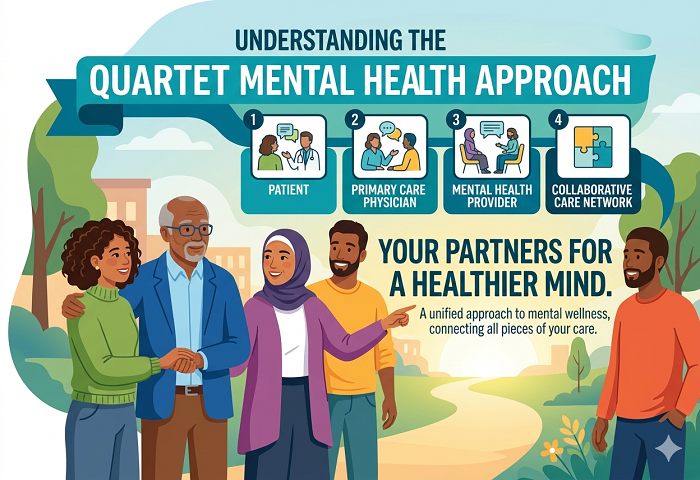
The name itself carries meaning. The name signals its foundational vision: four key stakeholders working in harmony — the patient, the behavioral health provider, the primary care provider, and the payer. When these four parties communicate fluidly, share clinical data, and coordinate their actions, outcomes improve dramatically. When they operate in isolation, patients fall through the cracks.
This platform is not a standard therapy app. It does not sell therapy subscriptions directly to consumers. Instead, it operates as a behavioral health care coordination and enablement platform — a sophisticated layer between health plans, health systems, primary care physicians, and mental health specialists that makes the connections between them faster, smarter, and more clinically effective.
More than two-thirds of people with mental illness also have at least one medical condition. Yet those two health issues are typically treated in separate, siloed systems that are difficult for patients to navigate and often result in fragmented care delivery. That challenge is precisely the problem this platform was designed to solve.
How Quartet Mental Health Works: The Four-Stage Model
Understanding Quartet mental health requires looking at how it actually functions in practice. The platform operates through four interconnected stages, each essential to delivering integrated, coordinated behavioral care.
Stage 1: Identification Through Data
The process begins with data. Quartet mental health leverages claims data, electronic health records (EHRs), and screening results to identify patients who may have unmet behavioral health needs or undiagnosed comorbid conditions. This predictive model is one of the most powerful aspects of the platform — rather than waiting for a patient to self-identify and seek help (which many people with mental illness never do), the system proactively surfaces individuals who need support but are not yet receiving it.
This shift from reactive to proactive care is significant. In a traditional system, a person with untreated depression may not receive help until they appear in an emergency room or primary care visit with acute symptoms. The platform aims to identify that person weeks or months earlier, connecting them with care before the situation becomes a crisis.
Stage 2: Navigation and Matching
Once a patient is identified — whether through predictive analytics, a physician referral, or a health plan flagging — the care team provides what the company calls “white-glove navigation.” A dedicated care navigator helps the patient find the right provider, manage referrals, address barriers like insurance coverage and scheduling, and coordinate with their existing primary care team.
The SmartMatch Technology at the heart of this system connects individuals with appropriate mental health professionals based on clinical needs, patient preferences — such as in-person versus telehealth, specific therapeutic approaches, and language — and current provider capacity. Insurance alignment is a critical part of this matching process. One of the most common reasons people fail to follow through on a mental health referral is discovering that their chosen therapist is out of network. Quartet mental health builds this verification into the matching process from the start.
Stage 3: Direct Care Delivery
The platform does not only connect patients — it also delivers care directly. Through its telebehavioral health services and its network of clinical partners, patients can receive therapy, medication management, and psychiatric consultation via the platform. This is particularly important for patients in rural or underserved areas where in-person behavioral health providers are scarce.
For patients with serious mental illness (SMI), the company developed a Whole Health model that coordinates both physical and behavioral health services alongside social support — housing assistance, transportation, community resources — under value-based payment arrangements. The partnership with Clover Health to launch this Whole Health program was designed specifically to serve patients with SMI who average at least four chronic conditions and more than five different prescribing providers. One in five of these patients had not seen a primary care physician in the prior year. One in three had not seen a behavioral health provider.
Stage 4: Measurement and Continuous Improvement
Quartet mental health tracks outcomes continuously — not just volume of referrals completed, but actual clinical improvement, cost savings, and care utilization. This measurement-based approach creates a feedback loop: better data leads to better matching, which generates better outcomes, which in turn informs future care design and provider performance.
This commitment to measurement sets it apart from many care coordination platforms. Rather than counting the number of referrals generated, it asks whether those referrals actually resulted in improved patient health — and uses that answer to continuously refine the model.
Who Does Quartet Mental Health Serve?
The platform operates as a business-to-business platform, which means it primarily serves institutional partners rather than individual consumers directly. The three main groups it works with are health plans, health systems, and community mental health centers.
Health plans and payers use the service to improve behavioral health outcomes for their members, reduce unnecessary emergency department utilization and hospitalizations, and manage the total cost of care more effectively. When a member with untreated depression receives timely, appropriate behavioral health care, the downstream medical costs — fewer ER visits, fewer inpatient stays, better management of comorbid conditions — are significantly reduced. Quartet mental health has built its value proposition around demonstrating this cost reduction alongside clinical improvement.
Independence Blue Cross, one of the largest not-for-profit health insurance organizations in Pennsylvania, is among the most high-profile health plan partners of Quartet mental health. The relationship has continued through the NeuroFlow acquisition, with Dr. Richard Snyder, Executive Vice President at Independence Blue Cross, stating that the collaboration has proven “incredibly impactful in terms of improving outcomes for our patients and driving significant reductions in the total cost of care per patient.”
Health systems and hospitals partner with the platform to strengthen their behavioral health referral pipelines, improve care coordination between primary care and psychiatry, and reduce the frequency of patients falling through the cracks between a referral and an appointment. Primary care physicians diagnose a significant proportion of behavioral health conditions but often lack the time and tools to follow up on those diagnoses. This service provides that follow-through infrastructure.
Employers increasingly use this service as part of workforce mental health support programs. The COVID-19 pandemic accelerated employer awareness of the connection between employee mental health and productivity, absenteeism, and retention. Embedding this care coordination service within an employer-sponsored health plan gives workers a faster, easier path to behavioral health care.
For individuals, the experience of Quartet mental health depends on their entry point into the system. A patient whose primary care physician refers them to the platform receives care navigation support. A member of a health plan that partners with Quartet mental health may be proactively contacted when screening data suggests unmet behavioral health need. In all cases, the patient experience is designed to reduce friction — less navigating confusing provider directories, fewer insurance verification headaches, shorter waits from referral to first appointment.
The NeuroFlow Acquisition: What Happened and Why It Matters
In January 2025, the platform reached a major inflection point. NeuroFlow, a Philadelphia-based behavioral health technology company, acquired Quartet Health in a deal that closed at the end of January 2025. Around the same time, Quartet’s telepsychiatry subsidiary, InnovaTel, was separately acquired by Iris Telehealth.
The acquisition represented a strategic combination of complementary capabilities. NeuroFlow’s technology and analytics platform integrates behavioral health into physical health workflows and tracks care quality and risk management. Quartet brings an extensive behavioral health provider network, sophisticated referral management infrastructure, value-based care enablement expertise, and a patient navigation model that has been refined over a decade.
“By bringing Quartet and its customers onto our platform, we will accelerate our goal of making behavioral health care more accessible, personalized, and effective,” said NeuroFlow CEO Chris Molaro at the time of the acquisition. For patients and partners, the transition means expanded capabilities and reach rather than a disruption in service.
The acquisition also followed NeuroFlow’s 2024 purchase of Owl Health, which added measurement-based care software to its capabilities. With Quartet mental health now integrated, NeuroFlow has assembled a comprehensive behavioral health platform that spans risk identification, care navigation, direct care delivery, and outcome measurement — the full continuum that Quartet mental health was built to enable.
Quartet Health raised a total of $216.5 million across multiple funding rounds during its decade as an independent company. Investors included Google Ventures, Oak HC/FT, Independence Blue Cross, and Deerfield. The company operated across 39 states at the time of acquisition, a national footprint that NeuroFlow immediately inherited and continues to expand.
The Broader Context: Why Quartet Mental Health Matters Now
To fully appreciate the value of what Quartet mental health does, it helps to understand the scale of the mental health crisis it is operating within.
According to the World Health Organization, roughly 1 in 8 people worldwide currently live with a mental disorder. In the United States, nearly 1 in 5 adults experience a mental illness each year. A staggering 55% of those adults receive no treatment whatsoever. The reasons are familiar: cost, stigma, provider shortages, geographic barriers, insurance complexity, and the particular cruelty of mental illness — that it often reduces a person’s capacity to navigate the exact systems they need to access.
More than two-thirds of people with mental illness also have at least one chronic physical health condition. Diabetes, heart disease, hypertension, and obesity are all significantly more prevalent among people with serious mental illness. These conditions worsen in the absence of coordinated care. Life expectancy for someone with serious mental illness is, on average, 10 to 20 years shorter than the general population — largely due to preventable physical health complications that go unmanaged because the behavioral health and primary care systems are not talking to each other.
This is the structural problem the platform was designed to address. It is not a wellness app. It is not a meditation platform. It is a healthcare infrastructure company that operates in the space between siloed systems — the gap through which millions of people currently fall — and builds bridges across it.
The behavioral health technology market itself is growing rapidly. North America’s digital psychiatric tools market was valued at $2.90 billion in 2024 and is projected to reach $10.60 billion by 2034, a compound annual growth rate of 13.8%. This company operates at the center of that growth, with a model refined through years of implementation and a now-expanded platform under NeuroFlow’s ownership.
What Sets Quartet Mental Health Apart from Competitors
The landscape of mental health technology is crowded. Understanding what distinguishes Quartet mental health from other players requires looking at both the model and the market positioning.
Spring Health provides employer-focused behavioral health benefits with AI-driven assessment and a wide provider network. It competes in the employer space but focuses more on direct-to-employee consumer experience rather than health system integration.
Headway operates primarily as a provider credentialing and billing platform, helping therapists accept insurance and giving patients access to in-network providers. It solves a real problem but operates at a different layer of the care system than Quartet mental health.
Ginger (now Headspace Health) focuses on workplace mental health coaching and therapy via a consumer app. It competes in the employer wellness space but does not offer the deep health system integration and value-based care infrastructure that defines this platform.
What truly differentiates Quartet mental health is the combination of three things most competitors do not offer simultaneously: deep health system integration (working within existing EHR workflows rather than building parallel ones), a value-based care model (taking accountability for outcomes and total cost of care, not just engagement metrics), and a Whole Health approach for serious mental illness that addresses both physical and behavioral needs together. This combination makes Quartet mental health particularly valuable to health plans and health systems rather than primarily to employers or individual consumers.
Patient Experience: What It Feels Like to Use Quartet Mental Health
For someone navigating this system as a patient, the experience is designed to feel notably different from the frustrations that typically accompany seeking mental health care.
One patient described the experience this way in a public testimonial: “The entire process was so simple and stress-free. I didn’t have to do anything other than answer a few questions. My provider was also a good match and very easy to talk to. I’ve already had three sessions, and each one was better than the last.”
That frictionless quality — the “simple and stress-free” aspect — is the direct result of the coordination infrastructure that Quartet mental health has built. The insurance verification is handled upfront. The provider matching takes clinical fit and patient preferences into account. The Care Navigator stays involved as a point of contact if anything needs adjusting. For people who have previously tried to find a therapist by sifting through an insurance directory, calling through a list of numbers, and encountering provider after provider who is not accepting new patients, this experience represents a genuine and meaningful improvement.
The platform has aimed to reduce wait times from the industry average of weeks or months down to days or even hours in some markets. This speed matters enormously in mental health, where delayed care often means worsening symptoms, crisis escalation, and eventual higher-acuity and higher-cost intervention.
Another healthcare provider partner noted: “Quartet has allowed us to coordinate care with our patients’ referring providers in an easy and streamlined way. Partnering with Quartet not only increases the quality of care we provide, but also allows us to have an additional reliable referral source.” That dual benefit — better quality and a more reliable pipeline — captures the value the platform delivers on both the patient and provider side.
Challenges and Honest Limitations
No honest guide to Quartet mental health should present it without acknowledging the genuine challenges and limitations of what it does.
Provider shortage is a systemic constraint that technology alone cannot fully solve. Even with excellent matching algorithms and navigation support, if there are not enough psychiatrists, therapists, and behavioral health providers who accept insurance in a given market, wait times remain. The platform can optimize the matching and referral process, but it cannot manufacture providers where the workforce pipeline has not produced them.
Value-based care payment models — which are central to this business model — are complex to implement and still evolving across the US healthcare system. Getting health plans and health systems to accept shared risk, agree on outcome benchmarks, and build the infrastructure for data sharing requires sustained organizational effort and trust-building that takes time.
Data interoperability is another ongoing challenge for this platform and every health technology company that depends on information flowing between systems. Ensuring that patient data moves securely and appropriately between EHR systems, payers, and behavioral health providers requires solving both technical and regulatory problems simultaneously.
Some patients may be reluctant to engage with technology-driven referral pathways or may not respond to outreach from care navigators. Building trust with populations that have historically been underserved or mistrustful of the healthcare system requires human-centered approaches that go beyond what algorithms can deliver on their own.
The Road Ahead for Quartet Mental Health Under NeuroFlow
This acquisition by NeuroFlow creates a more comprehensive behavioral health platform than either company could have built alone. NeuroFlow’s AI-powered analytics and care coordination workflows now combine with Quartet’s extensive provider network, referral management capabilities, and decade of value-based care experience.
The combined organization serves a national footprint of payers, health systems, and federal government partners. Its capability set — spanning risk identification, care navigation, direct care delivery, and outcome measurement — represents the most complete end-to-end behavioral health solution currently available at scale in the US market.
For patients, the practical implications are continued and expanding access to behavioral health services through their health plans and health systems. For health plan partners, the combination of NeuroFlow’s analytics and Quartet’s care coordination network means more sophisticated identification of unmet need and more efficient pathways to appropriate care.
Quartet mental health‘s Care Connections platform adds a large network of referral options that enhances care accessibility for NeuroFlow’s existing customers. In return, NeuroFlow’s analytics capabilities strengthen the predictive models that allow the platform to identify and proactively reach patients with unmet behavioral health needs.
The vision articulated when the acquisition was announced — making behavioral health care more accessible, personalized, and effective — is the same vision that animated Quartet mental health from its founding in 2014. What has changed is the scale and sophistication of the tools available to pursue it.
Closing Thoughts
Mental health care in America has a structural problem that cannot be solved by individual willpower, better apps, or awareness campaigns alone. The silos between physical health, behavioral health, and the insurance systems that fund both are too deep and too institutionalized to be dissolved by anything short of deliberate, well-funded, technology-enabled infrastructure change.
Quartet mental health is one of the most serious attempts in the digital health sector to build that infrastructure. By connecting the four players that must work in harmony for mental health care to actually function — patients, behavioral health providers, primary care physicians, and payers — it addresses the coordination failure at the heart of the system’s dysfunction.
As Quartet mental health continues its work under NeuroFlow’s ownership, expanding into new markets and serving more patients across more health plans and health systems, it remains a model worth understanding — both for what it has already achieved and for what it represents about where the behavioral healthcare system must go.
For anyone navigating their own path through the mental health system, the clearest message from the Quartet mental health story is this: the barriers you face are real, structural, and not your fault. And platforms like this one exist specifically to help you find a way through them.