
Introduction
There is something quietly powerful about a person who decides to wear their story permanently on their skin. A mental health awareness tattoo is not just body art. It is a declaration, a memorial, a conversation starter, and for many people who have survived the darkest moments of their lives, it is proof — visible, indelible, carried everywhere — that they made it through. As conversations around depression, anxiety, suicide prevention, and emotional wellbeing have steadily moved from whispered shame into open, necessary dialogue, the mental health awareness tattoo has grown into one of the most meaningful and widely recognized forms of advocacy that exists today.
This guide covers everything you need to know about getting a mental health awareness tattoo — the symbols and what they mean, the histories behind them, how different designs speak to different experiences, and how to choose the right one for your own story. Whether you are a survivor, an advocate, someone who has lost a loved one to mental illness, or simply someone who wants to carry a reminder of strength and hope with you wherever you go, this is the article for you.
Why People Choose a Mental Health Awareness Tattoo
Before exploring specific designs, it is worth understanding the deeper reason why someone would permanently ink a symbol of mental health onto their body. The answer goes beyond aesthetics, and it goes beyond trend.
Tattoos have been used across virtually every human culture throughout recorded history to mark moments of transformation, identity, loss, and belonging. The mental health awareness tattoo fits squarely into that ancient tradition. For someone who has battled depression and found their way back to living, a tattoo marks that journey in a way that a journal entry or a social media post simply cannot. It is there in the morning when they look in the mirror. It is there during the hard days, when they need a reminder most. It goes with them into every room.
For others, a mental health awareness tattoo is an act of solidarity. Not every person who wears one has struggled personally with mental illness. Many wear these symbols in memory of a parent, a friend, a sibling, or a partner who fought and lost. These tattoos become memorials that are carried in the most literal sense — on the body, close to the heart.
There is also a social function that should not be underestimated. A visible mental health awareness tattoo invites conversation. Strangers notice. Questions get asked. And in those small, unexpected exchanges, stigma gets chipped away. One woman who lost her husband to bipolar disorder described a moment when a waitress noticed her semicolon tattoo and said simply: “I like your tattoo.” In two seconds, with four words, two people acknowledged a shared understanding of something enormous and unspeakable. That is what a mental health awareness tattoo can do.
The Semicolon: The Most Recognized Mental Health Awareness Tattoo in the World
No discussion of the mental health awareness tattoo is complete without starting here. The semicolon tattoo is arguably the single most recognized symbol of mental health advocacy in the modern era, and its story is one of extraordinary human courage.
In grammar, a semicolon is used when a writer could have ended a sentence but chose not to. That simple mechanical function became a metaphor for survival when Amy Bleuel founded Project Semicolon in 2013. Bleuel had lived through childhood abuse, depression, addiction, and the suicide of her father. Rather than letting that pain define her ending, she chose to use it as a beginning — founding a nonprofit organization with a mission to “present hope and love for those who are struggling with mental illness, suicide, addiction, and self-injury.”
The message Project Semicolon attached to the semicolon tattoo is as simple and as profound as anything in recent mental health advocacy: “The author is you, and the sentence is your life.” Getting a semicolon tattooed on your body is choosing not to end your story. It is a statement that more is coming, even when everything inside you is telling you it is over.
The movement became globally visible around 2015, when photos of semicolon tattoos flooded social media platforms. People who had never publicly spoken about depression, anxiety, or suicidal thoughts were rolling up their sleeves and photographing a tiny punctuation mark inked onto their wrists, their ankles, behind their ears. The response was overwhelming. Tattoo artists began donating their time to offer free semicolon tattoos on April 16 — the date Project Semicolon became an official nonprofit, now observed as World Semicolon Day.
In 2017, the movement gained even broader recognition when Selena Gomez, Tommy Dorfman, and Alisha Boe — cast members of the Netflix series 13 Reasons Why — each got a semicolon tattoo in an act of public solidarity with the mental health community. The American Journal of Psychiatry acknowledged the phenomenon, noting that the semicolon tattoo had become clinically significant — something healthcare providers should recognize and understand as a meaningful communication from patients about their histories.
Tragically, Amy Bleuel herself died by suicide in March 2017. She was 31. Her death was a heartbreaking reminder of the relentless, unpredictable nature of mental illness — that even the person who built a global movement around survival and hope was not immune. But it did not end what she started. Project Semicolon continues, and the semicolon tattoo continues to be one of the most requested mental health awareness tattoo designs in parlors around the world.
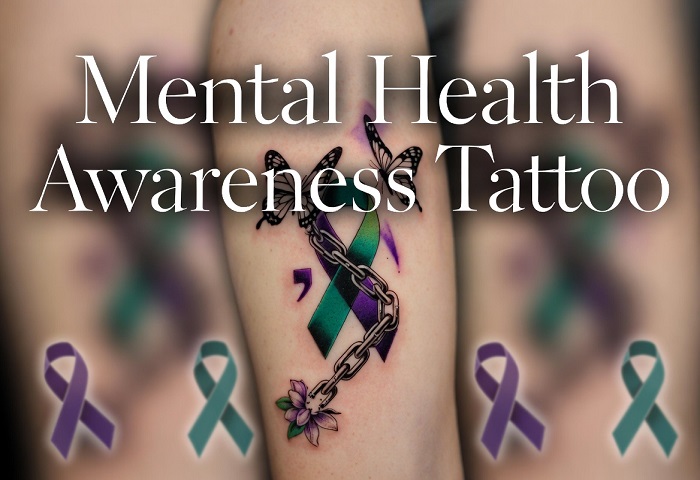
Common semicolon tattoo designs include the standalone mark — simple, minimal, quietly powerful — placed on the wrist, inner forearm, or behind the ear. Many people combine the semicolon with other images: a heart, a butterfly, an infinity symbol, a lotus flower, or a short phrase like “Still Breathing,” “Keep Going,” or “My Story Isn’t Over.” Each addition layers new personal meaning onto the original symbol while remaining rooted in the movement’s message of hope.
The Green Ribbon: The International Mental Health Awareness Tattoo Symbol
If the semicolon tattoo is the most personal of mental health symbols, the green ribbon is the most institutional — and for good reason. The green ribbon is the internationally recognized symbol of mental health awareness, functioning similarly to the pink ribbon for breast cancer or the red ribbon for HIV/AIDS advocacy. A mental health awareness tattoo featuring the green ribbon declares solidarity with the entire community of people affected by mental illness, whether personally or through someone they love.
The shade is typically kelly green — bright, vital, alive — like a leaf in spring. It is a color associated with growth and renewal, which makes it particularly fitting for a movement centered on recovery and hope. People choose this mental health awareness tattoo for varied reasons: some have been diagnosed with depression, anxiety, bipolar disorder, PTSD, or another condition; others wear it as a tribute to loved ones who struggled; still others wear it as pure advocacy, a public commitment to fighting stigma.
The green ribbon translates beautifully into tattoo art. On its own, a small ribbon is understated and elegant. Many tattoo artists incorporate it into larger designs — as the stem of a flower, woven into a butterfly’s wings, alongside text, or integrated into a mandala. Some choose color-filled ribbon designs; others prefer a minimal black-line version. Whatever the style, the green ribbon mental health awareness tattoo carries immediate recognition within the community and often opens exactly the kind of conversation the wearer hopes to spark.
The Butterfly: Transformation, Recovery, and Resilience
Butterflies have been symbols of transformation in human culture for thousands of years, and nowhere does that symbolism feel more earned than in the context of mental health. The butterfly begins its existence as a caterpillar — crawling, vulnerable, earth-bound — before retreating into the darkness of a cocoon and emerging, completely transformed, capable of flight. That journey maps almost too perfectly onto the experience of someone working through depression, trauma, addiction, or any prolonged mental health struggle.
A butterfly mental health awareness tattoo speaks to the process of becoming. It honors the hard work of therapy, the courage of asking for help, the painful in-between period when nothing feels like it is working, and the gradual, often unexpected moment when something shifts. For survivors, a butterfly tattoo says: I was the caterpillar. I built my own cocoon. And I came out the other side.
Butterfly designs offer enormous creative flexibility. Realistic, detailed butterfly tattoos sit beautifully on the shoulder blade, the back of the neck, or the upper arm. Watercolor butterfly designs have become particularly popular for mental health awareness tattoos because their fluid, painterly aesthetic captures both the fragility and the beauty of recovery. Small minimalist butterflies behind the ear or on the wrist offer a more subtle option. Some people combine a butterfly with a semicolon incorporated into the body of the wings — merging two of the most powerful mental health symbols into a single design.
The Lotus Flower: Beauty Rising From the Difficult
Few images in the world capture the experience of emerging from hardship as gracefully as the lotus flower. Lotus plants grow in muddy, stagnant water. They root themselves in the muck at the bottom, and every morning they rise through the murk and bloom at the surface in extraordinary beauty. At night, they retreat below the surface and repeat the cycle again.
For anyone who knows what it is like to exist in the difficult — to feel weighed down by depression, anxiety, trauma, or grief while still trying to rise each morning — the lotus is a natural and deeply meaningful mental health awareness tattoo choice. It says: my roots are in something heavy and dark, and I bloom anyway.
The lotus is also significant in Buddhist tradition, where it represents spiritual awakening, purity of mind, and the possibility of enlightenment rising from ordinary, complicated human existence. This dimension adds depth for those who find meaning in mindfulness practices as part of their mental health journey.
Lotus tattoos translate beautifully across styles. A bold, color-filled lotus in reds and pinks makes a striking chest or shoulder piece. A fine-line black lotus is breathtaking as a forearm or ankle tattoo. Geometric lotus designs, particularly those incorporating mandala elements, have become a go-to choice for people who want a mental health awareness tattoo that functions also as a meditation anchor — something they can visually focus on during moments of anxiety or emotional overwhelm.
The Serotonin Molecule: Where Science Meets Advocacy
One of the more contemporary and distinctly modern mental health awareness tattoo choices is the serotonin molecule — the chemical structure of the neurotransmitter most commonly associated with mood regulation, happiness, and emotional stability. A serotonin tattoo bridges the deeply personal with the scientifically accurate: it acknowledges that mental health has a biological reality, that depression and anxiety are not character flaws or weaknesses but neurochemical realities, and that understanding that biology is part of dismantling the stigma.
The molecular structure of serotonin (C₁₀H₁₂N₂O) is elegant in its own right — clean lines and angular connections that tattoo artists have embraced and expanded upon with considerable creativity. Many serotonin designs incorporate flowers, leaves, or other organic elements growing from the molecular chain, creating a visual metaphor of nature and science coexisting. Others keep the design strictly scientific — precise, minimalist, quietly powerful.
For people in mental health professions — therapists, psychiatrists, social workers, nurses — a serotonin tattoo can serve as both a personal statement and a professional one: an acknowledgment that they understand mental illness from the inside out, whether through their own experience or through years of sitting with people in their most vulnerable moments.
Word and Phrase Tattoos: Carrying Your Mantra
Not everyone finds their truth in symbols. For many people, the most powerful mental health awareness tattoo is a few carefully chosen words. Mantras and affirmations tattooed on the body serve as constant, wearable reminders of what the wearer needs to remember during the hard days.
Some of the most common phrases chosen for these designs include: “Still I Rise,” “You Are Enough,” “This Too Shall Pass,” “Keep Going,” “Breathe,” “Not Today,” “It Gets Better,” and “My Story Isn’t Over.” Each of these carries a different emotional register and speaks to a different aspect of the mental health journey — from surviving suicidal ideation to navigating anxiety to honoring recovery from addiction.
Script tattoos have the advantage of total personalization. The phrase that matters most to you may not be on any list of popular designs. It might be a line from a song that helped you through a hospitalization. It might be something your therapist said during a session that changed the way you saw yourself. It might be a date that represents the day you decided to get help. Whatever words your mental health awareness tattoo carries, they are yours — and that ownership is part of their power.
The Phoenix, the Moth, and the Anchor: Other Meaningful Designs
Beyond the most widely recognized symbols, the world of tattoo design for mental health is rich with less mainstream but equally powerful options.
The phoenix — the mythological bird that burns and rises reborn from its own ashes — speaks to the experience of hitting the absolute lowest point and somehow finding a way back up. A phoenix tattoo is for the people who genuinely feel they were destroyed and rebuilt. It is bold, dramatic, and utterly honest about the scale of what they have been through.
The moth deserves more recognition than it typically receives in mental health tattoo conversations. Nocturnal by nature and drawn instinctively toward light, the moth is a powerful symbol for someone who has navigated the darkest periods of their life while always orienting toward hope. Unlike the butterfly, the moth does its work in the dark — which makes it particularly resonant for people whose recovery has not been visible or celebrated, but has been real and hard-earned.
The anchor, while sometimes associated simply with maritime imagery, carries strong mental health meaning for many people. An anchor keeps a ship steady when the water gets rough. A mental health awareness tattoo featuring an anchor can represent a relationship, a practice, a belief, or a community that keeps a person grounded when everything around them feels like it is pulling them under.
Where to Place Your Mental Health Awareness Tattoo
Placement is one of the most personal decisions in the tattooing process, and for a mental health awareness tattoo it carries additional emotional weight. Where you choose to put your design says something about your relationship with the meaning it holds.
The wrist is the most popular placement for mental health awareness tattoos — particularly for semicolons and small symbols. There is a reason for this that goes beyond aesthetics. The inner wrist is visible to you throughout the day, making it a natural place for a reminder or a mantra. It is also visible to others in everyday interactions, which means it invites exactly the kind of conversation that advocates hope to have. The wrist is intimate, accessible, and carries its own emotional resonance in the context of self-harm and survival, which gives certain mental health awareness tattoos placed there an additional layer of meaning.
The forearm — inner or outer — is a step up in visibility and in canvas size. This placement works beautifully for more elaborate designs: a detailed butterfly, a lotus flower with fine shading, a longer phrase in elegant script, or a combination design that weaves multiple symbols together. It is a placement that says: I am not hiding this. I am wearing it with intention.
Behind the ear is a favored spot for minimalist designs — a tiny semicolon, a small green ribbon, a single word. It is subtle enough to be private, visible enough to be seen when you want it to be. Many people choose this placement when they want a mental health awareness tattoo that feels deeply personal rather than publicly declarative.
The upper arm, shoulder, collarbone, ribcage, and ankle all offer larger and more private canvases. These placements are perfect for designs that carry significant personal meaning but that the wearer wants to share selectively rather than with the world at large. A phoenix rising across a shoulder blade. A lotus on a ribcage. A full mandala wrapping around an upper arm. These are tattoos for you first, and for others only when you choose to show them.
Whatever placement you choose, work closely with your tattoo artist. Different parts of the body have different skin textures, natural movement patterns, and healing characteristics. A skilled artist will guide you toward placements that will allow the design to age well and remain sharp and readable over time.
With so many symbols and styles available, choosing the right mental health awareness tattoo comes down to a few core questions worth sitting with before you book your appointment.
First: what part of your story do you want this tattoo to tell? Are you honoring your own survival? Memorializing someone you lost? Advocating for a community you love? The answer shapes which symbol will feel most true.
Second: how visible do you want it to be? A wrist tattoo opens conversations with strangers. A tattoo on your upper back is more private, meaningful primarily to you. Neither choice is better — both have their place.
Third: think long-term. Mental health awareness tattoos are not trend pieces. Choose a design that will carry meaning not just in this chapter of your life but across all the chapters still to come. The best tattoo is one that will still feel right twenty years from now.
Finally, find a tattoo artist whose work resonates with the style you have in mind, and talk to them. Good tattoo artists are collaborative creatives who take these conversations seriously — particularly when a client explains that the design carries emotional and personal weight.
A Final Word
Every mental health awareness tattoo is a small act of courage. Getting inked is not always easy. Wearing your story on your skin, visible to the world, takes something. It says: this is part of who I am, and I am not ashamed. That declaration — quietly radical, deeply human — is exactly what the mental health community needs more of.
If you are considering your first mental health awareness tattoo, or your fifth, the most important thing to know is this: there is no wrong answer. Every symbol covered in this article is valid. Every design holds meaning. What matters is that the ink you choose feels true to your experience, your hope, and your journey — and that it reminds you, every single day, that your story is still being written.
If you are currently struggling with mental health challenges, please reach out. The 988 Suicide and Crisis Lifeline (call or text 988 in the US) is available around the clock. You do not have to be in crisis to call — anyone who is struggling is welcome. Help is real, and it is available.