
Introduction
Mental health movies offer something textbooks rarely do: an emotional window into what anxiety, depression, trauma, and recovery actually feel like from the inside. This guide covers the most meaningful films across different mental health themes, explains what each one gets right, and helps you choose what to watch based on where you are emotionally right now.
Quick Answer
The best mental health movies include A Beautiful Mind, Silver Linings Playbook, Inside Out, The Perks of Being a Wallflower, and Good Will Hunting. These films portray psychiatric conditions, emotional struggles, and therapy with honesty and depth. They work as conversation starters, reduce stigma, and help people feel less alone.
What Makes a Mental Health Movie Worth Watching
Not every film that features a troubled character qualifies as a responsible mental health movie. The best ones show the full picture: the diagnosis, the daily impact, the treatment process, and the recovery journey. They avoid romanticizing suicide, overdramatizing symptoms, or turning mental illness into a plot device.
Good mental health movies show how conditions affect relationships, work, and identity. They help viewers build empathy for others, and sometimes they help viewers recognize themselves.
Mental Health Movies About Depression
Silver Linings Playbook (2012)
This film follows Pat Solitano, a man with bipolar disorder who returns home after a psychiatric hospitalization. The story shows mood swings, medication resistance, and family tension without turning any of it into a joke or a spectacle.
What it gets right: the difficulty of medication compliance, how loved ones burn out, and how structure and connection can support recovery. It also portrays cognitive behavioral therapy concepts without ever naming them.
Ordinary People (1980)
This Oscar-winning film explores survivor’s guilt and clinical depression in a teenage boy after his brother drowns. The therapy scenes with Judd Hirsch are some of the most accurate portrayals of the therapeutic relationship ever put on screen.
The film shows how suppressed grief can fracture a family. It remains one of the most emotionally honest mental health movies ever made.
The Hours (2002)
Three women across different eras each wrestle with depression, suicidal ideation, and the search for meaning. The film doesn’t offer easy resolutions. It treats each character’s internal world with care and seriousness.
Mental Health Movies About Anxiety and OCD
As Good as It Gets (1997)
Jack Nicholson plays Melvin Udall, a man with obsessive-compulsive disorder. The film shows OCD behaviors accurately: rigid routines, intrusive thoughts, and social isolation. It’s also genuinely funny without mocking the condition.
The character’s slow emotional opening through relationship and disruption mirrors real therapeutic change. This movie works well as an entry point for understanding OCD for people who have never experienced it.
Matchstick Men (2003)
Nicolas Cage plays a con artist with OCD and agoraphobia. The film gets specific about rituals, medication effects, and how anxiety disorders distort decision-making. It’s a thriller, but the mental health portrayal holds up.
Mental Health Movies About Trauma and PTSD
Good Will Hunting (1997)
Will Hunting is a genius with untreated trauma from childhood abuse. The film’s central relationship is between Will and his therapist Sean, played by Robin Williams. Their sessions show what good trauma-informed therapy looks like: patience, boundary-setting, rupture, and repair.
The famous “it’s not your fault” scene is emotionally raw because it captures how trauma survivors often carry false self-blame. This is one of the most referenced mental health movies in counseling education.
The Perks of Being a Wallflower (2012)
Charlie is a high school freshman dealing with depression, PTSD, and repressed childhood trauma. The film handles dissociation, emotional numbness, and the way trauma resurfaces through triggers with unusual accuracy.
It also shows how supportive friendships and a caring teacher can function as protective factors. Many people working through their own childhood trauma say this film helped them name experiences they couldn’t articulate before.
Megan Leavey (2017)
A war film that takes PTSD seriously. It portrays how military trauma affects reintegration, relationships, and sense of purpose. The emotional bond between Megan and her service dog Rex also illustrates the role of animal-assisted support in trauma recovery.
Mental Health Movies About Schizophrenia and Psychosis
A Beautiful Mind (2001)
John Nash, a Nobel Prize-winning mathematician, lives with schizophrenia. The film uses visual storytelling to put the viewer inside Nash’s experience of psychosis before the diagnosis reveal. It’s a deliberate and effective technique.
The film shows how antipsychotic medication reduces symptoms but also dulls the mind in ways that feel like loss. It also shows the role of a patient spouse and academic community in long-term stability.
Take Shelter (2011)
Curtis LaForche begins having apocalyptic visions and obsessively builds a storm shelter. The film holds ambiguity throughout about whether he is experiencing psychosis or genuine premonition. It captures the terror of losing trust in your own perception.
This is one of the most psychologically intense mental health movies in recent decades.
Mental Health Movies About Eating Disorders
To the Bone (2017)
Ellen, played by Lily Collins, lives with anorexia and enters a non-traditional treatment program. The film sparked criticism from some eating disorder advocates for potentially glamorizing thinness, but it also generated important conversations about inpatient care, family dynamics, and recovery resistance.
Watching this one with context from a therapist or recovery community is worth considering.
Wintergirls (inspired content)
While this is primarily a novel, several short films and adaptations explore the psychological grip of restriction, competition between people with eating disorders, and the distorted thinking that drives the condition. Films in this space work best when they show recovery as a real possibility.
Mental Health Movies for Younger Audiences
Inside Out (2015)
Pixar’s Inside Out personifies emotions as characters inside the mind of an 11-year-old girl navigating a major life change. The film teaches emotional literacy: that sadness is not weakness, that all emotions have purpose, and that mixed feelings are normal.
Child psychologists and school counselors regularly use this film as a teaching tool. It works for adults too. Many people report watching it as adults and finally understanding their own emotional patterns.
If you work with young people who are navigating their mental health, this film opens conversations that direct questions can’t.
A Monster Calls (2016)
A grieving boy develops a relationship with a tree monster as he processes his mother’s terminal illness. The film deals with anticipatory grief, anger, guilt, and the stories we tell ourselves to avoid pain. It’s one of the most emotionally honest films about childhood loss ever made.
Mental Health Movies About Addiction
Requiem for a Dream (2000)
This film is not easy to watch. It shows four people destroyed by different addictions: heroin, diet pills, television compulsion, and the desire for status. Director Darren Aronofsky uses visual distortion to put the viewer inside addiction’s psychological pull.
It’s often used in harm reduction education. Its honesty about where addiction leads is unflinching.
Beautiful Boy (2018)
Based on two memoirs, this film follows a father and son through the son’s methamphetamine addiction and repeated relapses. It captures the family system dimension of addiction, the exhaustion of enabling, and the truth that recovery is rarely linear.
Timothée Chalamet and Steve Carell both give grounded, unsentimental performances.
Mental Health Movies That Show Therapy Honestly

Most films get therapy wrong. They show breakthroughs in one session, therapists who cross professional lines, or therapy as entertainment. A few films show it accurately.
Good Will Hunting, Ordinary People, and In Treatment (a TV series that functions as a long-form film) all portray the therapeutic process with accuracy. They show how therapy requires repetition, trust-building, and the client’s own readiness to change.
Understanding what real counseling looks like helps people decide whether to seek it out and sets realistic expectations for what it can do.
How to Use Mental Health Movies as a Healing Tool

Watching mental health movies passively is fine, but watching them intentionally can do more.
Before watching: Know your current emotional state. If you are in an acute mental health crisis, some of these films can intensify distress rather than relieve it.
During watching: Notice which characters or scenes activate something in you. That reaction is information.
After watching: Talk about it. Whether with a friend, a therapist, or an online community, the conversation after a film often does more work than the film itself.
Some therapists assign specific films as part of treatment. If you are working with a mental health professional, ask whether there are films they recommend for your specific situation.
Mental Health Movies That Get It Wrong
Some films misrepresent mental illness badly enough to cause harm. Psycho, Split, and many horror films conflate psychosis with violence, reinforcing a dangerous and statistically false stereotype.
13 Reasons Why (a series, not a film) was criticized by suicide prevention researchers for depicting suicide in ways that violate safe messaging guidelines. Copycat behavior was documented in research following its release.
Being a thoughtful viewer means knowing what a film is doing with mental health content and whether it serves accuracy or sensationalism.
Films That Reduce Mental Health Stigma
Stigma keeps people from seeking care. Mental health movies that show ordinary people struggling and recovering push back against the idea that mental illness is a character flaw or a rare extreme condition.
Silver Linings Playbook, Inside Out, A Beautiful Mind, and Good Will Hunting all portray people with mental health conditions as fully dimensional human beings. That matters.
Reading mental health quotes for healing alongside watching these films can reinforce the same shift in perspective.
Best Mental Health Movies by Condition: Quick Reference
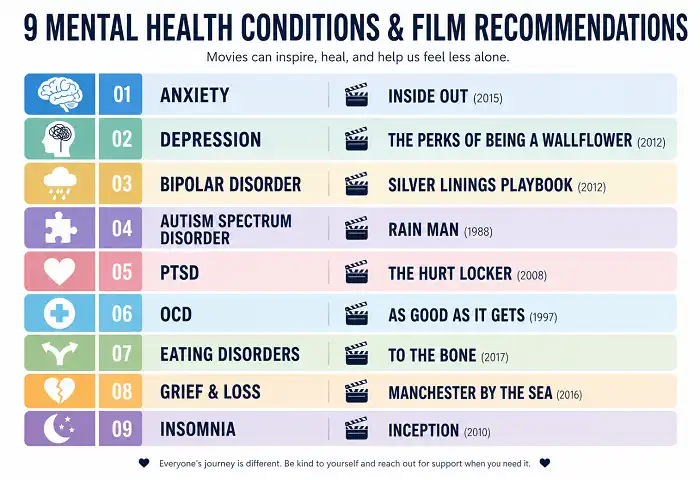
| Condition | Recommended Film |
|---|---|
| Depression | Ordinary People, The Hours |
| Bipolar Disorder | Silver Linings Playbook |
| OCD | As Good as It Gets |
| PTSD / Trauma | Good Will Hunting, The Perks of Being a Wallflower |
| Schizophrenia | A Beautiful Mind, Take Shelter |
| Eating Disorders | To the Bone |
| Addiction | Beautiful Boy, Requiem for a Dream |
| Grief | A Monster Calls |
| Emotional Literacy (Kids) | Inside Out |
Using Mental Health Movies in Schools and Group Settings
Mental health movies work well as discussion anchors in school counseling programs, community mental health groups, and workplace wellness initiatives. They lower the barrier to conversation because the emotional weight is carried by the characters, not the participants.
A good facilitated screening includes a brief context-setting before the film, a structured discussion afterward, and clear information about available support resources. People who are curious about what mental health support looks like in a community setting often respond better to a film than to a brochure.
What to Watch If You Are Currently Struggling
If you are going through something difficult right now, not every mental health movie on this list is the right choice.
Start with Inside Out or A Beautiful Mind. Both are honest without being overwhelming. Both show that the mind can be understood, and that struggle does not define a person permanently.
Avoid Requiem for a Dream and 13 Reasons Why if you are in crisis. These films are important, but they require a stable emotional foundation to watch safely.
If you find that a film brings up something you are not equipped to handle alone, reaching out for support is not overreacting. That is the film doing its job.
Conclusion
Mental health movies are not a substitute for treatment, but they are a legitimate part of how people understand their own minds and develop empathy for others. The films on this list represent some of the most thoughtful, accurate, and emotionally honest portrayals of mental health conditions in cinema. Watch them with intention, talk about what they bring up, and let them be a starting point for something real.