

Introduction
A mental health cooperative brings together behavioral health, primary care, and community support under one coordinated system so people with serious mental illness get whole-person care without falling through the cracks. This guide covers what a mental health cooperative is, who it serves, what services it provides, how to access care, and what to expect when you reach out.
Quick Answer: A mental health cooperative is a community-based, nonprofit organization that delivers integrated mental health, substance use, primary care, and social support services. It serves adults and children with serious psychiatric conditions, often regardless of their insurance status or income level.
What Is a Mental Health Cooperative?

A mental health cooperative is a behavioral health organization built on a team-based model of care. Instead of sending you from one office to another, it coordinates your psychiatrist, therapist, care manager, and primary care provider inside one connected system.
These organizations use an integrated, person-centered approach to serve children, adolescents, and adults in a warm, caring, and stigma-free environment. Mental Health America
The cooperative model differs from a standard clinic. Care managers follow up with you in your home or community, not just inside an office. That makes it easier to stay connected to treatment even when life gets difficult.
The approach combines community-based care management, psychotherapy, psychiatry, crisis services, and primary care into an integrated, person-centered system of care. Indeed
Who Does a Mental Health Cooperative Serve?
Mental health cooperatives primarily serve people with serious mental illness, including those dealing with schizophrenia, bipolar disorder, major depression, trauma, and co-occurring substance use disorders. Children and youth with serious emotional or behavioral challenges also qualify.
Many remain among the few nonprofits solely dedicated to serving people with serious mental illness, especially those affected by poverty, trauma, and limited access to care. Mhc-tn
Most cooperatives accept TennCare, Medicaid, and other public insurance plans. Some offer services to people without coverage who meet income guidelines.
If you have struggled to get consistent mental health care because of cost, geography, or past negative experiences, a mental health cooperative is specifically built for your situation.
Core Services a Mental Health Cooperative Provides
Therapy and Psychiatric Care
Clients receive individual, family, and group therapy for conditions including anxiety, depression, bipolar disorder, trauma, ADHD, and psychosis. Psychiatric evaluations and medication management are also available, ensuring continuity of care and close coordination between providers. Mentalhealthproviders
Therapists at a mental health cooperative use approaches like cognitive behavioral therapy, dialectical behavior therapy (DBT), EMDR, and trauma-focused counseling. These are proven methods, not guesswork.
Community-Based Care Management
Care managers connect you with housing, financial benefits, education, and transportation. They meet you where you are, literally, whether that is your home, school, or neighborhood. This makes it easier to stay stable between appointments.
Crisis Services
When crisis strikes, the team responds immediately with expert care and compassion, providing round-the-clock mobile crisis response and walk-in psychiatric care at a Crisis Treatment Center. Mhc-tn
Components of the crisis system typically include a 24-hour Mobile Crisis Response Team, Urgent Care Psychiatry referrals, a 24-hour Crisis Center, and a Crisis Resolution Center. Givingconnection
This matters because psychiatric crises rarely happen during business hours.
Substance Use Treatment
Many cooperatives offer same-day access to medication-assisted treatment (MAT), plus full-service pharmacy support tailored for individuals managing complex mental and physical health needs. Mhc-tn
If you are dealing with opioid use disorder alongside a mental health condition, MAT combined with counseling and peer support gives you a structured path forward.
Integrated Primary Care
Physical health and mental health are not separate problems. Many people with serious mental illness also struggle with chronic conditions like diabetes, hypertension, or heart disease.
When mental and physical health care is integrated in primary care settings, treatments for both can inform and complement each other, and patients benefit from improved coordination between different types and levels of care. Healthymindspolicy
A mental health cooperative addresses both in one place, so your care team sees the whole picture.
How the Cooperative Care Model Actually Works
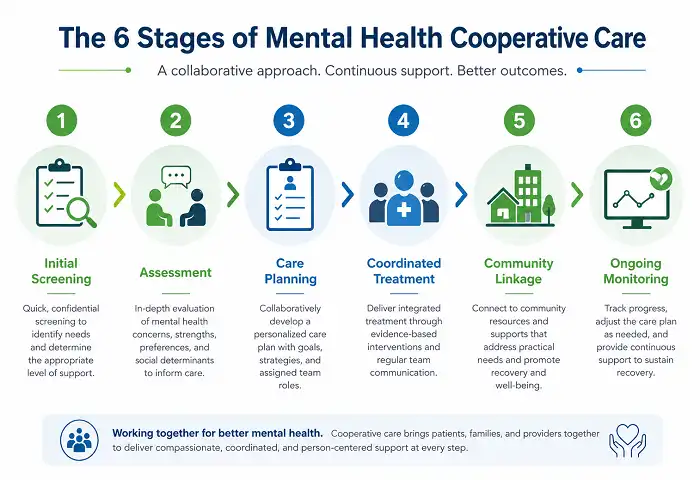
Understanding how the model works helps you know what to expect before your first appointment.
Step 1: Initial Screening
You call or walk into a location. An intake specialist completes an initial screening by phone or in person. Most cooperatives keep this process fast, sometimes completing it the same day.
Step 2: Assessment and Diagnosis
A licensed clinician assesses your mental health history, current symptoms, and any physical health or social needs. A psychiatrist or advanced practice nurse reviews your case and prescribes medication if appropriate.
Step 3: Care Planning
Your care team builds a plan that includes your personal goals, not just clinical targets. Primary care and behavioral health providers collaborate using shared care plans that incorporate patient goals. Psychiatry.org
Step 4: Coordinated Treatment
You receive therapy, psychiatric follow-up, and care management together. Your providers communicate with each other regularly rather than working in silos.
Step 5: Community Linkage
Your care manager connects you to housing, food assistance, job support, or other services based on what you need to stay stable outside the clinic.
Step 6: Ongoing Monitoring
Treatment teams track patients using a registry to ensure no one falls through the cracks, and treatments are actively adjusted if patients are not improving as expected. Psychiatry.org
This is one of the biggest advantages of the cooperative model over a standard referral-based system.
Why Integrated Care Produces Better Outcomes
Research consistently shows that cooperative, team-based mental health care outperforms fragmented treatment. Several randomized controlled trials have demonstrated that collaborative care increases access to mental health care and is more effective and cost efficient than the current standard of care for treating common mental illnesses. PubMed Central
A review of more than 70 clinical trials found the Collaborative Care Model demonstrates higher effectiveness than usual care, with savings in pharmacy, inpatient, outpatient, and mental health specialty care. Proemhealth
When you get your therapy, psychiatry, and case management from one coordinated team, information flows better. Your providers catch problems earlier, and you spend less time re-explaining your history at every appointment.
For people who are also managing serious mental illness and co-occurring conditions, that coordination can be the difference between stable housing and a hospitalization.
What Makes a Mental Health Cooperative Different from a Clinic
A standard outpatient clinic gives you appointments. A mental health cooperative gives you a care team.
Standard clinics refer you out to other services and leave navigation to you. A cooperative keeps you connected across all your needs. Care managers follow up if you miss appointments rather than waiting for you to re-schedule.
When a need falls outside the cooperative’s scope, they connect patients to trusted partners but remain at the helm to ensure everything works together and nothing slips through the cracks. Glassdoor
This is especially important if you have ever struggled to follow through on a referral, missed an appointment during a hard week, or felt like no one was tracking your overall progress.
Services for Children and Families

Mental health cooperatives do not serve only adults. Children and teenagers with serious emotional and behavioral disorders also qualify for coordinated support.
For children and youth, services are provided through coordinated, compassionate care at home, in schools, and in clinics. Mhc-tn
If your child has experienced trauma, anxiety, school behavioral challenges, or a first episode of psychosis, a cooperative can provide therapy, psychiatric evaluation, and family support in one place. Parents are included in the care planning process, not kept at arm’s length.
If you want to learn more about finding the right support for children, this guide to mental health counseling options covers what different providers offer.
How to Access a Mental Health Cooperative
Getting started is simpler than most people expect. Here is how to move from uncertainty to a first appointment.
- Call the welcome center. Most cooperatives have a toll-free line and extended enrollment hours. You do not need a referral.
- Ask about insurance. Bring your TennCare card, insurance ID, or proof of income. If you have no coverage, ask about financial assistance guidelines.
- Request a phone screening. If transportation is a barrier, many cooperatives complete initial screenings entirely by phone.
- Show up for your assessment. You will meet with a clinician who reviews your needs, not a form that categorizes you.
- Ask about care management. If you need help navigating housing, benefits, or transportation, tell the intake team upfront. That is exactly what care managers are there for.
For people in active crisis, a 24-hour line and walk-in locations are available so you can reach care when every moment matters. Mhc-tn
First Episode Psychosis Support
One specialized area where mental health cooperatives stand out is early intervention for psychosis.
The First Episode Psychosis Initiative (FEPI) is an evidence-based program for youth and young adults between 15 and 30 years of age who have experienced a first episode of psychosis. It includes individual and group psychotherapy, supported employment and education, family education and support, psychopharmacology, peer support, and care coordination. Indeed
Early intervention after a first psychotic episode significantly improves long-term outcomes. If you or someone you know is experiencing hallucinations, disorganized thinking, or a sudden break from reality, reaching out to a mental health cooperative quickly is the right move.
You can also read more about inpatient and intensive care options for situations that require a higher level of support.
Common Mistakes to Avoid When Seeking Cooperative Care
Waiting too long. Many people spend months in crisis before reaching out because they assume they do not qualify or cannot afford services. Most cooperatives have no waitlist for an initial screening call.
Assuming you need insurance. Financial assistance and TennCare enrollment support are often built into the intake process. Do not let insurance status stop you from calling.
Expecting one provider to handle everything alone. Cooperative care works because a team shares your care. Resisting care management or skipping team-based appointments limits the model’s effectiveness.
Not telling your care manager about social needs. Housing instability, food insecurity, and lack of transportation directly affect mental health outcomes. Your care manager cannot connect you to resources they do not know you need.
Mental Health Cooperative and Stigma Reduction
One underrated benefit of the cooperative model is that it reduces stigma in practical ways. When you receive mental health care in the same place as your physical health care, it normalizes the experience.
When patients are screened for mental health conditions the same way they would have their blood pressure checked, it reinforces the idea that mental health is health. Healthymindspolicy
Cooperatives are designed to feel welcoming. Staff members are trained to treat everyone with dignity, regardless of diagnosis or background. That environment encourages people to stay in care long enough to see real improvement.
If you are exploring how emotional wellness connects to everyday life, reading about sound mental health practices can also help you build a stronger foundation outside the clinic.
Conclusion
A mental health cooperative gives you something most care systems do not: a connected team that follows through. Whether you are managing a serious mental illness, supporting a child through emotional challenges, navigating a crisis, or trying to stay stable after a hospital discharge, this model removes the barriers that typically break the chain of care.
The most important step is the first one. Call your local mental health cooperative, ask about enrollment, and let the team figure out the rest with you.