

Introduction
Journaling gives your thoughts a place to land, and the right journal prompts for mental health make it easier to actually start. This guide covers the most effective prompts organized by emotional need, so you can pick up a pen and use them today. Whether you are processing anxiety, grief, or stress, these prompts meet you where you are.
Quick Answer: Journal prompts for mental health are short, focused questions or statements that guide your writing toward emotional clarity and self-awareness. They work by directing your attention to specific feelings or patterns so you move past the blank page and into genuine reflection.
What Are Journal Prompts for Mental Health?
Journal prompts for mental health are writing starters designed to help you explore your emotional state with direction and intention.
They differ from a blank diary entry because each prompt gives you a specific angle. Instead of staring at a page, you respond to a question. That small shift removes the friction that keeps most people from journaling consistently.
Mental health journaling is not therapy. But expressive writing research from the American Psychological Association supports it as a tool that reduces stress, processes difficult emotions, and builds self-understanding over time.
Why Journal Prompts for Mental Health Actually Work

Writing slows your thoughts down. When anxiety spins fast, putting words on paper forces your brain to organize the noise into something concrete and manageable.
Using journal prompts for mental health builds emotional awareness over time. You start to notice patterns, triggers, and small wins that disappear in the rush of daily life.
Writing also creates distance from painful thoughts. Saying “I feel overwhelmed” on paper is different from just feeling overwhelmed. That act of naming it reduces emotional intensity and puts you in a more observational position.
If you are exploring daily mental health check-in strategies, journaling with focused prompts is one of the most accessible tools available without any cost or appointment.
Journal Prompts for Mental Health: Anxiety and Stress

These journal prompts for mental health target anxiety by separating real concerns from spiraling thoughts.
- What is one thing I am worried about right now, and what is the most realistic outcome?
- What would I tell a close friend who felt exactly the way I feel today?
- What does my body feel like right now? Where do I notice tension?
- What is one small thing I can control today?
- What am I catastrophizing? What is actually true?
- What has helped me get through a stressful time before?
- What would a calm version of me do right now?
These prompts target the cognitive patterns behind anxiety disorders, not just the surface feeling. Writing through “what would calm me do?” builds a self-regulation habit over time.
Journal Prompts for Mental Health: Depression and Low Mood
When depression is present, motivation to journal drops. Keep these journal prompts for mental health short and forgiving.
- What is one thing, however small, that I noticed today?
- What did I do today that took effort? Can I give myself credit for it?
- What would I need to hear right now from someone who loves me?
- What has felt easier in the past? What was different then?
- What am I holding that I wish I could put down?
- What does “getting through the day” look like for me right now?
These prompts do not demand positivity. They ask for honesty, which is more healing than forced gratitude. If you are also exploring supportive reading for emotional recovery, combining books with journaling deepens the reflection process.
Journal Prompts for Mental Health: Self-Discovery
Self-discovery is one of the strongest uses for journal prompts for mental health. These prompts build the emotional awareness that prevents burnout and improves relationships.
- What value matters most to me and am I actually living by it?
- When do I feel most like myself?
- What boundary have I been afraid to set?
- What story do I keep telling about myself that may not be accurate?
- What emotion shows up most often in my week, and what is driving it?
- Who in my life makes me feel most understood?
- What do I need more of right now, and what do I need less of?
These journal prompts for mental health move beyond daily mood into deeper identity work, which is where lasting emotional change tends to happen.
Journal Prompts for Mental Health: Grief and Loss
Grief does not move in a straight line. These journal prompts for mental health help you stay present with it without being consumed by it.
- What do I miss most, and why does that matter to me?
- What has this loss taught me about what I value?
- Where am I in my grief today compared to a month ago?
- What would I say to the person or situation I lost, if I could?
- What part of healing feels hardest right now?
- What does “moving forward” actually mean to me?
Writing about grief is not about moving past it faster. It is about processing it with intention. Many people exploring emotional wellbeing resources find that expressive journaling offers an outlet that conversation alone cannot provide.
Journal Prompts for Mental Health: Gratitude and Positive Focus
Gratitude-based journal prompts for mental health go deeper than simple daily lists.
- What happened today that I almost missed but am glad I noticed?
- Who has shown up for me recently, and how can I acknowledge that?
- What about my current life would my past self be relieved to see?
- What strength do I use often but rarely credit myself for?
- What recent challenge taught me something I needed to know?
These journal prompts for mental health build a habit of positive attention grounded in specific, honest experience rather than forced optimism.
Journal Prompts for Mental Health: Relationships and Social Stress
Relationship tension carries real emotional weight. These journal prompts for mental health help clarify feelings before difficult conversations happen.
- What do I actually need from this relationship right now?
- Is there something I have wanted to say but have held back? Why?
- How do I feel after spending time with this person?
- What pattern keeps repeating in my close relationships?
- What would a healthy boundary look like here?
- What am I afraid would happen if I expressed how I truly feel?
Many people navigating social stress or relationship difficulty find that mental health retreat and recovery tools pair well with regular journaling for a more complete approach to emotional health.
Journal Prompts for Mental Health: Work Stress and Burnout
Burnout builds slowly. These journal prompts for mental health help you catch it before it peaks.
- What part of my work feels meaningful right now, and what does not?
- When did I last feel genuinely energized at work?
- What expectation am I putting on myself that may be unrealistic?
- Am I working to live, or living to work?
- What would I do differently if I gave myself permission to slow down?
- What does rest actually feel like for me, and when did I last have it?
Journal Prompts for Mental Health: Morning and Evening Routines
Timing matters when you use journal prompts for mental health consistently.
Morning prompts set the tone for the day:
- What is one intention I want to carry into today?
- What is one thing I want to feel by tonight?
- What am I bringing into today that I would rather leave behind?
Evening prompts close the emotional loop:
- What is one thing that happened today that I want to acknowledge?
- What drained me today, and what restored me?
- What do I want to let go of before I sleep?
Using journal prompts for mental health at the same time each day is the single most effective habit-building approach. Consistency beats length every time.
How to Start Using Journal Prompts for Mental Health
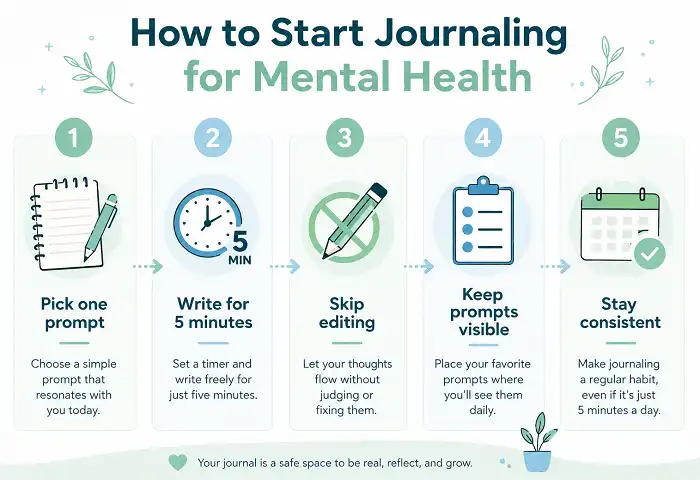
Pick one prompt, not ten. Choosing too many creates pressure. One honest response to one prompt is a complete session.
Write for five minutes. You do not need 30 minutes to get value from journal prompts for mental health. Five focused minutes produces more insight than 20 distracted ones.
Skip editing. The goal is honest thinking, not polished writing. Spelling and grammar do not matter here.
Keep prompts visible. Write a few favorites on a sticky note near your journal. Removing the friction of choosing helps you actually start.
Use any format. Pen and paper, a private digital document, or a voice memo all work. The format matters less than the consistency.
If you are working with a licensed counselor, sharing your journal entries can support clinical mental health counseling by giving your therapist a clearer picture of your patterns between sessions.
Common Mistakes When Using Journal Prompts for Mental Health
Writing only on good days. The most useful journal prompts for mental health get used on the hard days, not just the easy ones.
Forcing a lesson from every entry. Not every session needs a conclusion. Sometimes the point is just to get it out.
Using journaling to avoid action. Writing about a problem is useful. But if the same issue fills 20 entries with no change, the journal has become avoidance. That is when professional support becomes the better step.
Rereading painful entries repeatedly. Occasional review builds insight. Obsessive rereading reinforces distress rather than healing it.
When Journal Prompts for Mental Health Are Not Enough
Journal prompts for mental health are a wellness tool, not a clinical treatment. If you are experiencing persistent depression, trauma responses, suicidal thoughts, or symptoms that interrupt daily functioning, speak with a licensed professional.
Journaling works best as a supplement to therapy. A licensed clinical mental health counselor can help you work through what you uncover in your writing with trained, structured guidance.
Conclusion
Journal prompts for mental health give your inner life a visible form. They reduce anxiety, build self-awareness, and help process emotions that otherwise stay stuck. Start with one prompt. Write honestly. Do it again tomorrow. Over time, those small sessions build something real: a clearer relationship with yourself and a stronger daily foundation for emotional health.