

Introduction
Getting the right therapist takes time, and most people give up before they find one who actually fits. Headway mental health simplifies that process by connecting patients with in-network therapists who accept insurance, cutting out the cost barrier most people face. This guide covers what Headway is, how its platform works, who qualifies, what to expect from sessions, and how it compares to other mental health options so you can decide if it is right for you.
Quick Answer: Headway is a mental health care platform that helps people find therapists and psychiatrists who accept their insurance. It connects patients with licensed providers, handles billing automatically, and makes booking a covered mental health appointment straightforward.
What Is Headway Mental Health?
Headway is a healthcare technology company that builds and manages a network of independent mental health providers across the United States. It does not employ therapists directly. Instead, it partners with licensed therapists, psychologists, and psychiatrists who run their own practices and handles the administrative side, including insurance credentialing, billing, and appointment scheduling.
The company launched to solve a specific problem: most therapists do not accept insurance because the paperwork is time-consuming and reimbursement rates are low. Headway takes over that entire process, which lets providers focus on patient care rather than billing.
For patients, this means more therapists to choose from at in-network rates, which is a meaningful difference when out-of-pocket therapy costs can run $150 to $300 per session.
How Headway Mental Health Works

The process on Headway is built around three steps: find a provider, verify your insurance, and book an appointment.
Step 1: Search for a provider. You enter your insurance plan, location, and the type of support you need. The platform filters results to show only therapists who accept your specific plan.
Step 2: Confirm your coverage. Headway verifies your benefits before your first appointment. You see your estimated copay or cost-sharing amount upfront, so there are no billing surprises after your session.
Step 3: Book and attend. You schedule directly through the platform. Sessions can be in-person or via telehealth, depending on the provider you choose.
After each session, Headway handles the insurance claim automatically. You pay only your copay or coinsurance, and the rest goes through your insurance.
Who Uses Headway and Why
Headway mental health serves two groups: patients looking for affordable, covered therapy and providers who want to accept insurance without the administrative burden.
For patients, the main draw is cost. Insurance coverage for mental health therapy can cut a session cost from $200 down to $20 to $50 depending on your plan. Headway also offers a wider selection than most directories because it actively recruits providers and handles their credentialing.
For therapists and psychiatrists, Headway manages insurance contracts, billing, claims, and collections. Providers get paid faster and spend less time on administrative tasks. This is why a growing number of independent clinicians join the network.
What Conditions Does Headway Support?
Headway mental health providers treat a broad range of conditions, including:
- Anxiety and panic disorders – ongoing worry, panic attacks, social anxiety
- Depression – major depressive disorder, persistent low mood
- Trauma and PTSD – past trauma, complex PTSD
- ADHD – diagnosis support and management in adults
- Relationship and family issues – couples therapy, family conflict
- Bipolar disorder – mood regulation support
- Grief and life transitions – loss, job changes, divorce
Providers on the platform also offer specialized therapy modalities including cognitive behavioral therapy (CBT), dialectical behavior therapy (DBT), and EMDR for trauma.
Does Headway Accept Insurance?

Yes, this is the core feature of headway mental health. The platform works with many major insurance carriers in the United States. Accepted plans include Aetna, Cigna, UnitedHealthcare, Blue Cross Blue Shield, and several state Medicaid plans depending on your location.
Coverage varies by state and by specific plan tier. When you search on Headway, you enter your insurance card details and the system confirms whether your plan is in-network before you see any providers. This eliminates guesswork.
If you are unsure whether your mental health benefits cover therapy, understanding your mental health insurance coverage before your first appointment helps you avoid unexpected costs.
Telehealth vs. In-Person Sessions on Headway

Headway supports both formats. Many providers offer telehealth-only, while some see patients in-person at their own office locations.
Telehealth on Headway uses a HIPAA-compliant video platform. You log in through the Headway portal at your appointment time. Sessions typically run 45 to 55 minutes, the same as in-person.
In-person sessions depend on whether the provider has a physical office in your area. You can filter for in-person availability when searching.
Telehealth works well for ongoing talk therapy. In-person is often preferred for initial psychiatric evaluations or when a provider uses assessments that are easier to complete face to face.
How to Sign Up for Headway Mental Health
Signing up takes about five minutes. Here is the full process:
- Go to headway.co and click “Find a therapist.”
- Enter your insurance information – plan name, member ID from your insurance card.
- Select your preferences – therapy type, provider gender, specialty, session format (telehealth or in-person).
- Browse matched providers – you see real profiles with background, approach, and availability.
- Pick a provider and select an appointment time that works for you.
- Complete intake forms – Headway sends paperwork electronically before your first session.
- Attend your session and pay only your copay or cost-sharing amount.
No insurance navigation on your own. No submitting claims. No waiting for reimbursement.
What to Expect in Your First Session
Your first appointment on Headway mental health is an intake session. The therapist or psychiatrist gathers background information about your mental health history, current symptoms, and goals for treatment.
This session sets the foundation. You discuss what brings you to therapy, any previous treatment history, and what you hope to get out of the process. You also get a sense of whether you connect with this provider.
It is normal to feel uncertain after one session. Give it two or three appointments before deciding whether the provider is a good fit. If the connection does not feel right, you can switch to a different provider through the same platform without starting the sign-up process over.
Headway Mental Health vs. Other Platforms
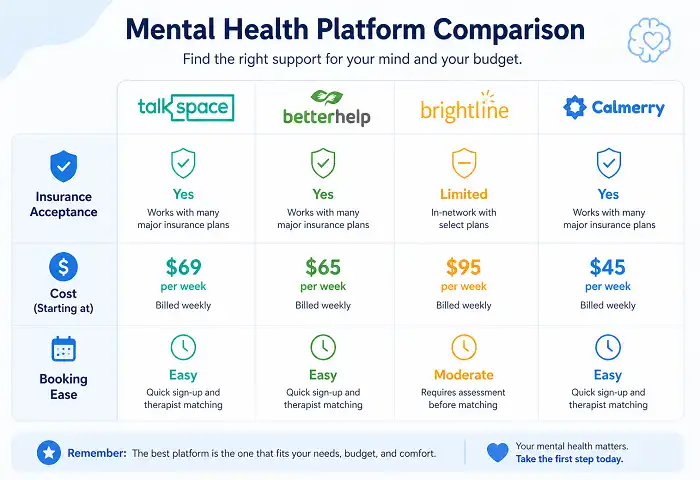
Several platforms offer similar services. Here is how headway mental health compares to common alternatives:
Headway vs. BetterHelp: BetterHelp does not accept insurance. You pay a flat weekly subscription fee. Headway uses insurance billing, which makes it more affordable for people with mental health benefits on their plan.
Headway vs. Zocdoc: Zocdoc is a general healthcare booking tool. It lists some therapists but does not specialize in mental health or manage insurance credentialing the way Headway does.
Headway vs. Psychology Today directory: Psychology Today lists therapists but does not facilitate booking or billing. You contact providers directly and handle insurance on your own.
Headway vs. Alma: Alma mental health operates a similar model to Headway – a clinician-founded network that handles insurance credentialing for independent therapists. Both focus on in-network care, though provider availability differs by location.
Headway’s main advantage is its insurance-first approach with automatic billing. If you have insurance with mental health benefits, it removes the largest barrier most people face.
Common Questions About Headway Mental Health
Is Headway free to use? There is no subscription fee for patients. You pay only your insurance copay or coinsurance, the same as any other in-network provider visit.
Can I use Headway without insurance? Headway primarily operates through insurance billing. If you do not have coverage, most providers on the platform are not available to you through Headway. You would need to contact providers directly for self-pay rates.
Does Headway offer psychiatric medication management? Yes. Some providers on Headway are psychiatrists or psychiatric nurse practitioners who can prescribe and manage medication. When searching, filter for “psychiatry” to find these providers.
How is my privacy protected? Headway operates under HIPAA regulations, the federal law governing health information privacy. Your session notes and billing data are protected under the same rules that apply to any healthcare provider.
What if I want to switch therapists? You can search for a new provider on Headway at any time and book a new intake session without leaving the platform.
Who Should Consider Headway
Headway mental health works best for people who:
- Have insurance with mental health benefits and want to use them
- Need help finding a provider who is actually accepting new patients
- Prefer telehealth or want the option to choose
- Are looking for talk therapy, psychiatric evaluation, or medication management
It works less well if you need a very specialized treatment program, intensive outpatient services, or crisis intervention. Those needs call for a higher level of care than Headway’s independent provider network typically offers.
If you are in crisis, contact the 988 Suicide and Crisis Lifeline by calling or texting 988. Headway is not designed for emergencies.
Mistakes to Avoid When Using Headway
Not verifying your specific plan. Not every plan from a given insurer is in-network. An Aetna PPO and an Aetna HMO may have different results. Always enter your full plan details, not just the insurer name.
Skipping the intake paperwork. Headway sends forms before your first session. Completing them in advance saves time during your appointment and helps your provider prepare.
Giving up after one session. Therapeutic fit takes time to assess. One uncomfortable session does not mean the platform or therapy is wrong for you.
Ignoring the provider’s specialty. Browse each provider’s listed approach and conditions they treat. A therapist who specializes in anxiety may not be the best fit if your primary concern is ADHD or grief.
Does Headway Work for Children and Teens?
Some providers on Headway mental health see minors, but availability varies. When searching, you can filter by age group. If you are looking for therapy for a child or teenager, filter for providers who specifically list adolescents or children in their age range.
For teenagers dealing with youth mental health challenges, finding a therapist who has experience with that age group matters significantly. Do not skip that filter when searching.
When Headway May Not Be Enough
Headway connects you with outpatient therapy and psychiatric care. It does not offer:
- Inpatient hospitalization
- Partial hospitalization programs (PHP)
- Intensive outpatient programs (IOP)
- Crisis stabilization
If your situation requires more structured support, a partial hospitalization program or an inpatient facility provides a higher level of care. Your primary care physician or a psychiatric provider can help you determine what level of care fits your current needs.
Conclusion
Headway mental health solves a real access problem. Most people with insurance cannot easily find a therapist who accepts it and is taking new patients. Headway builds that system, handles the billing, and puts you in a session faster.
It is not the right fit for every situation, but for outpatient therapy and psychiatric care covered by insurance, it is one of the most practical options available today. If you have mental health benefits on your insurance plan and have avoided using them because finding a provider felt too complicated, Headway is worth trying.