
Introduction
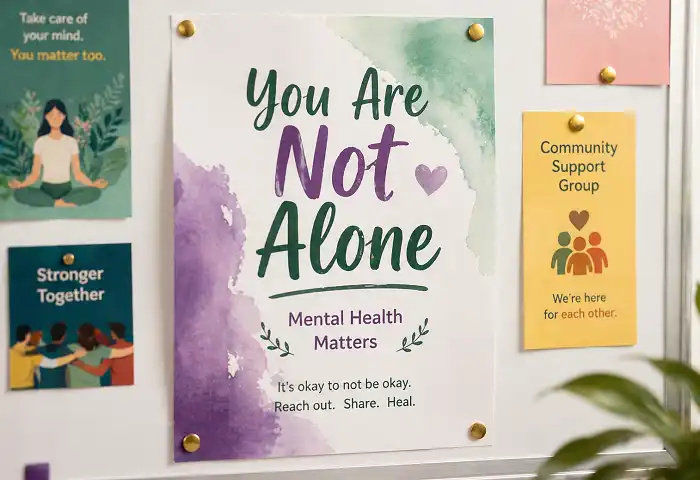
A mental health poster is one of the most direct tools for spreading awareness, reducing stigma, and encouraging people to seek support. This guide covers what makes a mental health poster effective, the different types used in schools, clinics, and workplaces, what messages work best, and how to choose or design one that actually connects with your audience.
Quick Answer: A mental health poster is a visual communication tool that raises awareness about emotional wellbeing, mental illness, available resources, or coping strategies. Effective posters use clear messaging, relatable visuals, and a supportive tone to reach people who may be struggling silently.
What Is a Mental Health Poster?
A mental health poster is a printed or digital visual designed to communicate a mental health message to a specific audience. It can promote awareness, share crisis resources, reduce stigma, or encourage healthy habits.
These posters appear in schools, hospitals, workplaces, community centers, and social media feeds. The goal is simple: start a conversation, offer hope, or point someone toward help.
Unlike a flyer or pamphlet, a poster is meant to be seen quickly. It uses bold visuals, short text, and strong imagery to land a message in seconds.
Why Mental Health Posters Matter
Stigma keeps millions of people from seeking help. A well-placed mental health poster normalizes the conversation. It tells someone in a waiting room or a school hallway that their feelings are valid and that support exists.
According to the National Institute of Mental Health, mental illness affects roughly one in five adults in the United States each year. Awareness tools like posters play a real role in reaching people before a crisis develops.
When I see a mental health awareness poster on a break room wall at work, it signals that the organization cares. That visibility matters more than most people realize.
Types of Mental Health Posters
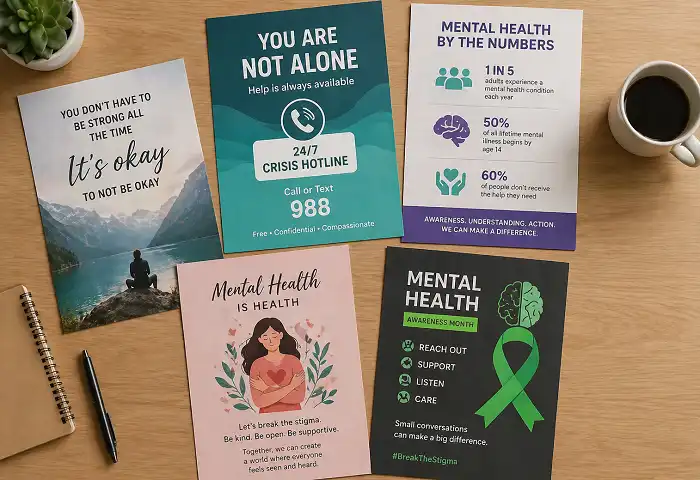
Not every mental health poster serves the same purpose. Understanding the type helps you choose the right one for your setting.
Awareness posters focus on facts and statistics about mental health conditions like depression, anxiety, PTSD, or bipolar disorder. They educate without overwhelming.
Motivational and healing posters use uplifting quotes and calming visuals. These work well in therapy offices, hospitals, and wellness spaces. If you’re looking at mental health quotes for healing, you’ll notice the same principles apply in poster format.
Resource and crisis posters share hotline numbers, local services, or step-by-step instructions on what to do in a mental health emergency. These are critical in schools and clinical settings.
Destigmatization posters challenge myths about mental illness. They often use relatable language and real faces to show that mental health struggles affect ordinary people.
Campaign posters are tied to events like Mental Health Awareness Month in May or Men’s Mental Health Month in June. They often use specific colors and ribbon symbols tied to those campaigns.
Where Mental Health Posters Work Best
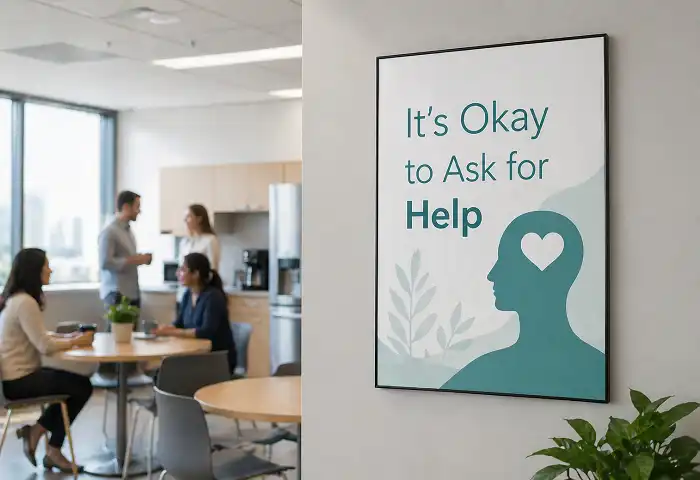
Placement determines whether a poster gets noticed or ignored.
Schools and universities benefit most from posters near counseling offices, restrooms, and common areas. Teenagers and young adults often notice these spaces and respond to peer-facing language.
Workplaces need posters in break rooms, near HR offices, and in wellness rooms. Employees dealing with burnout or stress are more likely to pause and read something in a quiet space.
Healthcare facilities use clinical mental health posters in waiting areas to reduce patient anxiety and normalize help-seeking behavior. Clinicians also use them to explain conditions or coping tools to patients. Learning more about clinical mental health counseling can help you understand what kind of messaging works in those settings.
Community centers and nonprofits use them for outreach, especially in underserved communities where access to mental health services is limited.
What Makes a Mental Health Poster Effective
A poster fails when it tries to say too much. The most effective ones follow a few clear principles.
One clear message. Every great mental health poster centers on a single idea. “You are not alone.” “It’s okay to ask for help.” “Your mental health matters.” Clarity beats complexity every time.
Strong, relevant imagery. Visuals drive the emotional response. Images of people, nature, or abstract art that evoke calm and safety work better than clinical graphics. Avoid stock images that look staged or emotionally flat.
Readable typography. Large, clean fonts in high-contrast colors are essential. A poster no one can read across a room has no impact.
A call to action. Effective mental health awareness posters include something actionable: a hotline number, a website, an invitation to speak to someone. Without this, a poster inspires but doesn’t direct.
Inclusive representation. Mental health affects every demographic. Posters that show diverse faces, including different ages, genders, ethnicities, and backgrounds, resonate more broadly.
Mental Health Poster Messages That Actually Connect
The language on a poster shapes how someone receives the message. These approaches consistently work:
- Validation statements like “What you feel is real” acknowledge pain without minimizing it.
- Permission statements like “It’s okay not to be okay” reduce shame.
- Action invitations like “Talk to someone today” give a next step without pressure.
- Hope-focused language like “Recovery is possible” grounds someone in possibility.
Avoid clinical jargon. Words like “comorbidity” or “psychopathology” create distance. Simple, human language creates connection.
Inspirational quotes work well for motivational posters, and many people resonate with mental health awareness quotes that feel personal rather than generic.
Mental Health Poster Design: Key Elements
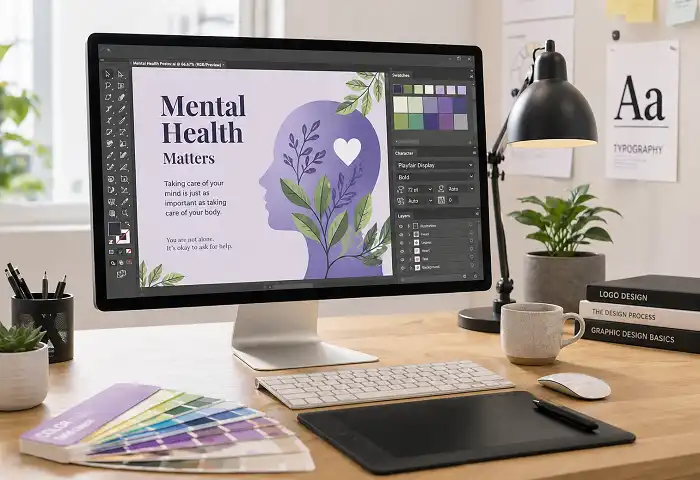
If you’re designing a mental health poster from scratch, these elements shape the outcome.
Color psychology plays a real role. Green signals growth and calm. Blue evokes trust and peace. Yellow suggests energy and optimism. Purple is widely associated with mental health awareness campaigns. Avoid harsh reds and blacks for messaging aimed at people in distress.
White space is underused. A poster doesn’t need to fill every inch. Breathing room makes messages feel approachable instead of aggressive.
Hierarchy means the viewer reads the most important thing first. Bold headline, supporting message, action step. That order works every time.
Size and format depend on placement. Standard poster sizes include 18×24 inches for walls and 11×17 for bulletin boards. Digital versions need to be optimized for social sharing, typically 1080×1080 or 1200×628 pixels.
Mental Health Poster for Different Audiences
The same mental health poster doesn’t work for every group. Audience-specific design produces better results.
Children and teens respond to bright colors, simple visuals, and language that mirrors how they actually talk. Illustrations work better than photography for younger audiences.
Adults and professionals respond to clean design, credible statistics, and clear resource links. A workplace mental health poster should feel professional without being cold.
Older adults need larger font sizes, high contrast, and messaging that avoids tech-heavy resource suggestions like app downloads.
Men are a particularly important audience given that men are significantly less likely to seek mental health support. Posters targeting men often use direct, non-clinical language and avoid imagery that feels stereotypically emotional. Exploring men’s mental health awareness can help inform better design choices for this group.
Common Mistakes to Avoid
Even well-intentioned mental health posters miss the mark. Watch for these issues:
Overloading with text. If someone needs a minute to read it, they won’t. Posters are a 3-second medium.
Using triggering imagery. Images associated with self-harm, isolation, or despair can cause harm rather than help. Stick to neutral or uplifting visuals.
Generic messaging. “Be happy” or “Think positive” minimizes real struggles and alienates the people who need the message most.
No contact information. A poster about depression with no hotline, no website, and no guidance is incomplete. Always include one clear action step.
Poor placement. A poster tucked behind a door or placed too high on a wall loses its audience entirely.
How to Use Mental Health Posters in a Campaign
A single poster rarely changes behavior. Posters work best as part of a broader mental health awareness campaign. Here’s a basic framework:
- Define your goal. Reducing stigma, increasing hotline calls, or promoting a local service all require different messages.
- Know your audience. Age, setting, and cultural background shape design and language choices.
- Choose your placement strategy. Map out where posters will live before printing them.
- Pair with digital content. Share poster versions on social media to extend reach.
- Evaluate impact. Track hotline call volume, website traffic, or event attendance to see if the campaign worked.
Many organizations tie campaigns to events or monthly observances. Understanding services like Teladoc mental health or other digital platforms can also complement physical poster campaigns for broader outreach.
Free and Paid Resources for Mental Health Posters
You don’t need a design team to produce a good mental health poster.
Canva offers hundreds of free mental health poster templates that are easy to customize for schools, workplaces, or community settings. Their drag-and-drop editor requires no design experience.
SAMHSA (Substance Abuse and Mental Health Services Administration) provides free downloadable mental health awareness materials including posters, fact sheets, and campaign toolkits.
NAMI (National Alliance on Mental Illness) offers print-ready resources and campaign materials for awareness events.
For custom design, a graphic designer familiar with mental health communication can produce something tailored and high-impact for larger campaigns.
Mental Health Poster vs. Mental Health Infographic
These two formats get confused often, but they serve different purposes.
A mental health poster focuses on a single message or emotional appeal. It’s designed to be absorbed in seconds. A mental health infographic presents structured data, steps, or comparisons that require more reading time.
Use a poster to start a conversation. Use an infographic to explain a topic. Both belong in a comprehensive awareness strategy, but a cluttered poster that tries to be both ends up being neither.
Mental health clipart and illustrations also support poster design and can be layered into both formats effectively. Exploring how mental health clipart and visual tools work can help you make better design decisions.
Final Thoughts
A mental health poster is a small tool with real reach. When the message is clear, the design is clean, and the placement is intentional, it can be the thing that nudges someone toward help on a hard day.
The best posters don’t shout. They make someone feel seen. That’s the standard worth aiming for.
Whether you’re designing one for a classroom, a clinic, or a social media campaign, start with one honest message, build from there, and always include a next step for the person reading it.