
Introduction
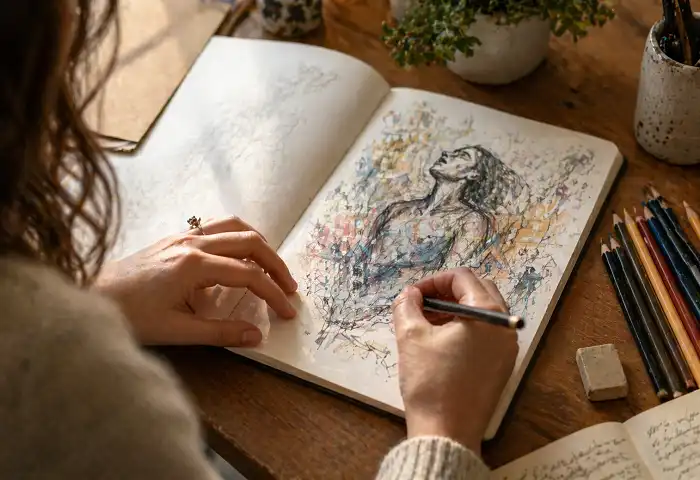
Have you ever picked up a pencil during a hard day and found yourself drawing without thinking? Maybe you scribbled in the margins of a notebook, shaded random shapes, or traced the outline of how you were feeling inside. That quiet, almost instinctive act was not just a habit — it was your mind reaching for healing. Mental health drawings have quietly become one of the most powerful, accessible, and underused tools in emotional wellness. And science is finally catching up to what artists and healers have known for centuries: putting your inner world onto paper changes something deep inside you.
This blog post is your complete, honest guide to mental health drawings — what they are, why they work, the types you can try, and how to make drawing a meaningful part of your mental wellness journey. Whether you have never picked up a sketchbook or you draw every single day, this guide is written for you.
What Are Mental Health Drawings?
Mental health drawings are any form of drawing, sketching, doodling, or illustrating done with the intention — or even just the effect — of supporting emotional wellbeing. These drawings are not judged by beauty or skill. A wobbly circle, a dark scribble, or a carefully shaded face can all carry just as much emotional weight as a masterpiece.
Mental health drawings exist on a wide spectrum. At one end, you have informal daily doodling that reduces stress without any formal plan. At the other end, you have structured art therapy sessions led by licensed professionals where mental health drawings become a clinical tool for treating depression, anxiety, PTSD, trauma, and other diagnosed conditions.
What unites all forms of mental health drawings is their core purpose: to give shape, color, and form to feelings that are too complex, too buried, or too painful to say out loud.
In recent years, mental health drawings have moved from the therapist’s office into everyday life. Social media communities dedicated to mental health art, illustrated mental health journals, and drawing prompt challenges have brought this healing practice to millions of people globally.
The Science Behind Mental Health Drawings
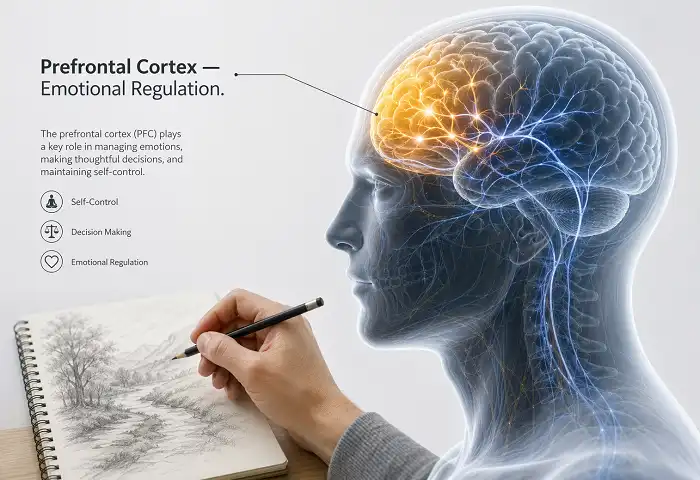
The link between drawing and emotional healing is not just poetic — it is neurological. Research published in 2024 shows that engaging in visual art activates the prefrontal cortex, the brain region primarily responsible for emotional regulation. When you create mental health drawings, your brain does not simply observe your emotions — it begins to process and organize them.
A study published in the Journal of Clinical Psychology found that participants who practiced expressive drawing for just 20 minutes daily reported a 38% reduction in anxiety symptoms over four weeks. That number is significant. Twenty minutes of drawing produced results that many people spend months seeking through other means.
The University of Arizona Health Sciences reviewed a large body of research and found that more than 80% of arts-based interventions — including mental health drawings — reported reduced stress levels among participants. Furthermore, a well-known study found that just 45 minutes of art-making significantly reduced cortisol, the body’s primary stress hormone. Structured and repetitive drawing activities, like pattern sketching or mandala drawing, were found to be especially effective at calming anxiety.
The American Art Therapy Association describes therapeutic drawing as a bridge between the conscious and subconscious mind. When you draw your fears, grief, or confusion, you are not just making an image. You are having a conversation with the parts of yourself that words cannot reach. Mental health drawings activate non-verbal communication, which is one reason they work so powerfully for people who struggle to articulate their feelings in therapy or conversation.
The American Congress of Rehabilitation Medicine has noted that even simply observing art can boost serotonin levels and increase blood flow to the brain. When you are actively creating mental health drawings, those brain benefits deepen significantly. Dopamine — the brain’s feel-good chemical — also increases during creative activity, which explains why many people feel a genuine lift in mood after a drawing session.
Key Benefits of Mental Health Drawings

Understanding the benefits of mental health drawings can motivate you to begin and stay consistent. These are not surface-level benefits. Each one is rooted in emotional and psychological science.
Reduced Anxiety and Stress Mental health drawings give your anxious mind a place to land. When anxiety loops through your thoughts in circles, drawing interrupts that cycle. Your focus narrows to the page, the pencil, the movement of your hand. Your nervous system begins to settle. Structured mental health drawings like mandalas — circular patterns drawn with repetitive motion — are especially good at reducing anxiety because their rhythm mimics meditative breathing.
Emotional Expression Without Words Many people, especially those dealing with trauma, grief, or depression, find verbal expression painful or impossible. Mental health drawings offer a non-verbal pathway. You do not need to explain anything. You do not need to form sentences. You can draw a storm, a locked door, an empty chair — and that image says everything your voice cannot. For trauma survivors in particular, mental health drawings create emotional distance from painful memories, allowing processing without re-traumatization.
Improved Self-Awareness Over time, mental health drawings become a mirror. The colors you choose, the recurring shapes and symbols, the way your style shifts during different emotional periods — all of these patterns reveal information about your inner state. Many people who keep regular mental health drawing journals report moments of genuine clarity: understanding something about their grief, their anger, or their relationships that they had never been able to verbalize.
Mindfulness and Presence Drawing pulls you into the present moment in a way that is difficult to replicate. When you are focused on the texture of a shadow or the curve of a line in your mental health drawings, you are fully in the now. This state mirrors mindfulness meditation, and research consistently links mindfulness practice to lower rates of depression, anxiety, and emotional burnout.
Building Resilience Regular creative activity through mental health drawings builds emotional resilience over time. When drawing becomes part of your daily or weekly routine, it functions as a low-cost emotional maintenance practice. It helps you process small stressors before they become large ones, reinforcing your capacity to cope with difficulty.
A Sense of Control and Agency Mental illness often strips people of their sense of control. Mental health drawings give it back. On the page, you decide everything — what to draw, what colors to use, when to stop. For people managing depression, this sense of agency can be quietly transformative.
Types of Mental Health Drawings You Can Try
There is no single correct way to use mental health drawings. Different approaches work for different people and different emotional needs. Here are some of the most effective types used in therapeutic and personal settings.
Expressive Free Drawing This is the most open form of mental health drawings. You sit with a blank page, pick up your pencil or brush, and draw whatever your hand wants to create. No plan, no subject, no rules. The goal is pure emotional release. Free drawing works well during moments of high emotional intensity — when you are overwhelmed, angry, or deeply sad. Many people are surprised by what emerges on the page when they allow themselves complete freedom.
Emotion Mapping In emotion mapping, you draw a simple outline of a body or a shape and then use colors, patterns, or symbols to mark where you feel different emotions. You might shade your chest in dark blue to represent grief, or fill your stomach with swirling red lines to represent anxiety. Emotion mapping in mental health drawings helps you locate feelings in your body and understand their physical presence, which is an important part of trauma processing.
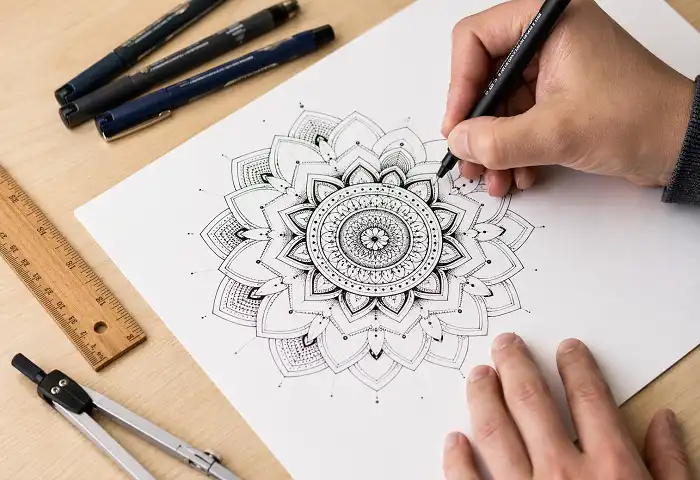
Mandala Drawing Mandalas are circular designs, often symmetrical, drawn in repetitive patterns. Creating mandalas as mental health drawings has a uniquely meditative quality. The repetitive motion calms the nervous system, the symmetry creates a sense of order and balance, and the finished image often feels like a visual expression of the emotional state you were in while drawing it. You do not need artistic training to draw mandalas — simple circles, petals, and geometric shapes are all you need.
Journaling With Drawings Combining written words with mental health drawings in an art journal is one of the most powerful daily wellness practices available. You might draw a quick sketch of your morning mood and add a few sentences beneath it, or illustrate a memory that has been surfacing and write about what it means. Over time, your art journal becomes a deeply personal record of your emotional life — one that you can look back on to trace patterns and measure growth.
Collage Drawing Collage involves cutting images, words, or textures from magazines and combining them with hand-drawn elements. This type of mental health drawing is especially useful when feelings are fragmented or hard to define. Collage allows you to piece together different elements into a whole image — which mirrors the emotional work of integrating complex or contradictory feelings.
Self-Portrait Drawing Drawing self-portraits as mental health drawings is a practice many therapists use with clients who struggle with self-worth. You are not aiming for accuracy. You are capturing how you feel about yourself — your inner sense of self — through shape, color, and expression. Over time, self-portrait drawings reveal shifts in self-perception in a way that is deeply meaningful.
Narrative Drawing In narrative drawing, you tell a story through a sequence of mental health drawings — often a story about your own experience. This technique is widely used in trauma therapy. Drawing a visual sequence of events creates a coherent narrative from fragmented memories, which is a key step in healing from PTSD and grief.
Mental Health Drawings for Specific Conditions
Mental health drawings are not one-size-fits-all. They offer specific benefits across a range of conditions, and research has documented their effectiveness in clinical settings.
Drawings for Anxiety For people managing anxiety, mental health drawings work primarily through interruption and redirection. The act of drawing disrupts the anxious thought loop and redirects cognitive energy toward sensory experience. Pattern-based mental health drawings — zentangle, mandalas, repetitive line work — are especially effective because their structure provides a sense of control without requiring decision-making, which is often exhausting for anxious minds.
Drawings for Depression A study published in 2026 on drawing and depression found sustained, growing interest in the link between creative expression and recovery from depressive episodes. Mental health drawings allow people with depression to externalize feelings that otherwise loop inward. They also create moments of small accomplishment, which gradually counters the sense of helplessness that depression generates. Drawing can be a first step toward emotional expression when verbal communication feels impossible.
Drawings for Trauma and PTSD Art therapy has demonstrated remarkable effectiveness for trauma survivors. Mental health drawings allow people to approach traumatic memories through symbols, metaphors, and abstract representation, creating emotional distance that direct verbal recall cannot provide. Visual trauma narratives — sequential mental health drawings that retell a traumatic experience — help reconstruct fragmented memories into coherent stories, which is a central goal of trauma therapy.
Drawings for Grief Grief creates a kind of wordless world that ordinary language struggles to reach. Mental health drawings give grief a form. Whether you draw the person you have lost, the space they used to occupy, or an abstract image of the emptiness you feel, the act of drawing grief externalizes it — and what is externalized can begin to be processed.
Drawings for Children and Teens Children often lack the vocabulary to communicate complex emotional experiences. Mental health drawings have long been used in child psychology and school counseling precisely because they bypass verbal development barriers. Teens who are separated from peers or struggling with social anxiety have also responded well to art therapy and mental health drawing programs, as they provide a judgment-free zone for emotional exploration.
How to Start Your Own Mental Health Drawings Practice
Beginning a mental health drawings practice does not require special talent, expensive supplies, or a formal plan. Here is a simple, honest approach to getting started.
Start With What You Have Any pencil, pen, or marker and any surface will work. Mental health drawings have nothing to do with materials. A plain notebook, printer paper, or the back of an envelope is all you need. If you want to invest in your practice over time, a simple sketchbook and a set of colored pencils are enough to begin.
Set Aside Regular Time Even 10 to 15 minutes per day is enough to experience the benefits of mental health drawings. Consistency matters more than duration. Many people find that drawing at the same time each day — morning to set emotional intentions, or evening to process the day — helps the practice become a genuine habit.
Use Prompts When You Are Stuck If a blank page feels paralyzing, prompts are enormously helpful. Some effective mental health drawing prompts include: draw how your day felt as a weather pattern; draw where your anxiety lives in your body; draw what home means to you; draw your current mood as an animal; draw a door you want to open. These prompts give your mental health drawings a starting point without limiting where they end up.
Do Not Judge What You Create This is the most important rule of mental health drawings: it is not about art. It is about expression. A drawing that looks like nothing to anyone else may be one of the most emotionally significant images you have ever made. Resist the urge to evaluate your mental health drawings for skill or beauty. The only question worth asking is whether the act of making them helped you feel something, process something, or understand something.
Combine Drawing With Journaling Adding a few sentences to your mental health drawings deepens the reflective process. Write whatever comes up — observations, memories, questions, or just a single word. Over time, your written reflections alongside your mental health drawings become a rich map of your emotional life.
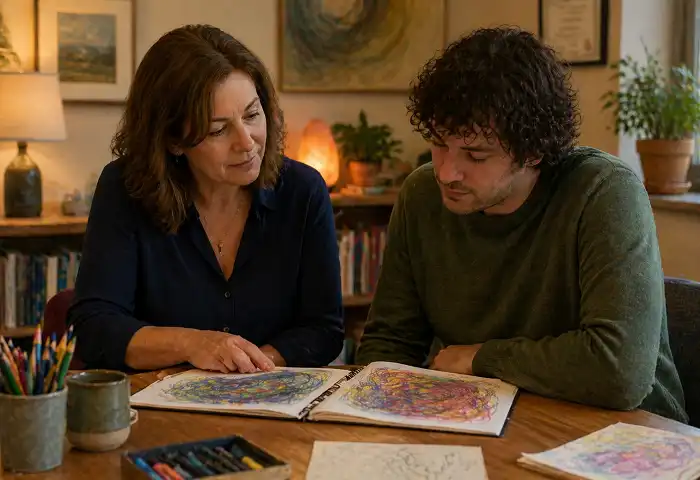
Consider Working With a Professional While personal mental health drawings practice offers real benefits, working with a licensed art therapist takes the process further. Art therapists are trained in both psychology and creative expression. They guide you through mental health drawings in ways that connect to specific therapeutic goals. The American Art Therapy Association maintains a directory of licensed art therapists for those seeking professional support.
Mental Health Drawings in Community and Culture
One of the most beautiful developments in recent years has been the rise of mental health drawings as a shared, public practice. Online communities centered around mental health art have created spaces where people share drawings that express their anxiety, depression, grief, or recovery. These communities reduce isolation, create belonging, and normalize conversations about emotional wellbeing through visual language.
The World Health Organization has recognized arts engagement, including mental health drawings and related creative practices, as an important contributor to mental health promotion and illness prevention. Because mental health drawings are low-cost, culturally adaptable, and require no prior expertise, they are especially powerful tools in community settings, schools, and underserved regions where traditional mental health resources may be limited or inaccessible.
Art exhibitions dedicated to mental health drawings have also grown in number. These exhibitions — sometimes featuring the work of people in recovery, psychiatric patients, or survivors of trauma — challenge stigma by making the invisible visible. When mental health drawings appear on gallery walls, they communicate a message that society often fails to send: emotional pain is real, it has shape and color, and it deserves to be seen.
Final Thoughts: Why Mental Health Drawings Matter
Mental health drawings matter because they honor the truth that some things cannot be spoken. Grief, trauma, anxiety, depression, confusion — these experiences live in the body, in the gut, in the tight space behind the eyes. Words are powerful, but they are not always enough. Sometimes healing requires a different language, and mental health drawings offer exactly that.
You do not need to call yourself an artist. You do not need a diagnosis to begin. You do not need permission, formal training, or a specific reason. All you need is a willingness to sit with yourself, pick up something to draw with, and let your inner world find a way onto the page.
Mental health drawings are not magic. They are not a substitute for professional support when that support is needed. But they are one of the most accessible, affordable, and deeply human tools available to anyone who wants to understand themselves better, process what they carry, and find small moments of peace in a difficult world.
Start today. Draw something. Let it be imperfect. Let it be honest. Let it be yours.