
Introduction: Why a Simple Ribbon Speaks Volumes
There are moments in life when words simply fail. When someone you love is struggling in silence, when you yourself are fighting battles invisible to the naked eye, or when you want the world to know that you stand firmly beside the millions of people living with mental illness — sometimes all it takes is a small piece of colored fabric folded into a loop.
The mental health awareness ribbon is one of the most quietly powerful symbols in the modern wellness movement. It is small enough to pin to a jacket lapel, yet meaningful enough to spark a life-changing conversation. It costs almost nothing, yet its message carries enormous weight — hope, solidarity, healing, and the collective demand for an end to the stigma that still surrounds mental illness today.
In this comprehensive guide, we will walk you through everything you need to know about the mental health awareness ribbon: its official color, the history behind it, what different shades represent, how organizations use it globally, and how you can incorporate it meaningfully into your daily life and advocacy work. Whether you are new to mental health awareness campaigns or a seasoned advocate, this article will deepen your understanding of a symbol that truly matters.
What Is the Mental Health Awareness Ribbon?
The mental health awareness ribbon is an internationally recognized symbol used to show support for individuals living with mental illness, to promote mental health education, and to break down the walls of shame and misunderstanding that prevent people from seeking help.
Unlike a badge or a slogan, the ribbon is an act. When someone wears it, pins it, shares it online, or places it on a window, they are making a public declaration: mental health matters, and so do the people affected by it.
The ribbon has become especially prominent during two key observances:
- Mental Health Awareness Month — observed every May in the United States, a tradition that dates back to 1949.
- World Mental Health Day — observed on October 10 every year since 1992, a global initiative that unites advocates across more than 150 countries.
During these periods, the mental health awareness ribbon appears on social media profile pictures, across government buildings, at community events, on wristbands, and in promotional materials distributed by mental health foundations worldwide. But the ribbon is not limited to these seasons — it is worn year-round by those who carry the message in their hearts every single day.
What Color Is the Mental Health Awareness Ribbon?
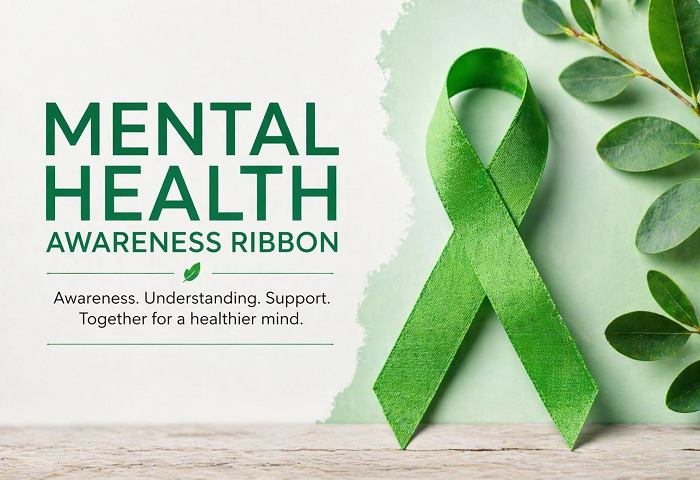
This is the most common question people ask, and the answer is beautifully simple: green.
Green is the designated color for mental health awareness. It symbolizes new life, renewal, and growth found in nature — representing the idea that individuals facing mental health challenges can experience recovery, healing, and personal growth.
The choice of green was not arbitrary. Think about what green naturally evokes. Forests. Spring leaves pushing through cold soil. Gardens coming back to life after a long winter. Green is the color of resilience. It says: no matter how dark things have been, growth is still possible.
The green ribbon is not limited to a specific mental health condition but is used to represent mental health awareness as a whole. However, it is particularly associated with depression awareness, showing support for individuals struggling with this mental illness.
In practical terms, the mental health awareness ribbon in green has been adopted by major organizations around the world. Key nonprofit organizations — including the Mental Health Foundation in the UK and the Time to Change campaign — have relied on green ribbons in their promotional materials. In the United States, Mental Health America has championed the green ribbon as the primary symbol of its annual awareness campaigns, encouraging communities, schools, businesses, and local governments to display it proudly.
The History of the Mental Health Awareness Ribbon
Understanding where the mental health awareness ribbon came from helps us appreciate what it represents today.
The green ribbon emerged in the early 1990s as a grassroots effort to unify mental health advocacy under a simple, powerful icon. In 1994, community groups began distributing green ribbons at awareness events, aligning with botanical metaphors of growth. This was not a top-down campaign driven by corporations or governments. It began with everyday people — family members, survivors, care workers, and therapists — who wanted a tangible way to show that they stood together.
The timing was significant. The early 1990s saw a broader cultural shift toward ribbon-based awareness campaigns. The red ribbon for HIV/AIDS awareness had launched in 1991, demonstrating that a small piece of fabric could carry enormous symbolic weight. Mental health advocates took inspiration and adapted the concept, choosing green to reflect the themes of renewal and hope that defined their message.
Over the following decade, the mental health awareness ribbon spread organically through advocacy networks, patient communities, and health organizations. Green is the color most widely associated with mental health awareness events and observances. Many online outreach efforts incorporate green into their graphics, and event organizers request that attendees wear green.
Today, the ribbon’s legacy is supported by decades of consistent messaging. From small community fundraisers to national legislative advocacy campaigns, the green mental health awareness ribbon has become the common thread tying together a global movement.
Other Awareness Ribbon Colors in Mental Health
While green stands as the primary mental health awareness ribbon color, the broader landscape of mental health advocacy includes several other ribbon colors — each representing specific conditions or communities.
Blue — Anxiety Awareness
You may have noticed the #BlueForAnxiety hashtag reaching one billion impressions, with navy blue ribbons becoming official anxiety awareness symbols. Research shows that blue environments reduce patient anxiety by 30% in hospitals, while blue-tinted glasses decrease anxiety symptoms by 25%. Blue has become increasingly associated with anxiety awareness campaigns, particularly in the digital space where mental health conversations are reshaping how younger generations seek help.
Purple — Bipolar Disorder and Substance Use Awareness
The purple awareness ribbon symbolizes bipolar disorder support campaigns as well as connections between neurological and mental health conditions. Light purple ribbons specifically represent bipolar awareness, thoughtfully chosen to reflect the mood fluctuations characteristic of this condition. Purple’s blend of calming blue and energizing red makes it a fitting choice for a condition defined by emotional contrasts.
Light Green — Childhood Depression and Bipolar Disorder
Light green ribbons are associated with certain mental health conditions and serve as a powerful means for raising awareness and demonstrating support. They are linked with specific mental health conditions, including bipolar disorder and childhood depression.
Yellow — Suicide Prevention
Yellow ribbons carry one of the most urgent messages in the mental health space. Tied to the Yellow Ribbon Suicide Prevention Program, this color represents hope for those who are struggling with thoughts of ending their lives, and solidarity for the families who have lost someone to suicide.
Silver — Schizophrenia and Brain Disorders
Silver is generally associated with Parkinson’s Disease awareness but also brings awareness to schizophrenia and brain disorders. The use of silver in mental health awareness spaces has grown as conversations about severe mental illness become more normalized in mainstream media.
Understanding this spectrum of ribbon colors is important because mental health is not a single condition — it is an entire ecosystem of experiences, diagnoses, and human stories. The mental health awareness ribbon in green unifies all of these stories, while the specific colors allow each community to speak in its own voice.
Why the Mental Health Awareness Ribbon Still Matters in 2025
In an era of hashtags, viral campaigns, and social media algorithms, one might wonder whether a physical ribbon still has relevance. The answer is an emphatic yes — and here is why.
It Creates Visible, Human Connection
Digital campaigns are powerful, but they live on screens. A mental health awareness ribbon worn on a lapel exists in the physical world. It creates a moment of eye contact, an invitation to speak, a signal that the person across from you is safe to talk to. Wearing a green ribbon prompts questions and opens dialogues, making silence about mental illness less acceptable. This public display of solidarity normalizes conversations, reduces isolation, and promotes empathy — paving the way for individuals to seek help without shame.
For someone in the early, fragile stages of recognizing that they need help, seeing a mental health awareness ribbon on a teacher’s desk, a nurse’s uniform, or a colleague’s jacket could be the quiet permission they needed to speak up.
It Confronts Stigma Where It Lives
Stigma is not just an abstract concept. It lives in break rooms, classrooms, family dinners, and doctor’s offices. It lives in the moment someone laughs off their anxiety, calls a colleague “crazy,” or tells a depressed person to “just cheer up.” The mental health awareness ribbon disrupts these spaces. It signals that the person wearing it takes mental health seriously — and it challenges bystanders to examine their own attitudes.
According to global mental health data, mental health challenges affect one in five adults, yet more than 60 percent of those in need do not receive treatment. That gap between suffering and treatment is largely driven by stigma. Every ribbon worn is a small act of resistance against the silence that keeps people sick.
It Builds Community
No one should fight mental illness alone. The mental health awareness ribbon is a signal flare — I am here, I see you, we are in this together. It builds community among survivors, caregivers, advocates, and allies who might never otherwise recognize each other.
How to Wear and Display the Mental Health Awareness Ribbon
One of the beautiful things about the mental health awareness ribbon is its simplicity. There are no rules about when or how to wear it. Here are some of the most meaningful ways people incorporate it into their lives:
Pin it on clothing. The classic enamel or fabric pin worn on a jacket, bag, or lanyard is the most traditional form. It goes with you wherever you go, sparking conversations in unexpected places.
Display it digitally. During Mental Health Awareness Month in May or on World Mental Health Day on October 10, adding a green ribbon to your social media profile picture or posting about it is a powerful act of public advocacy.
Wear it as jewelry. Green ribbon pendants, bracelets, and earrings have become popular ways to carry the message with style. Many of these products are sold by mental health nonprofits, so purchasing them also supports the cause financially.
Light your space in green. Mental Health America encourages owners of buildings, stadiums, and other structures to light their facilities in green during awareness observances. Individuals can do the same in a small way — green lights in windows, green-themed table settings at awareness events, or green decorations in classrooms and offices.
Integrate it into events. Whether you are organizing a workplace wellness day, a community fundraiser, a school assembly, or a health fair, distributing mental health awareness ribbons to attendees is a tangible way to bring the message home.
The Role of Mental Health Awareness Ribbons in Breaking the Silence
Let us be honest about what silence costs us. Every year, millions of people struggle with depression, anxiety, PTSD, bipolar disorder, schizophrenia, eating disorders, and other conditions — in complete isolation. They are afraid that speaking up will cost them their jobs, their relationships, or their reputation. They have been told, explicitly or implicitly, that mental illness is a weakness, a character flaw, something to be hidden.
The mental health awareness ribbon is a direct challenge to that narrative. It says: this is not shameful. This is human. And you are not alone.
Mental health professionals consistently note that the act of breaking silence — of naming the struggle — is often the first and most difficult step toward recovery. The green ribbon, by normalizing the conversation, lowers the threshold for that first step.
Wearing the green ribbon displays care and empathy for colleagues, loved ones, and anyone encountered, indicating a concern for their mental health. This simple act can make a significant difference, as it signifies that those struggling are not alone in their struggles.
In workplaces, the ribbon has sparked mental health policies. In schools, it has opened conversations between students and counselors. In families, it has created the permission structure for a son or daughter to say, “I think I need help.” These are not small outcomes. They are life-changing, and sometimes life-saving.
Mental Health Awareness Month: Ribbon in Action
Each May, the mental health awareness ribbon takes center stage during Mental Health Awareness Month in the United States. This observance, which has been observed since 1949, is the most sustained and comprehensive mental health advocacy effort in the country.
May was designated to coincide with the spring season — a natural emblem of renewal — amplifying the green ribbon’s message of growth and hope. National campaigns, media coverage, and policy initiatives concentrate during this period.
During this month, the ribbon appears everywhere. It is pinned to nurses and doctors in hospitals. It is featured in window displays of small businesses. It is shared millions of times on social media alongside personal stories of struggle and survival. Schools organize green-ribbon days. Corporations launch employee mental wellness programs. Governments issue proclamations.
World Mental Health Day on October 10 provides a second annual focal point. World Mental Health Day complements May observances by focusing on thematic issues — such as youth mental health or suicide prevention — using green ribbon imagery worldwide to sustain momentum across seasons.
Together, these observances create a year-round rhythm of advocacy, with the mental health awareness ribbon as the visual heartbeat of the movement.
How Organizations Are Using the Ribbon to Drive Real Change
The mental health awareness ribbon is not just a passive symbol — it is an active fundraising and organizing tool for mental health nonprofits and advocacy organizations worldwide.
The Mental Health Foundation in the UK has built entire campaigns around the green ribbon, using it to raise funds for research, education, and crisis support services. In Australia, organizations like Beyond Blue have incorporated the ribbon into their public awareness drives, linking it to practical helpline resources. In the United States, NAMI (the National Alliance on Mental Illness) distributes ribbons as part of its community outreach, training thousands of volunteers to use the symbol as an entry point for mental health conversations.
These organizations understand something crucial: the ribbon is not the end goal. It is the beginning of a conversation that leads to education, that leads to reduced stigma, that leads to policy change, that leads to more people getting the treatment they need and deserve.
From simple ribbon handouts, the campaign has grown to include digital advocacy kits, corporate partnership programs, legislative lobby days, and international awareness events — all anchored by the green mental health awareness ribbon.
Choosing the Right Ribbon: A Practical Guide
If you are looking to incorporate the mental health awareness ribbon into your advocacy or personal expression, here are some things to keep in mind:
Green is the universal choice. For general mental health awareness, the green ribbon is appropriate for any occasion, any audience, and any platform. It is the most widely recognized and the most broadly inclusive.
Choose condition-specific colors when appropriate. If your advocacy focuses on a particular condition — such as anxiety, bipolar disorder, or suicide prevention — the specific ribbon color for that condition may carry additional meaning for your audience.
Source your ribbons thoughtfully. Many mental health nonprofits sell ribbons and ribbon-themed merchandise as a fundraising tool. Buying from these organizations means your purchase directly supports the cause.
Quality matters. A well-made enamel pin or high-quality fabric ribbon communicates respect for the cause. It also lasts longer, meaning your visible advocacy continues over time.
Pair the ribbon with action. The ribbon is most powerful when it is accompanied by concrete support — whether that means learning about mental health conditions, donating to a mental health charity, volunteering with a crisis helpline, or simply committing to be a compassionate, non-judgmental presence for the people in your life.
Final Thoughts: Wear the Ribbon, Change the World
The mental health awareness ribbon is small. But the ideas it carries are enormous: dignity, hope, courage, community, and the unwavering belief that every person — regardless of their diagnosis, their history, or the battles they fight inside their own mind — deserves support, understanding, and care.
In a world where one in five adults lives with a mental health condition, and where the majority of them never receive adequate treatment, the ribbon is a reminder that silence is not neutral. Silence is harmful. Every time we choose visibility over shame, conversation over avoidance, and solidarity over isolation, we move closer to a world where mental health is treated with the same urgency, compassion, and seriousness as physical health.
Wear the green ribbon. Share its meaning. Learn its history. Use it to start conversations that matter. Because the most important thing a ribbon can do is not simply be seen — it is to make someone, somewhere, feel less alone.